Artificial Intelligence Capital Expenditure in 2026 and Its Electricity Counterpart: company guidance, nuclear uprate agreements and grid equipment backlogs
Company guidance compiled by Platformonomics sums to 735–750 billion dollars of 2026 capital expenditure for Alphabet, Amazon, Meta and Microsoft, on definitions that differ by company. On the electricity side, the International Energy Agency (IEA) puts global data centre consumption at 485 terawatt-hours in 2025 and 950 terawatt-hours in 2030. Three nuclear uprate agreements announced between 21 September and 6 October 2026 cover about 1,176 megawatts of additional capacity, and on 5 October 2026 the United States Department of Energy (DOE) announced a conditional loan commitment for a further 433 megawatts of uprates contracted to Meta. Quanta Services reported an order backlog of 53.4 billion dollars at 30 June 2026.
This edition places two series side by side for the period to 10 October 2026: the capital that technology companies are committing to computing infrastructure, and the electricity supply, generation capacity and grid equipment contracted, financed or ordered over the same period. Company figures are taken from filings with the United States Securities and Exchange Commission (SEC) and from company releases; where a figure was available only through secondary reporting, the text states this. Weekly Insight #12 (22 July 2026) examined grid connection as a constraint on data centre delivery, Weekly Insight #14 (5 August 2026) examined tariff design for new large loads, Weekly Insight #16 (23 August 2026) mapped European data centre capacity, and Weekly Insight #17 (4 September 2026) examined the financing of network investment. This edition updates the capital expenditure and demand figures cited in Weekly Insight #12 and, for PJM, adds the Interim Resource Adequacy Service filing, the Reliability Backstop order and the 2028/29 forecast peak load to the auction results reported in Weekly Insights #12 and #14; tariff design, the European capacity map and network financing are not re-examined.
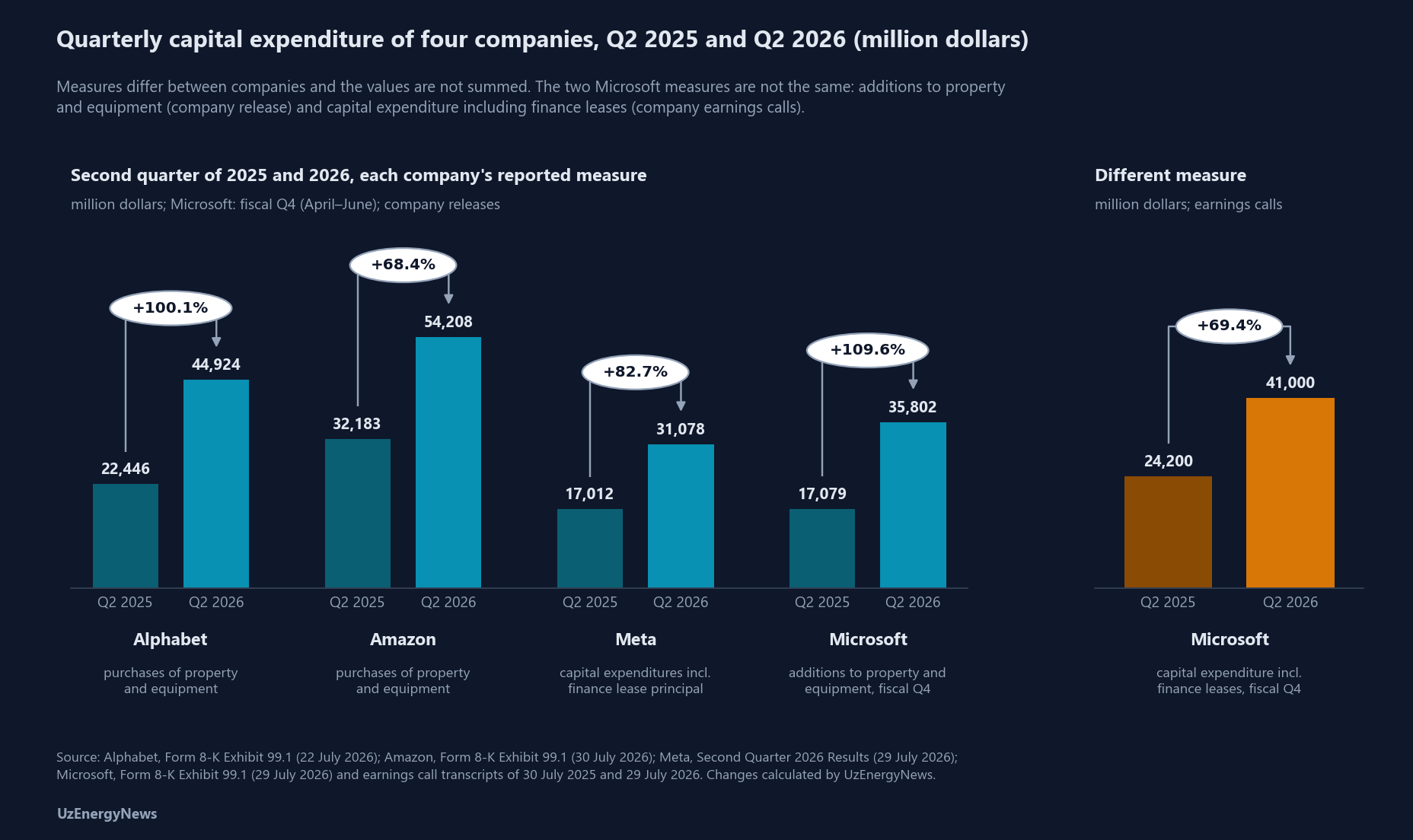
Second-quarter 2026 capital expenditure of four companies
Alphabet reported purchases of property and equipment of 44,924 million dollars in the second quarter of 2026, against 22,446 million dollars in the second quarter of 2025, and 80,598 million dollars for the first half of 2026, against 39,643 million dollars a year earlier (Form 8-K, Exhibit 99.1, 22 July 2026). Google Cloud revenue in the quarter was 24,768 million dollars, against 13,624 million dollars a year earlier, an increase of 82 per cent.
Amazon reported purchases of property and equipment of 54,208 million dollars in the second quarter of 2026, against 32,183 million dollars a year earlier, and 173,028 million dollars for the trailing twelve months, against 107,656 million dollars for the preceding twelve months (Form 8-K, Exhibit 99.1, 30 July 2026). The same release records 53.4 billion dollars of non-operating income in the quarter, "primarily from our investments in Anthropic", and states that Anthropic and OpenAI have made "multi-year, multi-gigawatt commitments" to Amazon's Trainium processors. The release does not state the number of gigawatts.
Meta reported capital expenditures, including principal payments on finance leases, of 31.08 billion dollars in the second quarter of 2026, comprising 30,116 million dollars of purchases of property and equipment and 962 million dollars of finance lease principal payments (press release, 29 July 2026). The corresponding figures for the second quarter of 2025 were 16,538 million dollars and 474 million dollars, a total of 17,012 million dollars.
Microsoft's release (Form 8-K, Exhibit 99.1, 29 July 2026) reports additions to property and equipment of 35,802 million dollars in the fourth quarter of its fiscal year 2026 (April to June 2026), against 17,079 million dollars a year earlier. On the earnings call of 29 July 2026, the company's chief financial officer put capital expenditure including finance leases at 41 billion dollars, of which 5.6 billion dollars were finance leases; on the call of 30 July 2025, the corresponding figure for the fourth quarter of fiscal year 2025 was 24.2 billion dollars, including 6.5 billion dollars of finance leases. The increase is 69.4 per cent (calculated). These figures are taken from the company's transcripts of the two calls, not from its filings.
Table 1. Quarterly capital expenditure, second quarter of 2025 and 2026 (million dollars)
| Company | Measure reported | Q2 2025 | Q2 2026 | Change |
|---|---|---|---|---|
| Alphabet | Purchases of property and equipment | 22,446 | 44,924 | +100.1% (calculated) |
| Amazon | Purchases of property and equipment | 32,183 | 54,208 | +68.4% (calculated) |
| Meta | Capital expenditures incl. finance lease principal payments | 17,012 | 31,078 | +82.7% (calculated) |
| Microsoft | Additions to property and equipment (fiscal Q4, Apr–Jun) | 17,079 | 35,802 | +109.6% (calculated) |
| Microsoft | Capital expenditure incl. finance leases (fiscal Q4, Apr–Jun) | 24,200 | 41,000 | +69.4% (calculated) |
Changes are calculated by UzEnergyNews from company figures. The Microsoft row including finance leases is taken from the company's earnings calls of 30 July 2025 and 29 July 2026 and is a different measure from the additions to property and equipment reported in the company's release. Measures differ between companies and the rows are not additive on a common definition.
Full-year 2026 guidance and the differences in definition
Alphabet's guidance for 2026 capital expenditure is 195 to 205 billion dollars, raised from a range of 180 to 190 billion dollars; the figure was given on the earnings call and is reported in secondary sources (W.Media, 23 July 2026). Amazon's guidance is approximately 220 billion dollars of cash capital expenditure, raised from approximately 200 billion dollars, with the company citing the cost of memory; this figure is also reported in secondary sources (Data Center Knowledge, 31 July 2026). Meta's release puts 2026 capital expenditures "in the range of $130-145 billion", against a previous range of 125 to 145 billion dollars.
For Microsoft, the company's chief financial officer put calendar-year 2026 capital expenditure at approximately 175 billion dollars on the earnings call of 29 July 2026; CFO Dive (30 July 2026) reports the previous estimate as 190 billion dollars. The company attributed the reduction to a shift of future data centre leases from finance to operating classification, following the extension of the estimated useful life of data centres and office buildings from 15 to 25 years. The chief financial officer stated: "Outside of this useful life impact, our calendar year 2026 CapEx investment expectations remain unchanged." The company expects capital expenditure of more than 50 billion dollars for the first quarter of fiscal year 2027, including the effect of the lease reclassification (earnings call of 29 July 2026; also reported in the MarketBeat summary of the same date). The MarketBeat summary of the earnings call (29 July 2026) assigns the 175 billion dollar figure to fiscal year 2027 rather than to calendar year 2026; this edition uses the calendar-year attribution contained in the statement quoted above.
Platformonomics, which compiles company guidance, sums the four 2026 figures to 735 to 750 billion dollars, against more than 640 billion dollars in January 2026; in the January total, the Microsoft component of more than 140 billion dollars is marked by Platformonomics as an estimate. The components are not defined uniformly: Amazon guides on cash capital expenditure, Meta includes finance lease principal payments, and Microsoft includes finance leases. A direct sum of the component ranges gives 720 to 745 billion dollars if Microsoft's figure is taken as 175 billion dollars, and 735 to 760 billion dollars if it is taken as 190 billion dollars; neither range equals the Platformonomics total of 735 to 750 billion dollars.
The IEA, in Key Questions on Energy and AI (April 2026), reports that capital expenditure by the largest technology companies exceeded 400 billion dollars in 2025, that a further increase of about 75 per cent is expected in 2026, and that this spending is "larger than global investment in oil and natural gas production". Weekly Insight #12 cited market estimates of 600 to 690 billion dollars for 2026 for five companies; the four-company compilation of 735 to 750 billion dollars cited above was published after the second-quarter results in July 2026. The two ranges cover different company sets.
Multi-year compute commitments in a draft registration statement
According to the draft registration statement reviewed by Reuters (29 September 2026), Anthropic has disclosed infrastructure commitments of at least 518 billion dollars, about 80 per cent of which are non-cancellable. The draft was submitted confidentially and is not available on the SEC's EDGAR system. The reported commitments include Google, 111.1 billion dollars (April 2026 to July 2033); Amazon, 110 billion dollars (May 2026 to April 2036); Microsoft, 31.4 billion dollars (November 2026 to May 2033); xAI, up to 84.5 billion dollars, largely cancellable on 90 days' notice; and computing capacity from AMD, more than 20 billion dollars. Reuters separately reports equipment leases with Broadcom of about 161.2 billion dollars; the report does not state whether this amount is included in the 518 billion dollar total. The reported filing does not state the electrical capacity or the energy associated with these commitments, and no conversion is made in this edition. Amazon's second-quarter release, cited above, records both a non-operating gain from its investment in Anthropic and a multi-gigawatt Trainium commitment from Anthropic and OpenAI.
Data centre electricity demand: IEA 2026 figures and the United States series
In Key Questions on Energy and AI (April 2026), the IEA puts global data centre electricity consumption at 485 terawatt-hours in 2025, an increase of 17 per cent on 2024, while global electricity demand grew by 3 per cent. Consumption by data centres focused on artificial intelligence rose by 50 per cent in 2025 and, in the Agency's central outlook, triples between 2025 and 2030. Total data centre consumption reaches 950 terawatt-hours in 2030, about 3 per cent of global electricity demand. Weekly Insight #12 cited 415 terawatt-hours for 2024 and 945 terawatt-hours for 2030 from the Agency's 2025 report; the 2026 report revises the 2030 figure to 950 terawatt-hours.
The same report records a 70 per cent increase in gas turbine orders in 2025, projects 15 to 27 gigawatts of on-site gas generation at data centres and 20 to 25 gigawatts of data centre batteries by 2030, and expects the shortage of high-bandwidth memory to last at least until the end of 2027.
For the United States, the Short-Term Energy Outlook (STEO) of the Energy Information Administration (EIA), published on 6 October 2026, puts electricity generation at 4,430 billion kilowatt-hours in 2025 and projects 4,545 billion kilowatt-hours in 2026 and 4,613 billion kilowatt-hours in 2027, increases of 2.6 and 1.5 per cent (calculated). These are generation figures, not consumption. The STEO puts consumption in the commercial sector, which includes data centres, 5 per cent higher in the third quarter of 2026 than a year earlier and forecasts commercial-sector growth of 2.8 per cent in 2027. A federal estimate dedicated to data centres, the 2024 United States Data Center Energy Usage Report published by Lawrence Berkeley National Laboratory for the DOE in December 2024, put United States data centre consumption at 176 terawatt-hours in 2023, 4.4 per cent of national consumption, and projected 325 to 580 terawatt-hours in 2028, or 6.7 to 12 per cent.
Contracted generation: nuclear uprate agreements and financing, 21 September to 6 October 2026
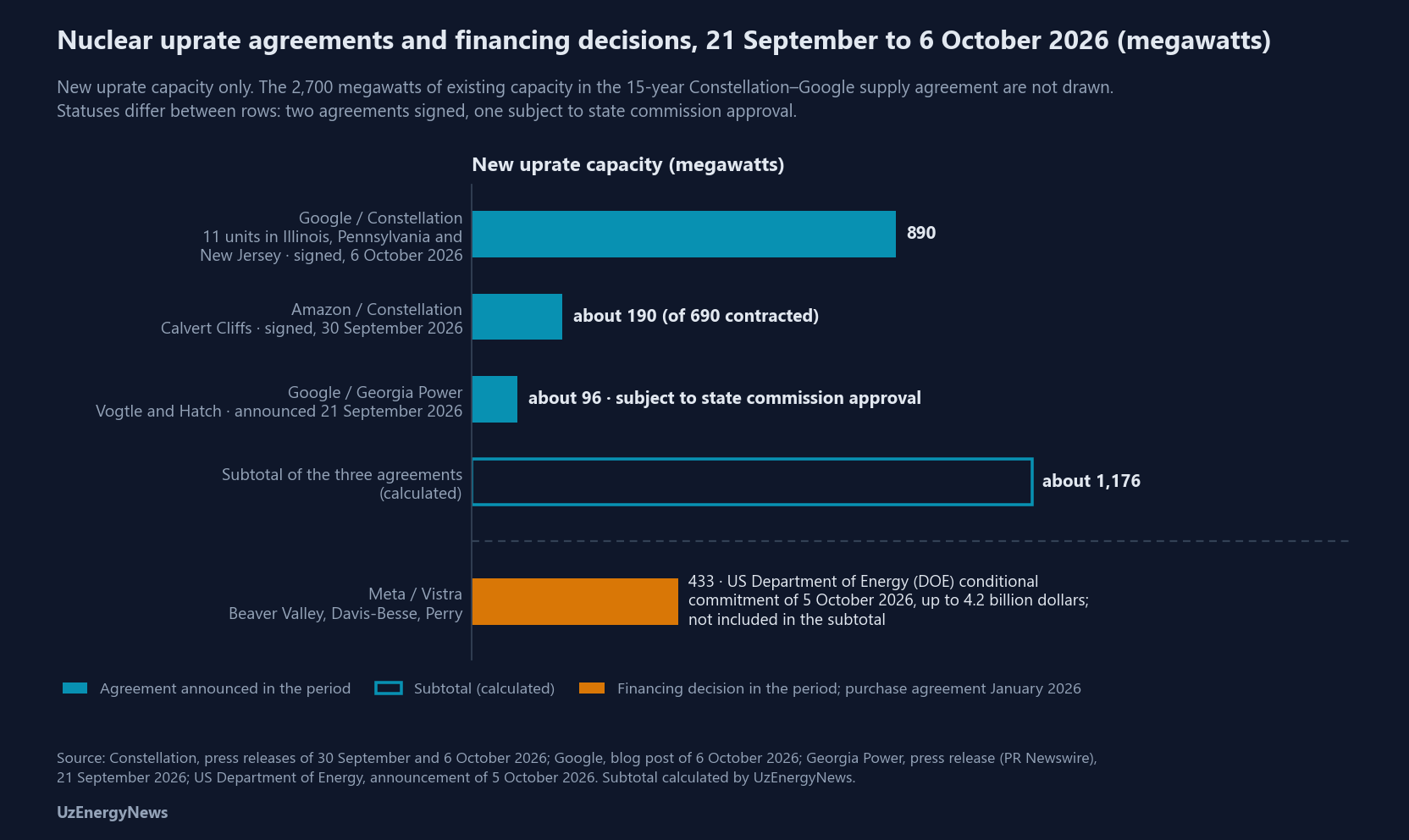
On 6 October 2026, Constellation and Google announced a 20-year power purchase agreement (PPA) covering 890 megawatts of capacity uprates at 11 reactor units in Illinois, Pennsylvania and New Jersey, supported by more than 4.3 billion dollars of new investment by Constellation. The first uprate is scheduled to enter service by 2028, and Google states that the full 890 megawatts will be in service before the end of 2032. The agreement is accompanied by a 15-year supply agreement for 2,700 megawatts of existing capacity, bringing the total to 3,590 megawatts; the 2,700 megawatts are existing output, not new capacity. The price was not disclosed. Secondary reports give differing counts of sites and plants; this edition follows the Constellation release.
On 30 September 2026, Constellation and Amazon announced a 20-year PPA at Calvert Cliffs for a total of 690 megawatts, of which about 190 megawatts are uprates scheduled to enter service between 2030 and 2032, with associated investment of more than 3 billion dollars.
On 21 September 2026, Georgia Power announced (press release, PR Newswire) an agreement with Google for about 96 megawatts of uprates at the Vogtle and Hatch plants under the NU-1 tariff, subject to approval by the Georgia Public Service Commission.
On 5 October 2026, the DOE's Office of Energy Dominance Financing announced a conditional loan commitment of up to 4.2 billion dollars to Vistra to finance 433 megawatts of uprates at the Beaver Valley, Davis-Besse and Perry nuclear plants. The output of these uprates was contracted to Meta under agreements announced in January 2026; the financing decision falls within the period covered here, the purchase agreement does not. A conditional commitment is not a disbursed loan.
Table 2. Nuclear uprate agreements and financing decisions, 21 September to 6 October 2026
| Buyer / counterparty | Plants | New uprate capacity (MW) | Announced | Term / in-service | Status |
|---|---|---|---|---|---|
| Google / Constellation | 11 units, Illinois, Pennsylvania, New Jersey | 890 | 6 October 2026 | 20-year PPA; first uprate by 2028, all before end-2032 | Signed (company release) |
| Amazon / Constellation | Calvert Cliffs | about 190 (of 690 MW contracted) | 30 September 2026 | 20-year PPA; 2030–2032 | Signed (company release) |
| Google / Georgia Power | Vogtle, Hatch | about 96 | 21 September 2026 | NU-1 tariff | Subject to state commission approval |
| Subtotal, agreements announced in the period | about 1,176 | statuses differ | |||
| Meta / Vistra | Beaver Valley, Davis-Besse, Perry | 433 | Purchase agreement January 2026; DOE commitment 5 October 2026 | not stated in source | DOE conditional commitment up to 4.2 billion dollars; not included in subtotal |
Subtotal calculated by UzEnergyNews. Constellation agreements from company releases; the in-service timing of the Google–Constellation uprates (all before the end of 2032) from Google's post "Why we're backing America's existing nuclear plants" of 6 October 2026; Georgia Power from the company release of 21 September 2026 (PR Newswire), also reported by World Nuclear News; Vistra from the DOE announcement of 5 October 2026, also reported by POWER and Utility Dive.
Capacity market and large-load rules in PJM
Weekly Insight #12 and Weekly Insight #14 reported the result of the 2028/29 capacity auction of PJM Interconnection, the transmission system operator covering all or parts of 13 states and the District of Columbia in the eastern United States, published on 14 July 2026: a clearing price of 325 dollars per megawatt-day, equal to the regulatory cap, against 333.44 dollars in the 2027/28 auction; 138,318 megawatts of unforced capacity procured; a cost of 16.4 billion dollars; and a shortfall of 6,831 megawatts against the reliability requirement. The PJM auction report puts the 2028/29 forecast peak load at 165,953.5 megawatts, 1,374.5 megawatts (0.8 per cent) above the forecast for 2027/28.
Two regulatory proceedings on large loads have followed. On 13 August 2026, PJM filed an Interim Resource Adequacy Service with the Federal Energy Regulatory Commission (FERC) under docket ER26-3515-000. The filing provides for new large loads connected after 1 June 2027 to be curtailed when resource adequacy is insufficient, and defines a large load as 50 megawatts or more at a single point of interconnection or within a one-mile radius; a bring-your-own-new-capacity option allows a load to be exempted from this obligation. The requested effective date is 12 October 2026, and the filing was pending as of 7 October 2026. Separately, FERC accepted PJM's Reliability Backstop mechanism on 29 September 2026 and suspended its effectiveness until 28 February 2027. The 2029/30 auction is scheduled for December 2026 (PJM schedule).
Grid and generation equipment: order backlogs and transformer supply
Quanta Services reported an order backlog of 53.4 billion dollars at 30 June 2026, which the company describes as a record, against 35.8 billion dollars at 30 June 2025, an increase of 49 per cent calculated from company figures. The company presents backlog as a measure not recognised under United States GAAP; it comprises remaining performance obligations and estimated orders under master service agreements (MSAs), including estimated renewals, and certain non-fixed price contracts. Of the total, 43.8 billion dollars is in the Electric segment. Remaining performance obligations were 33.6 billion dollars, against 19.2 billion dollars a year earlier. Second-quarter revenue was 9.56 billion dollars, and 2026 revenue guidance is 39.3 to 39.7 billion dollars. In describing an acquisition, the release refers to "the growing data center and mission-critical facility markets" (Form 8-K, Exhibit 99.1, 30 July 2026).
Eaton reported second-quarter 2026 sales of 4.0 billion dollars in its Electrical Americas segment, an organic increase of 18 per cent. The twelve-month rolling average of segment orders rose 41 per cent organically, and the segment backlog rose 33 per cent year on year. In the Electrical Global segment, the twelve-month rolling average of orders rose 33 per cent organically and backlog rose 103 per cent, to 3,602 million dollars against 1,771 million dollars, an organic increase of 54 per cent (Form 10-Q, 31 July 2026); the backlog figure includes Boyd Thermal, acquired on 12 March 2026. In the release (Form 8-K, Exhibit 99), the company's chief executive stated: "While data centers remain a key growth driver, we are benefiting from robust demand across our end markets."
GE Vernova reported that its gas equipment backlog and slot reservations together rose during the second quarter of 2026 from 100 gigawatts to 116 gigawatts, with backlog moving from 44 to 53 gigawatts and slot reservations from 56 to 63 gigawatts; slot reservations are not firm orders. The company targets at least 125 gigawatts by the end of 2026. In the Electrification segment, data centre orders exceeded 5 billion dollars year to date, "more than double our 2025 total". Total company backlog was 176 billion dollars (Form 8-K press release, 22 July 2026).
Schneider Electric reported second-quarter revenue of 11.5 billion euros, an organic increase of 17 per cent, with North America up 23 per cent organically (half-year results, 30 July 2026, as reported by trade press). A separate data centre order figure was not available in the sources consulted.
Transformer supply is measured by lead time and by shortfall. A Wood Mackenzie survey for the second quarter of 2025, as reported by POWER magazine on 2 January 2026, put average lead times at 128 weeks for power transformers and 144 weeks for generator step-up transformers. The same POWER article reports price increases of 77 per cent and 45 per cent respectively since 2019. A lead-time survey dated 2026 was not available in the sources consulted. In a release of 31 August 2026, Wood Mackenzie estimated the 2026 supply shortfall at about 15 per cent for power transformers and about 8 per cent for substations, and stated that the executive order on the bulk-power system will widen the shortfall. Executive Order 14421, "Declaring a National Emergency To Secure the United States Bulk-Power System", signed on 26 August 2026 and published in the Federal Register on 31 August 2026, authorises the DOE to prohibit, or to set conditions on, transactions involving bulk power system equipment from designated foreign entities; Wood Mackenzie's release describes it as a ban on Chinese bulk power equipment.
Equity market measures: Nasdaq-100 tracker weights, fund assets and value-chain company disclosures
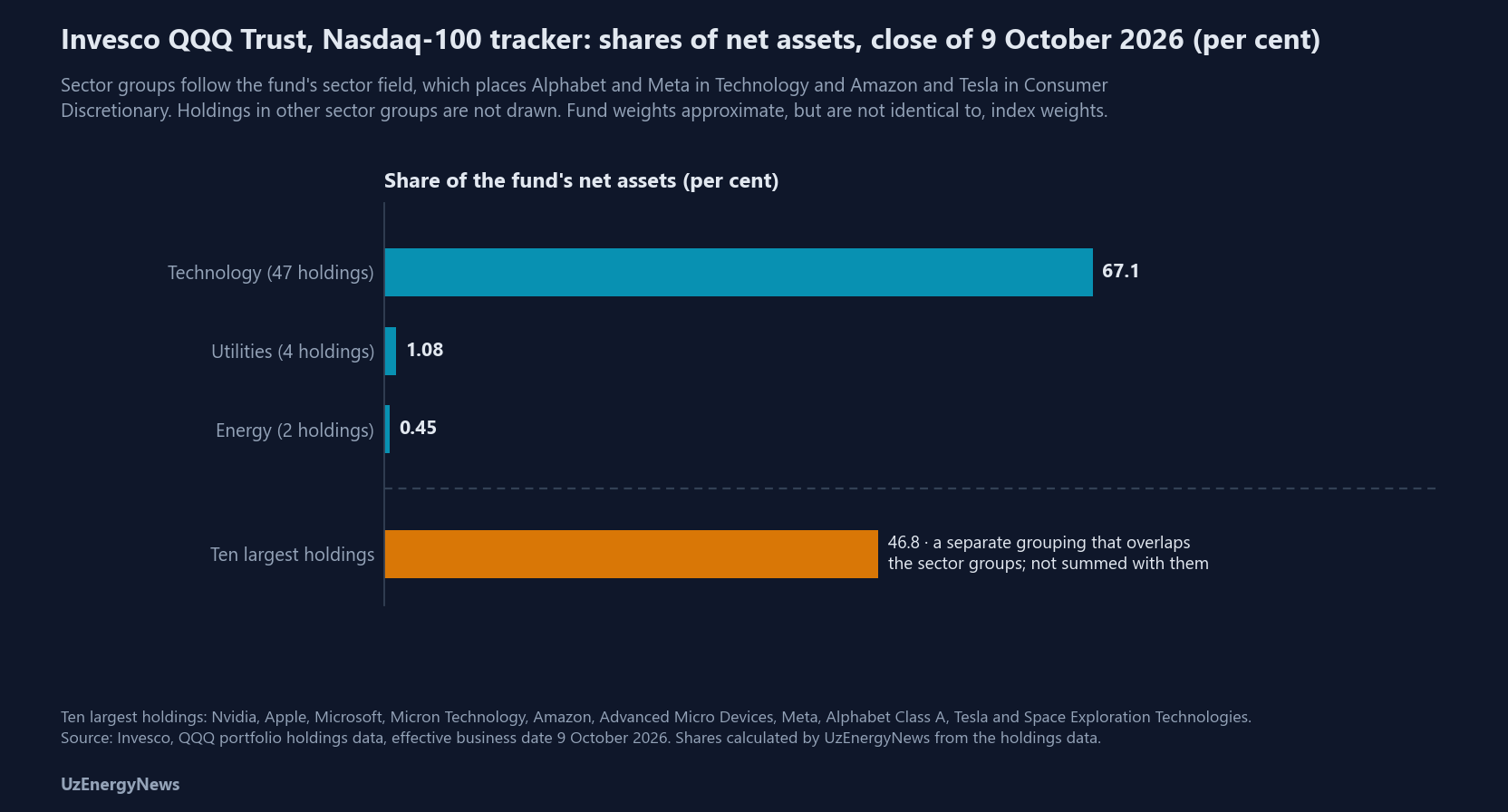
The holdings data published by Invesco for the Invesco QQQ Trust, an exchange-traded fund that tracks the Nasdaq-100 Index, record the portfolio at the close of 9 October 2026. The weights are shares of the fund's net assets; they approximate, but are not identical to, the official weights of the index. The ten largest holdings (Nvidia, Apple, Microsoft, Micron Technology, Amazon, Advanced Micro Devices, Meta, Alphabet Class A, Tesla and Space Exploration Technologies) account for 46.8 per cent of net assets (calculated); Alphabet Class C shares, listed as a separate holding, account for a further 2.9 per cent. Grouped by the sector field of the same data, the 47 holdings classified as Technology account for 67.1 per cent (calculated); this classification places Alphabet and Meta in Technology and Amazon and Tesla in Consumer Discretionary. The four holdings classified as Utilities (Constellation Energy, American Electric Power, Xcel Energy and Exelon) account for 1.08 per cent, and the two classified as Energy (Baker Hughes and Diamondback Energy) for 0.45 per cent. Constellation Energy, the counterparty to the uprate agreement with Google of 6 October 2026 described above, has a weight of 0.44 per cent, the largest of these six holdings.
StockAnalysis reports assets of 503.49 billion dollars for QQQ and 111.96 billion dollars for the Invesco Nasdaq 100 ETF (QQQM), which tracks the same index, and 12.02 billion dollars for the First Trust Nasdaq Clean Edge Smart Grid Infrastructure Index Fund (GRID). The pages do not state the date of the asset figures; each corresponds approximately to the fund's shares outstanding multiplied by its closing price of 8 October 2026 (calculated). GRID's ten largest holdings at 8 October 2026 were Quanta Services, Johnson Controls, Eaton, ABB, Schneider Electric, Prysmian, National Grid, E.ON, nVent and Hubbell, together 57.5 per cent of the portfolio. The Invesco fund pages did not return these figures and the First Trust website could not be accessed on 11 October 2026; the three asset figures and the GRID holdings are therefore taken from a secondary source.
Table 3 lists company disclosures for four links of the data centre value chain: optical connectivity, custom chips, optical fibre and power-intensive data centre hosting. Two further items are not taken from company filings. Lumentum's chief executive was quoted, in an interview with Bloomberg Television on 9 October 2026, as saying that the company was "almost sold out for 2029"; other secondary reports give the period as "through early 2029", and the statement does not appear in an SEC filing. Marvell's revision of its fiscal 2028 revenue target from about 18 billion dollars to about 20 billion dollars at its Investor Day on 6 October 2026 is reported by secondary sources; no company release containing the target was found on the company's investor relations site on 11 October 2026. Corning's core sales are a measure outside United States generally accepted accounting principles (GAAP); its GAAP net sales in the quarter were 4,505 million dollars.
Table 3. Company disclosures along the data centre value chain (million dollars unless stated)
| Link | Company | Measure reported | Value | Period | Source |
|---|---|---|---|---|---|
| Optical connectivity | Lumentum | Net revenue | 1,006.3 (480.7 a year earlier; +109.3%) | Fiscal Q4 2026, to 27 June 2026 | Form 8-K, Exhibit 99.1, 11 August 2026 |
| Custom chips and connectivity | Marvell | Net revenue; of which data centre | 2,739.3 (+37%); 2,171.5 (+46%) | Fiscal Q2 2027, to 1 August 2026 | Form 8-K, Exhibit 99.1, 27 August 2026 |
| Optical fibre | Corning | Core sales; Optical Communications net sales | 4,738 (+17%); 2,072 (1,566 a year earlier; +32%) | Q2 2026 | Form 8-K, Exhibit 99, 28 July 2026 |
| Power-intensive data centre hosting | IREN | Revenue; of which AI cloud services | 707.0 (501.0 in fiscal 2025); 128.8 | Fiscal 2026, to 30 June 2026 | Form 8-K, Exhibit 99.1, 27 August 2026 |
| Power-intensive data centre hosting | IREN | Power capacity (company statement) | about 5 GW under executed grid connection agreements, letters of agreement or equivalents; about 40 MW operating AI cloud services capacity; about 380 MW bitcoin mining capacity | At 30 June 2026 | Form 10-K, fiscal year to 30 June 2026 |
Percentage changes are as stated in the company releases. Corning core sales and Q2 2025 core figures follow the company's non-GAAP definition, which changed its currency adjustment from 1 April 2026; the company did not recast the 2025 figures. The company states that applying the new adjustment to 2025 would have resulted in higher year-on-year growth rates. Optical Communications segment net sales are on the same non-GAAP basis. IREN's 5 GW figure covers the United States, Canada, Spain and Australia and is not operating capacity.
Central Asia: data centre commitments in Uzbekistan
Euronews reported on 28 September 2026, citing Uzbekistan's Minister of Digital Technologies, that data centre investment commitments in the country exceed 6 billion dollars. The DataVolt facility in Tashkent has an initial capacity of 12 megawatts, with the first phase scheduled for the end of 2026 and a planned total of 300 megawatts. Project financing of up to 150 million dollars is provided by the European Bank for Reconstruction and Development (EBRD), the German development finance institution DEG, the French development finance institution Proparco and the OPEC Fund for International Development. Reported total capacity for the DataVolt project differs between sources (300 and 500 megawatts); the figure used here is the one reported by Euronews.
Summary of measured quantities
| Series | Value | Period | Source |
|---|---|---|---|
| Four-company capital expenditure guidance | 735–750 billion dollars (Platformonomics total); component sum 720–745 billion dollars with Microsoft at 175 billion dollars | 2026 | Platformonomics compilation; definitions differ |
| Capital expenditure of the largest technology companies | more than 400 billion dollars; about +75% expected in 2026 | 2025 | IEA, April 2026 |
| Anthropic infrastructure commitments | at least 518 billion dollars, about 80% non-cancellable | 2026–2036 | Draft filing reviewed by Reuters |
| Global data centre electricity | 485 TWh (2025); 950 TWh (2030) | 2025–2030 | IEA, April 2026 |
| United States electricity generation | 4,430 / 4,545 / 4,613 billion kWh | 2025 / 2026 / 2027 | EIA STEO, October 2026 |
| Nuclear uprate agreements announced | about 1,176 MW (three agreements) | 21 September–6 October 2026 | Company releases; sum calculated |
| Nuclear uprates under DOE conditional commitment | 433 MW (up to 4.2 billion dollars) | 5 October 2026 | DOE announcement |
| PJM 2028/29 shortfall against reliability requirement | 6,831 MW | Auction of July 2026 | PJM |
| Quanta Services backlog | 53.4 billion dollars (+49%, calculated; non-GAAP measure) | 30 June 2026 | SEC filing |
| GE Vernova gas backlog and slot reservations | 116 GW | Q2 2026 | SEC filing |
| Transformer supply shortfall | about 15% (power transformers); about 8% (substations) | 2026 estimate | Wood Mackenzie |
| Nasdaq-100 tracker (QQQ): ten largest holdings | 46.8% of net assets (calculated) | 9 October 2026 | Invesco holdings data |
| QQQ holdings classified as Technology / Utilities / Energy | 67.1% / 1.08% / 0.45% (calculated) | 9 October 2026 | Invesco holdings data, fund sector field |
| Constellation Energy weight in QQQ | 0.44% | 9 October 2026 | Invesco holdings data |
| Fund assets: QQQ / QQQM / GRID | 503.49 / 111.96 / 12.02 billion dollars | 8 October 2026 (closing prices; calculated) | StockAnalysis (secondary) |
| IREN power capacity under executed grid connection agreements, letters of agreement or equivalents | about 5 GW; about 40 MW AI cloud operating | 30 June 2026 | Form 10-K (company statement) |
| Uzbekistan data centre commitments | more than 6 billion dollars | September 2026 | Euronews, citing the Minister of Digital Technologies |
Sources (accessed 11 October 2026).
Alphabet, Form 8-K Exhibit 99.1, 22 July 2026 · Amazon, Form 8-K Exhibit 99.1, 30 July 2026 · Meta, Second Quarter 2026 Results, 29 July 2026 · CFO Dive, 30 July 2026, on Microsoft fiscal 2026 fourth-quarter results · Microsoft, Form 8-K Exhibit 99.1, 29 July 2026 · Microsoft, earnings call transcripts for the fourth quarter of fiscal year 2026 (29 July 2026) and of fiscal year 2025 (30 July 2025) · MarketBeat, Microsoft Q4 earnings call highlights, 29 July 2026 · W.Media, 23 July 2026, on Alphabet's 2026 capital expenditure guidance · Data Center Knowledge, 31 July 2026, on Amazon's 2026 capital expenditure · Platformonomics, "Follow the CapEx: Q2 2026 Scoreboard", July 2026 · Reuters, 29 September 2026, on Anthropic's draft registration statement, as republished by Zawya · IEA, Key Questions on Energy and AI, executive summary, April 2026, and press release of 16 April 2026 · EIA, Short-Term Energy Outlook, October 2026 · Lawrence Berkeley National Laboratory for the DOE, 2024 United States Data Center Energy Usage Report, December 2024 · Constellation, press releases of 30 September and 6 October 2026 · Google, "Why we're backing America's existing nuclear plants", 6 October 2026 · Georgia Power, press release (PR Newswire), 21 September 2026, and World Nuclear News, 22 September 2026 · DOE, Office of Energy Dominance Financing, announcement of 5 October 2026, and reports by POWER (5 October 2026) and Utility Dive (6 October 2026) · POWER, 2 January 2026 (transformers) · PJM Interconnection, 2028/29 Base Residual Auction report and results, 14 July 2026 · PJM, Interim Resource Adequacy Service filing, FERC docket ER26-3515-000, 13 August 2026 · FERC, order on PJM's Reliability Backstop, 29 September 2026 · PJM, 2029/2030 planning period parameters for the Base Residual Auction, posted 31 August 2026 · Quanta Services, Form 8-K Exhibit 99.1, 30 July 2026 · Eaton, Form 8-K Exhibit 99, second quarter 2026, and Form 10-Q for the quarter ended 30 June 2026, filed 31 July 2026 · GE Vernova, Form 8-K press release, 22 July 2026 · Schneider Electric, 2026 half-year results, as reported by EMR, 30 July 2026 · Invesco, QQQ portfolio holdings data, effective business date 9 October 2026 · StockAnalysis, fund pages for QQQ, QQQM and GRID, and GRID holdings at 8 October 2026 · Lumentum, Form 8-K Exhibit 99.1, 11 August 2026 · Bloomberg Television interview of 9 October 2026, as reported by FourWeekMBA and InvestorsHub · Marvell, Form 8-K Exhibit 99.1, 27 August 2026 · Marvell Investor Day of 6 October 2026, as reported by AskTraders · Corning, Form 8-K Exhibit 99, 28 July 2026 · IREN, Form 8-K Exhibit 99.1, 27 August 2026, and Form 10-K for the fiscal year ended 30 June 2026 · Wood Mackenzie, press release of 31 August 2026 · Federal Register, Executive Order 14421, "Declaring a National Emergency To Secure the United States Bulk-Power System", FR Doc. 2026-17843, published 31 August 2026 · Euronews, 28 September 2026 · Proparco, DataVolt financing release, 17 June 2026. Figures are cited from public sources; copyrighted charts and tables are not reproduced. Analysis by UzEnergyNews Editorial Desk. Data as of 10 October 2026; sources accessed 11 October 2026.