Europe's Data-Centre Map Is Being Redrawn: Power Constraints Push New Capacity Toward the Centre and East
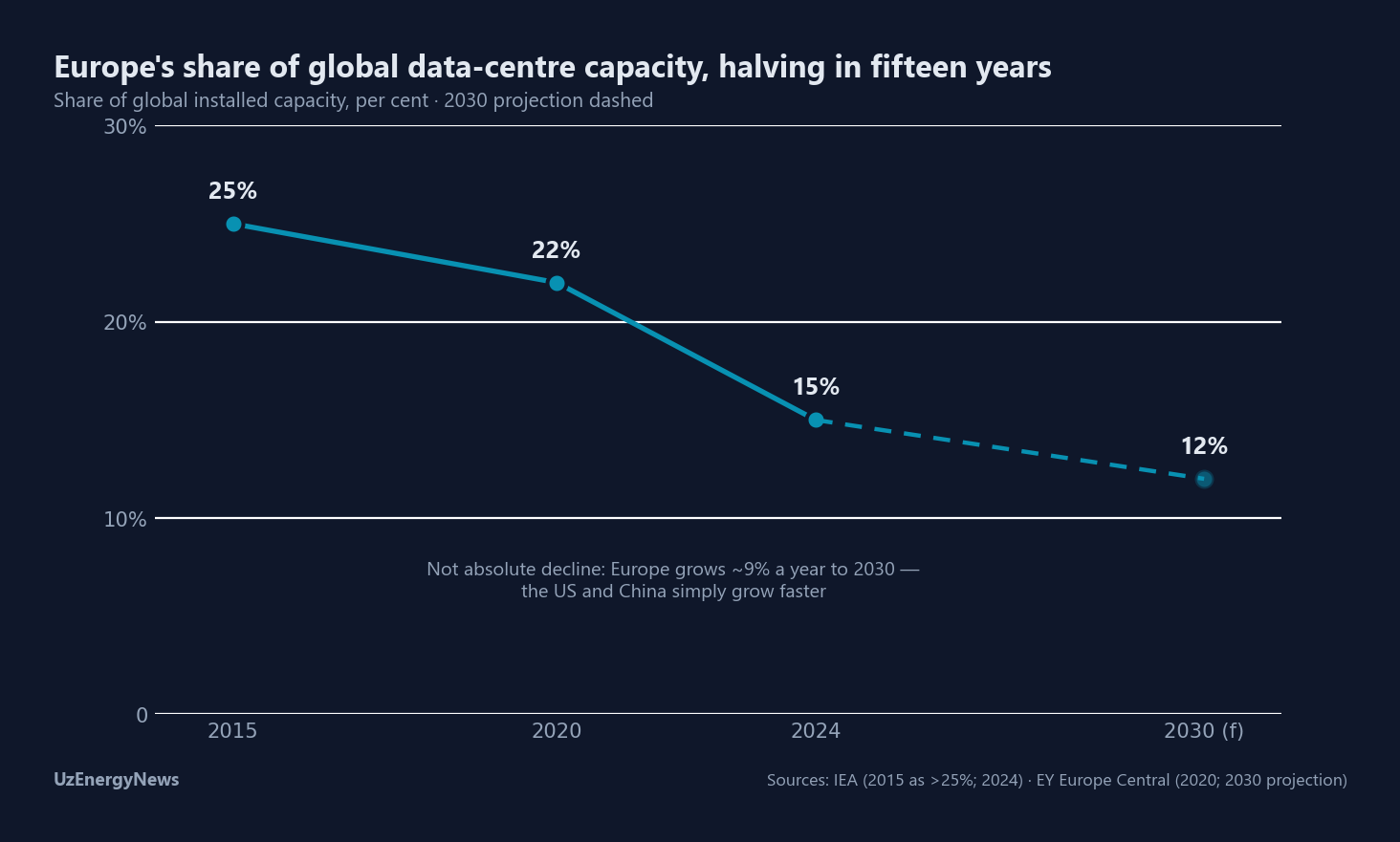
In the second quarter of 2026, Europe delivered 685 megawatts of new data-centre capacity — and 252 megawatts of it, 37 per cent, went to the five hub markets of Frankfurt, London, Amsterdam, Paris and Dublin, with secondary and tertiary markets taking the rest (CBRE). In Amsterdam, London and Frankfurt, data centres consumed between 33 and 42 per cent of local electricity demand in 2023, and nearly 80 per cent in Dublin (Ember); reported grid-connection waits in the hub markets run to seven and ten years. A 69-page EY Europe Central study — AI and Energy: The Two-Way Dependency (May 2026; published online 30 June) — maps where growth is going instead: markets with grid headroom, land and low-carbon power, in a 33-country grouping that runs from the Nordics through Poland, Czechia, Romania and Greece to Türkiye, the Caucasus and Central Asia. This season's announcements are concentrated on that map — a fully leased 110-megawatt first phase at Seinäjoki in Finland, a 1.5-gigawatt AI hub opened to investors at Cernavodă in Romania, Microsoft taking the 230-megawatt Narvik campus in Norway — and so are its frictions: Denmark's operator paused new large-load connection agreements in March after its queue reached 60 gigawatts, and Ireland reopened Dublin applications in December for projects that bring their own dispatchable generation. Europe's share of global capacity was above 25 per cent in 2015 and 15 per cent in 2024, with about 12 per cent projected for 2030 — a relative decline: Europe grows about 9 per cent a year while the United States and China grow faster.
CBRE's second-quarter figures, reported on 18-19 August, show Europe delivering 685 megawatts of new data-centre capacity — 352 megawatts in colocation and 333 in self-build — of which 252 megawatts, or 37 per cent, landed in the FLAP-D hubs of Frankfurt, London, Amsterdam, Paris and Dublin; secondary and tertiary markets accounted for the rest. FLAP-D live capacity stood at about 3.8 gigawatts at mid-2026 on DC Byte's count, within a European total CBRE expects to reach 13 gigawatts by the end of the year. The EY Europe Central study published this summer describes the movement as structural and locates the constraint on the electricity side: local consumption shares, connection queues measured in years, with land and permitting on top. This edition sets out the numbers on both sides of the shift.
The constraint in the hubs
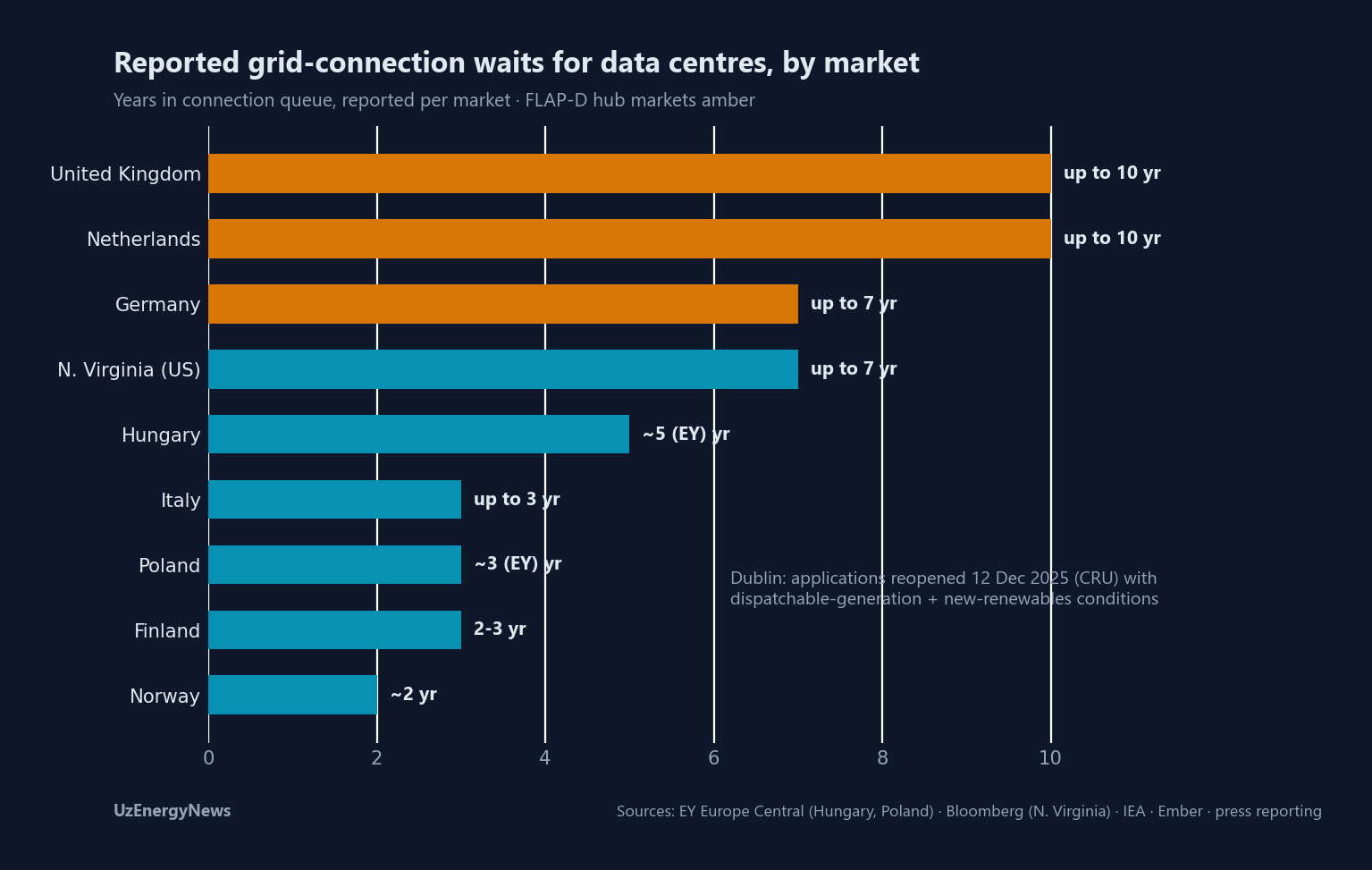
On EY's count, the five FLAP-D hubs held about 4.6 gigawatts in early 2025 — over 60 per cent of European capacity on that basis; DC Byte's narrower measure of live capacity puts them at about 3.8 gigawatts. The demand shares: in 2023, data centres consumed between 33 and 42 per cent of local electricity demand in Amsterdam, London and Frankfurt, and nearly 80 per cent in Dublin (Ember). Nationally, Irish data centres passed 22 per cent of electricity demand, from 5 per cent in 2015 (CSO/IEA); EirGrid's projection reaches 31 per cent by 2034. Dublin's connection regime changed in December: EirGrid had indicated in 2022 that new connections in the capital were unlikely before 2028, and the CRU's Large Energy Users Connection Policy of 12 December 2025 superseded its 2021 Direction — applications are open again, but only for projects that bring on-site or nearby dispatchable generation and contract at least 80 per cent of annual demand from new renewable capacity, the regime Weekly Insight #14 recorded as bring-your-own-power. Reported connection waits elsewhere: up to ten years in the United Kingdom and the Netherlands; up to seven in Germany — Amazon has said some of its European connections take up to seven years — and seven in Northern Virginia, the world's largest data-centre market, for comparison; about five in Hungary and about three in Poland on EY's comparison table; reported waits of up to three in Italy, two to three in Finland and about two in Norway. The United Kingdom has re-ordered its queue: connection applications had reached 722 gigawatts before the TMO4+ reform, which released 283 gigawatts of generation and storage projects plus 99 gigawatts of demand connections into the re-ordered process in late 2025.
Where the growth goes
EY's Europe Central grouping spans 33 countries — the Nordics, Poland and the Baltics, Czechia, Slovakia, Hungary, the Balkans, Romania, Greece and Türkiye, and eastward through Ukraine and the Caucasus to Central Asia, Kazakhstan and Uzbekistan included. At the end of 2025 the grouping held about 24 per cent of Europe's data-centre facilities; Poland, the Nordics, Türkiye, Czechia and Romania host about 63 per cent of those facilities, and the region's power mix is about 65 per cent low-carbon (EY). The announcements of recent months cluster in the same geography. In Norway, the Narvik campus announced in July 2025 as Stargate Norway — 230 megawatts with a 290-megawatt expansion option — changed offtaker in April: Nscale and OpenAI did not conclude an offtake agreement, and Microsoft took the capacity; Nscale and Nordkraft formed an operating venture, Nordscale, in July. In Finland, Pure Data Centres launched a 110-megawatt, 1.5-billion-euro first phase at Seinäjoki in July — fully leased at launch, with permits and grid connection in place and a campus potential above 550 megawatts. In Romania, the energy ministry opened expressions of interest on 15 April for the Black Sea AI Gigafactory: up to 4-5 billion euros and 1.5 gigawatts at Cernavodă, a second phase tied to the Doicești small-modular-reactor site, and commissioning targeted from the end of 2028. In Poland, the transmission operator PSE has allocated 1.2 gigawatts of connection capacity for data centres by 2034, within a plan to connect 53 gigawatts of renewables and 3.8 gigawatts of nuclear by the same date. In Greece, reporting this month describes declared investor interest of about 50 billion euros over ten years — 1.4 to 2.2 gigawatts of proposals, of which about 30 per cent hold a connection opinion, on the PwC study the reports cite. In Türkiye, the Turkcell-Google Cloud hyperscale regional data centre in Ankara — 3 billion dollars in total, Google's 2 billion over ten years alongside Turkcell's 1 billion — targets an initial 15 megawatts in 2028, with the Google Cloud region planned to go live in 2028-29 and Turkcell aiming to double its company-wide active capacity to 100 megawatts by 2032; the AI Action Plan in force since 18 August sets national targets of at least 1 gigawatt of AI and data-centre capacity and 10 terawatt-hours a year of low-carbon power purchase agreements by 2030. Connection limits have appeared at the destinations too: Energinet's Danish queue reached 60 gigawatts — about 14 gigawatts of it data centres — against a national peak near 7 gigawatts; the operator abolished first-come-first-served allocation on 1 February 2026 and paused new large-load connection agreements in March.
| Measure | FLAP-D hubs | Europe Central (EY's 33-country grouping) |
|---|---|---|
| Installed capacity | ~4.6 GW early 2025 — over 60% of Europe on EY's basis; ~3.8 GW live (DC Byte) | — |
| Share of Europe's facilities, end-2025 | — | ~24%; Poland, the Nordics, Türkiye, Czechia and Romania host ~63% of them (EY) |
| Local electricity demand share | Amsterdam, London, Frankfurt 33-42%; Dublin ~80% (Ember, 2023) | 2035 projections: Denmark ~13%, Norway ~9%, Sweden >8% (EY) |
| Reported connection waits | Up to 7-10 years | About 2-5 years |
| Power mix | — | ~65% low-carbon (EY) |
| Q2 2026 new capacity | 252 of 685 MW — 37% | Secondary and tertiary markets took the rest (CBRE) |
| This season's markers | UK reform releases 283 GW + 99 GW demand; Ireland reopens under generation-and-renewables conditions | Narvik 230 MW to Microsoft · Seinäjoki 110 MW fully leased · Cernavodă 1.5 GW EoI · Ankara initial 15 MW (2028) · Greece ~€50bn declared interest · Denmark pauses large loads |
The global frame
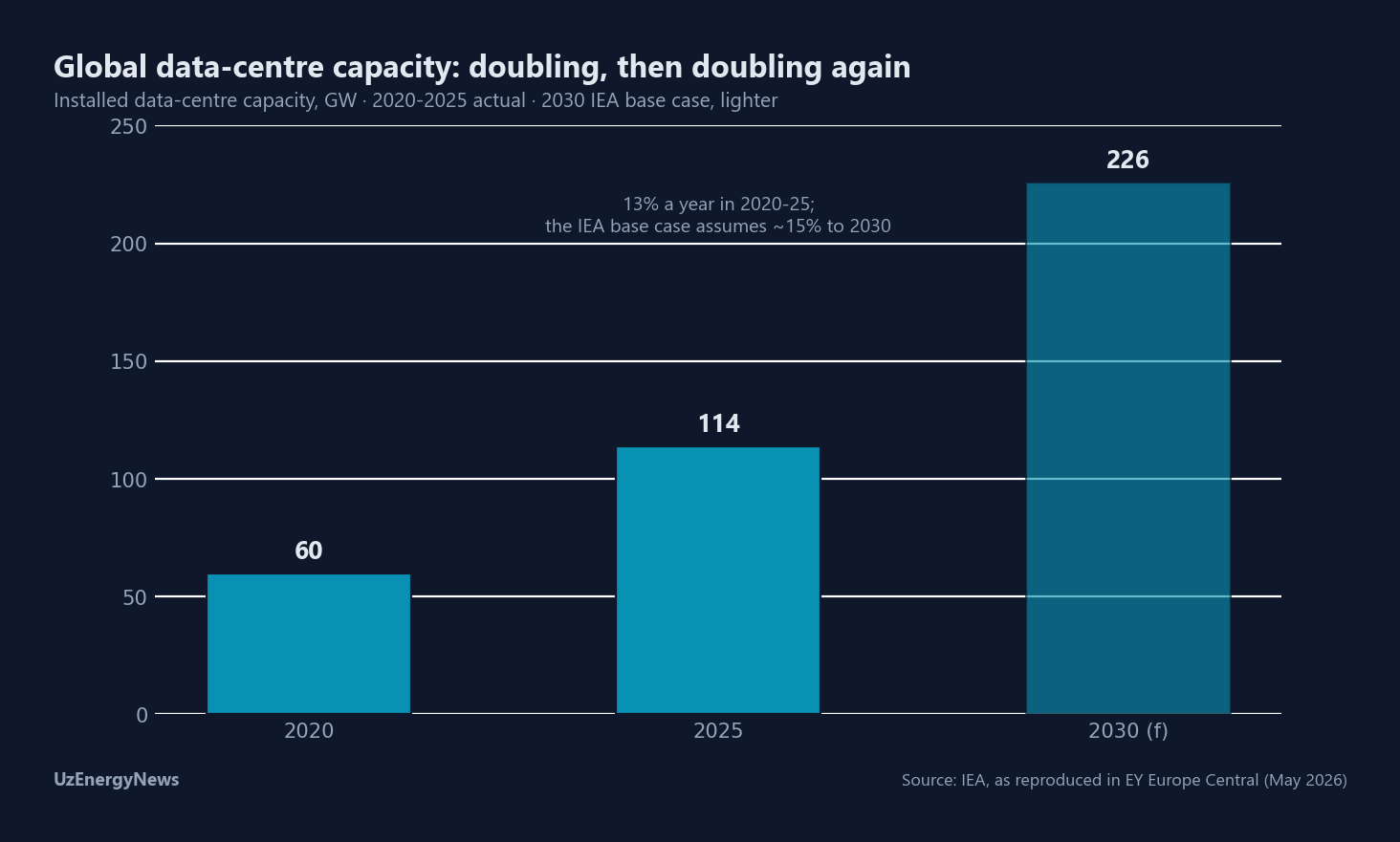
Global installed data-centre capacity was 60 gigawatts in 2020 and 114 gigawatts in 2025; the IEA base case reproduced by EY reaches 226 gigawatts by 2030 — growth of 13 per cent a year in 2020-25, with about 15 per cent a year assumed to the end of the decade. Europe's share of the global total was above 25 per cent in 2015 and 15 per cent in 2024 on the IEA's figures; EY's series puts 2020 at 22 per cent and projects about 12 per cent for 2030. The decline is relative, not absolute — Europe's capacity grows about 9 per cent a year to 2030 on the same projections; the United States and China grow faster. The IEA's Energy and AI report describes the mechanism that moves the load: training workloads tolerate latency and follow available power and land, while inference workloads sit near users — the same distinction that moves capacity between continents also moves it within Europe.
The siting variables and what to watch
EY's siting comparison scores markets on grid headroom and connection time, land availability, low-carbon supply, cooling climate, labour cost, water stress and connectivity. Its 2035 projections put data centres at about 13 per cent of national electricity demand in Denmark, about 9 per cent in Norway and above 8 per cent in Sweden. The sequence Weekly Insight #14 (5 August 2026) documented for jurisdictions taking this load — a connection queue, a cost-allocation fight and a tariff redesign — is now visible outside the hubs as well: Denmark's paused queue is the largest current example. Watchpoints: whether connection offers are issued under Ireland's December policy; whether the UK reform shortens reported hub waits; Energinet's paused queue and its 14-gigawatt data-centre share; and Türkiye's National AI Compute Strategy, due within six months of the AI Action Plan's publication.
↩ Weekly Insight #14 — Paying for the New Load: Tariff Design for Hyperscale Demand →Sources cited in text and figures: CBRE European Q2 2026 data-centre figures as reported by DCD and TNW (18-19 August 2026); EY Europe Central — AI and Energy: The Two-Way Dependency (May 2026; published online 30 June 2026); IEA — Energy and AI (2025) and IEA commentary on Europe's data-centre goals (November 2025); Ember — Grids for Data Centres (June 2025); CSO and IEA on Ireland's national share; EirGrid statements of 2022 and the CRU Large Energy Users Connection Policy (CRU2025236, 12 December 2025); Norton Rose Fulbright and HSF Kramer on the UK TMO4+ reform; Bloomberg (Northern Virginia, August 2024); The Register and Tom's Hardware (Amazon's European connections, February 2026); Nscale/Aker (Stargate Norway, July-August 2025), CNBC (Microsoft takeover, 15 April 2026) and Data Center Knowledge (Nordscale venture; Seinäjoki, July 2026); Energinet connection-queue reporting via TNW and DCD (2026); cursdeguvernare.ro, Balkan Green Energy News, ACTMedia and Energy Industry Review (Black Sea AI Gigafactory, April 2026); Prime East and Montel/Enerdata (PSE allocations); ProtoThema, citing a PwC study (Greece, 7 August 2026); CNBC, DCD and the Presidency's Invest Office (Turkcell-Google Cloud, November 2025). Prior UzEnergyNews reporting: Paying for the New Load (Weekly Insight #14, 5 August 2026); Türkiye's AI Action Plan Enters Into Force (18 August 2026). Copyrighted material is not reproduced. Analysis by UzEnergyNews.