The Fuel Behind the Buildout: uranium supply, enrichment capacity and the reactor pipeline
Reactor construction programmes from India to Central Asia depend on three measurable inputs: mine output, conversion and enrichment capacity, and long-term supply contracts. World mine production reached 60,213 tonnes of uranium in 2024 and covered 90 per cent of reactor requirements, against 76 per cent in 2022 (World Nuclear Association, updated 20 January 2026). Kazatomprom reported 25,839 tonnes for 2025 on a 100 per cent basis and guides to 27,500-29,000 tonnes for 2026, below the nominal subsoil-use level it had set for the year; Navoiyuran of Uzbekistan reported 7,000 tonnes against 5,200 the year before. Eighty reactors totalling 87,046 megawatts gross are under construction, and the association's reference case puts 2040 requirements a little above 150,000 tonnes against 68,920 tonnes in 2025. In enrichment, 42.8 per cent of capacity sits with one supplier and 20.3 per cent with a second. This edition sets out the producers, the buyers and the contracts, with the dated schedules on which they depend.
Mine output: the producers and the 2026 guidance
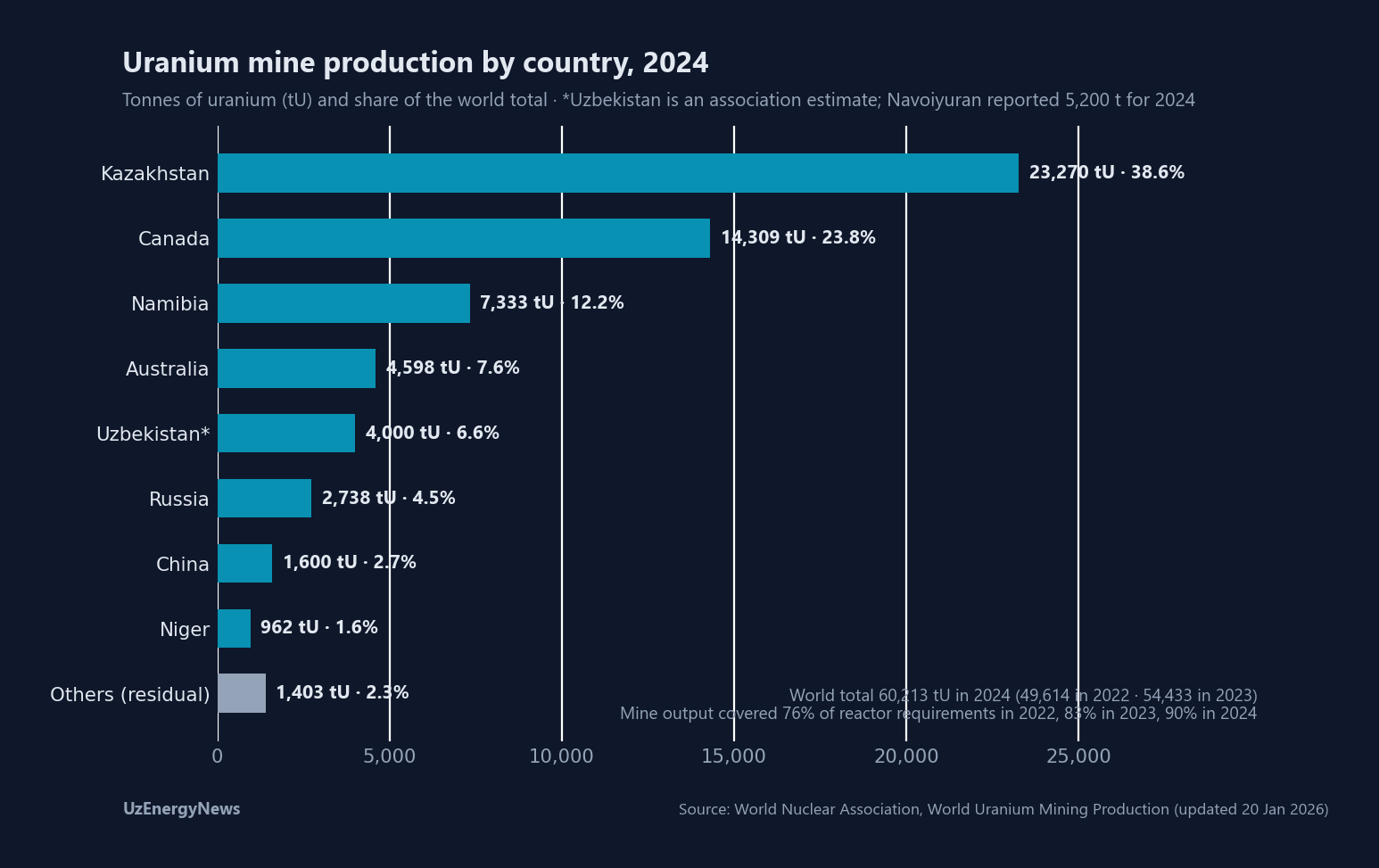
World uranium mine production was 60,213 tonnes of uranium (tU) in 2024, of which Kazakhstan supplied 38.6 per cent, Canada 23.8 per cent and Namibia 12.2 per cent (World Nuclear Association, updated 20 January 2026). Mine output covered 76 per cent of reactor requirements in 2022, 83 per cent in 2023 and 90 per cent in 2024, leaving about 6,700 tU to secondary supply in 2024 on the same basis. No comparable world total has been published for 2025, and the figures below are company statements on their own stated bases rather than a country aggregate.
Kazatomprom produced 25,839 tU in 2025 on a 100 per cent basis — the measure that covers its joint ventures — against 13,519 tU attributable to the company itself (fourth-quarter operations and trading update, 2 February 2026). For 2026 it guides to 27,500-29,000 tU on the 100 per cent basis, unchanged at its 21 August 2026 results, having already cut its nominal subsoil-use level for the year from 32,777 tU to 29,697 tU — about 3,000 tU, or some 5 per cent of world primary supply, the larger part at the Budenovskoye joint venture (World Nuclear News, 22 August 2025). The company states that the guidance depends on sulphuric acid supply; commissioning of its TQZ acid plant has moved to the third quarter of 2027 or the first quarter of 2028, a delay of six to twelve months. First-half 2026 output was 13,291 tU, with inventories of 8,245 tU at 30 June. Cameco produced 21.0 million pounds of U3O8 in 2025 on its own share basis, about 8,077 tU.
Uzbekistan's Navoiyuran reported 7,000 tonnes for 2025 against 5,200 tonnes in 2024, an increase of 35 per cent, on revenue of 1,112 million dollars, a realised price of 69.5 dollars a pound and a total cash cost of 27 dollars (company statement, 13 April 2026). The bulletin expresses these volumes as tonnes of U3O8, while the association carries the same figures as tU in its country profile; the two bases differ by a factor of 0.848 and are not reconciled here. The association's 2024 world table shows Uzbekistan at an estimated 4,000 tU, below the company's own 5,200 tonnes for that year. The Qizilkok deposit entered commercial in-situ recovery production with a fifteen-year life and peak output of 1,200 tonnes a year; Nurlikum Mining — Orano 45 per cent, Navoiyuran 45 per cent, Itochu 10 per cent — is developing South Djengeldi at a first-phase cost of 214 million dollars over three years for an average of about 500 tU a year. A 2022 presidential decree sets a 2030 national target of 7,100 tU against a base of 3,500 tU.
Namibia produced 7,333 tU in 2024 on the association's world table and 8,507 tU on its country profile, which sums Husab at 5,611, Rössing at 2,205 and Langer Heinrich at 691; both figures are published by the association and both are stated here. Ownership of the three mines runs through Chinese entities in each case: Husab through Taurus Minerals, 60 per cent held by a CGN-led vehicle; Rössing 68.6 per cent through a CNNC subsidiary; and Langer Heinrich, operated by Paladin Energy, 25 per cent through CNNC Overseas. Niger's output fell from 2,020 tU in 2022 to 962 tU in 2024; the SOMAÏR operation at Arlit, held 63.4 per cent by Orano and 36.6 per cent by the state holding Sopamin, was nationalised in June 2025, and Orano — which had stated in December 2024 that it lost operational control — filed for ICSID arbitration on 20 January 2025 and obtained a tribunal order halting the sale or transfer of stockpiled uranium.
Conversion and enrichment: capacity, concentration and the sanctions calendar
Enrichment capacity totalled 68,076 thousand separative work units (SWU) a year in 2025 and is projected at 77,784 thousand in 2030 on the association's tabulation of 4 September 2026, an increase of 14.3 per cent. Rosatom holds 42.8 per cent of the 2025 total, Urenco 25.4 per cent, CNNC 20.3 per cent and Orano 11.0 per cent; the CNNC figure is the association's estimate derived from the domestic reactor fleet and is marked as such. On the 2030 projection the shares are 38.3, 23.1, 23.4 and 12.9 per cent respectively, and CNNC accounts for 45.7 per cent of the total capacity added between the two dates. Capacity outside Rosatom is 57.2 per cent of the 2025 total and 61.7 per cent of the 2030 projection.
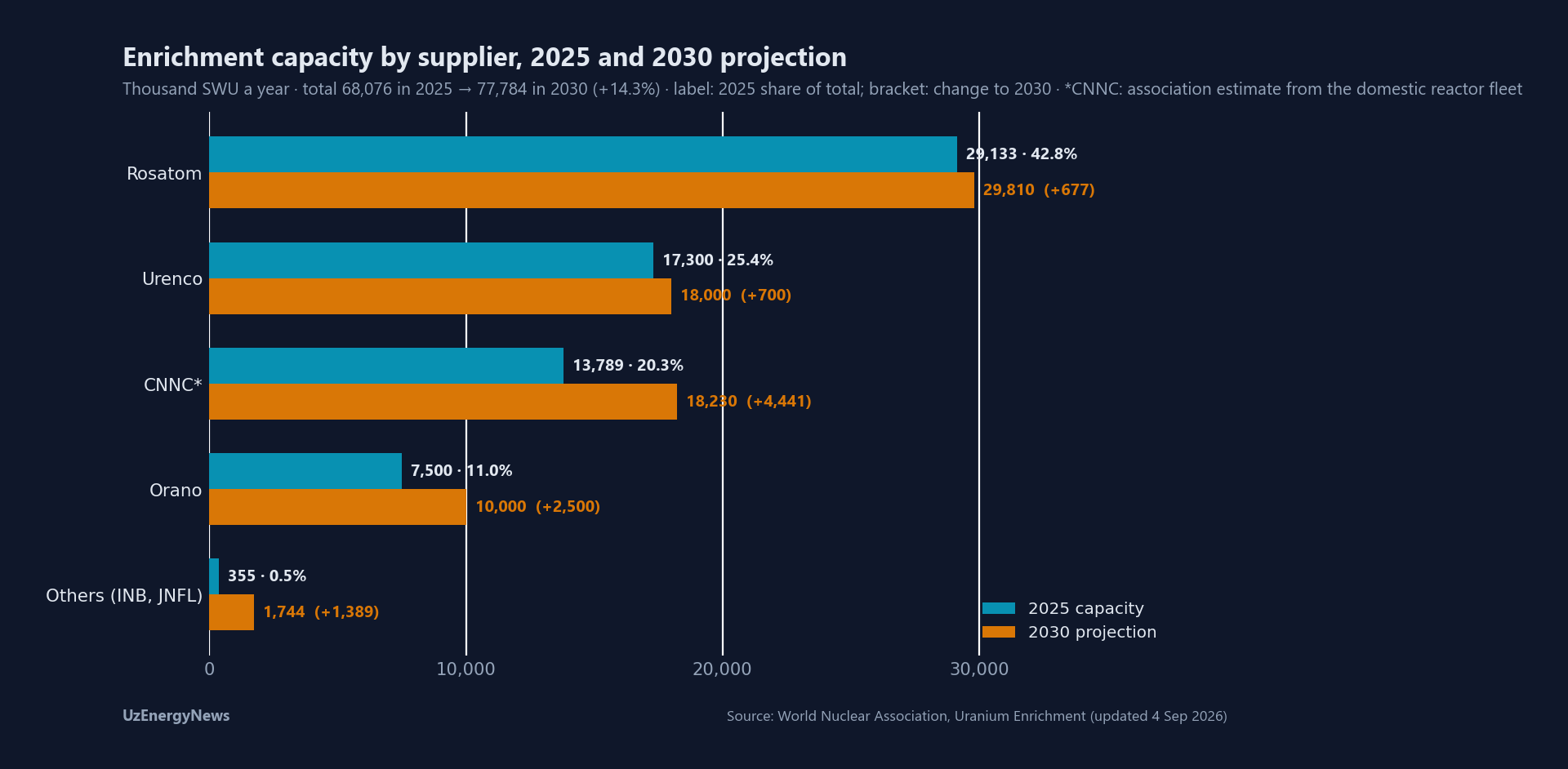
The announced additions are dated. Orano's Georges Besse II extension adds 2.5 million SWU, about 30 per cent of capacity, for some 1.7 billion euros, with first production in 2028 and full commissioning in 2030. Urenco's capacity is projected 700,000 SWU higher in 2030 than in 2025 on the same tabulation. Centrus had produced more than 1,900 kilograms of high-assay low-enriched uranium (HALEU) by June 2026 under its demonstration contract, and the Department of Energy allocated 900 million dollars in January 2026 for commercial production targeting 12 tonnes a year in 2029; the award was announced on 1 July 2026 at a total value of 1.07 billion dollars including purchase options. Rosatom's GC-9+ centrifuge replacement was completed at Zelenogorsk in July 2025 and began at Seversk in December 2025 for completion in 2027. The United States banned imports of Russian low-enriched uranium from August 2024; the waiver authority expires at the start of 2028 and the ban runs to the end of 2040. In the European Union, all operators of VVER reactors had contracted alternative fuel from non-Russian suppliers by the end of 2025 (Euratom Supply Agency annual report for 2025).
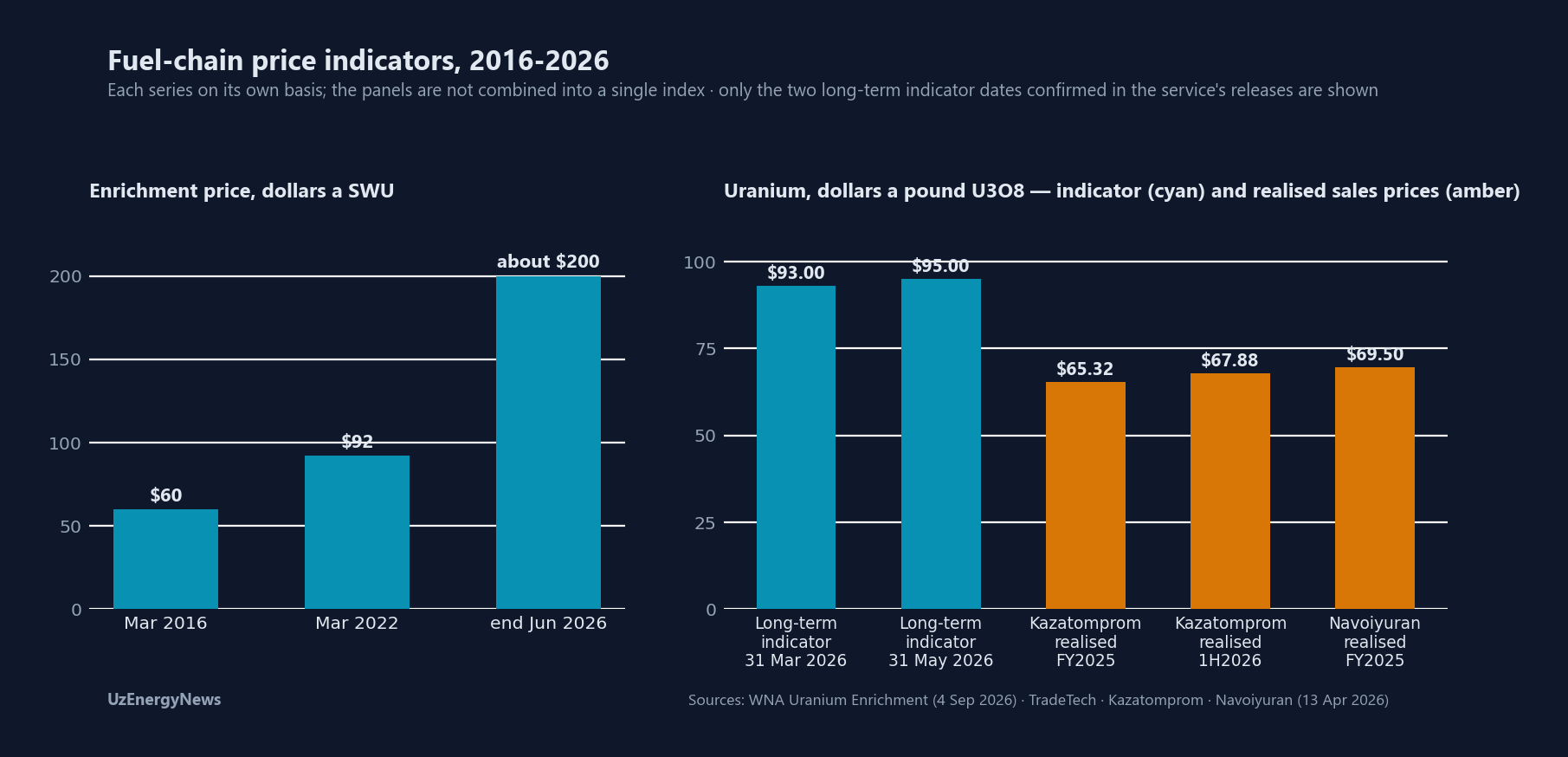
The enrichment price averaged about 200 dollars a SWU at the end of June 2026, against 60 dollars in March 2016 and 92 dollars in March 2022. TradeTech's long-term U3O8 indicator stood at 93 dollars a pound on 31 March 2026 and 95 dollars on 31 May 2026, a level the service reports as equal to its peak of May 2007 to March 2008. Realised sales prices ran below both indicators: Kazatomprom's group average was 65.32 dollars a pound in 2025 and 67.88 in the first half of 2026, and Navoiyuran's was 69.5 dollars in 2025.
The reactor pipeline and the 2040 requirement
Eighty reactors totalling 87,046 megawatts gross are under construction on the association's count of 8 September 2026; the International Energy Agency counts 78 gigawatts across fifteen countries, with half the capacity in China, in its Global Energy Review 2026. The two totals are stated on gross and net bases with different cut-off dates and are not interchangeable. Ten reactors totalling 12.2 gigawatts started construction in 2025, nine of them in China; 3 gigawatts were connected and 3 gigawatts retired, leaving the world total at 420 gigawatts. Reactor uranium requirements were 68,920 tU in 2025. The association's Nuclear Fuel Report of 5 September 2025 puts reference-case requirements a little above 150,000 tU in 2040, with an upper case above 204,000 and a lower case above 107,000, on installed capacity rising from 398 gigawatts in June 2025 to 746 gigawatts in 2040; the report states that existing mines will meet resource exhaustion in the mid-2030s.
Central Asia: two producers without conversion or enrichment
Uzbekistan and Kazakhstan rank among the world's largest uranium producers and both have contracted the fuel for their first reactors from outside; neither has conversion or enrichment capacity, and Kazakhstan's Ulba plant fabricates fuel assemblies without enriching. Uzbekistan's plant in the Farish district of Jizzakh region is configured as two VVER-1000 units and two RITM-200N units of 55 megawatts each, about 2,110 megawatts in total, under a contract capped at 9.5 billion dollars; first concrete for the base plate was poured on 4 June 2026 together with the construction licence, and the schedule runs from the first small modular unit in 2029 to the first large unit in 2033. A fuel supply agreement between Uzatom and Rosatom was concluded in September 2025. On 2 September 2026 a presidential briefing proposed a joint venture with leading foreign engineering companies for project management, technical control and independent expertise; the published text does not name Rosatom, and Uzatom stated on 4 September that the participants and timetable had not been determined. Local content stands at 21 per cent, or 1.9 billion dollars, against a target of at least 30 per cent. In Kazakhstan, a Rosatom-led consortium was selected on 14 June 2025 for the Balkhash plant — two VVER-1200 units, 2,400 megawatts, at Ulken — with an intergovernmental agreement in May 2026 and an engineering, procurement and construction contract signed on 3 September 2026 at the Eastern Economic Forum in Vladivostok; construction is to begin in 2027 and commissioning is stated for the middle of the 2030s, and CNNC has been named preferred contractor for a second plant. In Türkiye, the four Akkuyu units of 4,800 megawatts are under construction, with a 2025 uranium requirement of 620 tU on the association's reactor table; 163 dummy fuel assemblies were loaded into the first unit in March 2026 as part of the fuel-loading rehearsal, which was reported as completed in July 2026.
Buyers, contracts and the timing difference
Deliveries of natural uranium to European Union utilities totalled 14,678 tU in 2025, of which 15.98 per cent — 2,346 tU — was of Russian origin, with four countries supplying more than 83 per cent of the total; Tenex held about 23 per cent of enrichment-service deliveries and about 24 per cent of conversion. United States utilities purchased 46.9 million pounds of U3O8 equivalent, 16 per cent below 2024, with Canada at 32 per cent and Kazakhstan at 28 per cent, and sent 63 per cent of their natural uranium feed to enrichers outside the country. The two markets are compared in the table below, on the delivery basis for the European Union and the purchase basis for the United States.
| Indicator | European Union (Euratom Supply Agency, delivered) | United States (EIA, purchased) |
|---|---|---|
| Total natural uranium | 14,678 tU delivered | 46.9 mn lb U3O8e purchased (about 18,040 tU), −16% on 2024 |
| Largest origins | Canada and Kazakhstan | Canada 32% · Kazakhstan 28% · Australia 15% · Uzbekistan 7% · United States 7% · Namibia 4% |
| CIS-origin share | 46.81% | not stated separately |
| Russian-origin natural uranium | 2,346 tU · 15.98% | withheld for 2025 |
| Concentration | four countries above 83%, six above 98% | — |
| Enrichment services | Orano and Urenco 8.84 mn SWU · Tenex 2.74 mn · others 0.55 mn (Tenex about 23%) | 32 mn lb feed delivered; 37% to domestic enrichers, 63% abroad |
| Conversion | Russian share about 24%; 7,908 tU converted under separate contracts (60% of service deliveries) | — |
| Policy status | all EU VVER operators contracted non-Russian fuel by end-2025 | Russian LEU imports banned from August 2024; waiver authority expires at the start of 2028; ban runs to end-2040 |
On the contracting side, Kazatomprom's extraordinary general meeting approved in April 2026 a long-term supply to the Directorate of Purchase and Stores of India's Department of Atomic Energy, valued above 4 billion dollars; the transaction exceeded half the company's book value and therefore required a shareholder vote, which carried with 92.9 per cent of votes cast. India also signed a nine-year agreement with Cameco on 2 March 2026 for about 22 million pounds of U3O8 over 2027-2035, worth some 2.6 billion Canadian dollars. A framework with Uzbekistan was reported on 30 August 2026 without a signed contract, and the existing Uzbek long-term agreement expires in 2026. Cameco's total long-term commitment portfolio stood at about 230 million pounds at the end of 2025. The dated schedules behind these volumes are set out in the table below. Enrichment capacity is projected 14.3 per cent higher in 2030 than in 2025; the reference-case uranium requirement is stated for 2040; the individual plant and mine milestones fall between 2027 and 2033. The capacity projection and the requirement projection carry different end years and different scopes and are not compared here.
| Milestone | Date |
|---|---|
| Kazatomprom TQZ sulphuric acid plant | Q3 2027 - Q1 2028 |
| Balkhash construction start | 2027 |
| Orano Georges Besse II first production / full commissioning | 2028 / 2030 |
| Centrus commercial HALEU, 12 t/yr | 2029 |
| Uzbekistan NPP, first small modular unit | 2029 |
| Uzbekistan NPP, first VVER-1000 | 2033 |
| Enrichment capacity projection | 2030 (+14.3% on 2025) |
| Reference-case uranium requirement above 150,000 tU | 2040 |
Sources cited in text and figures: World Nuclear Association — World Uranium Mining Production (20 January 2026), Uranium Enrichment (4 September 2026), World Nuclear Power Reactors and Uranium Requirements (8 September 2026), Uranium in Uzbekistan (11 June 2026), Uranium in Namibia (21 January 2026) and the Nuclear Fuel Report 2025 press statement (5 September 2025); Kazatomprom fourth-quarter 2025 operations and trading update (2 February 2026) and first-half 2026 results (21 August 2026); Navoiyuran full-year 2025 preliminary results (13 April 2026); Cameco fourth-quarter 2025 results (13 February 2026) and India supply agreement release (2 March 2026); Centrus Energy releases on the Department of Energy HALEU award (5 January 2026 and 1 July 2026); Orano statements on Georges Besse II and on the Niger arbitration (20 January 2025); Euratom Supply Agency annual report for 2025; United States Energy Information Administration, Uranium Marketing Annual Report 2025; International Energy Agency, Global Energy Review 2026 — Nuclear; IAEA Power Reactor Information System; TradeTech monthly price indicators; World Nuclear News (22 August 2025; 11 August 2026; 1 September 2026; 3 September 2026); NucNet; American Nuclear Society; president.uz (2 September 2026), gazeta.uz, spot.uz and Interfax. Copyrighted material is not reproduced. Analysis by UzEnergyNews.
↩ Weekly Insight #5 — Small Modular Reactors: From Blueprint to First Concrete →