Paying for the New Load: Tariff Design for Hyperscale Demand
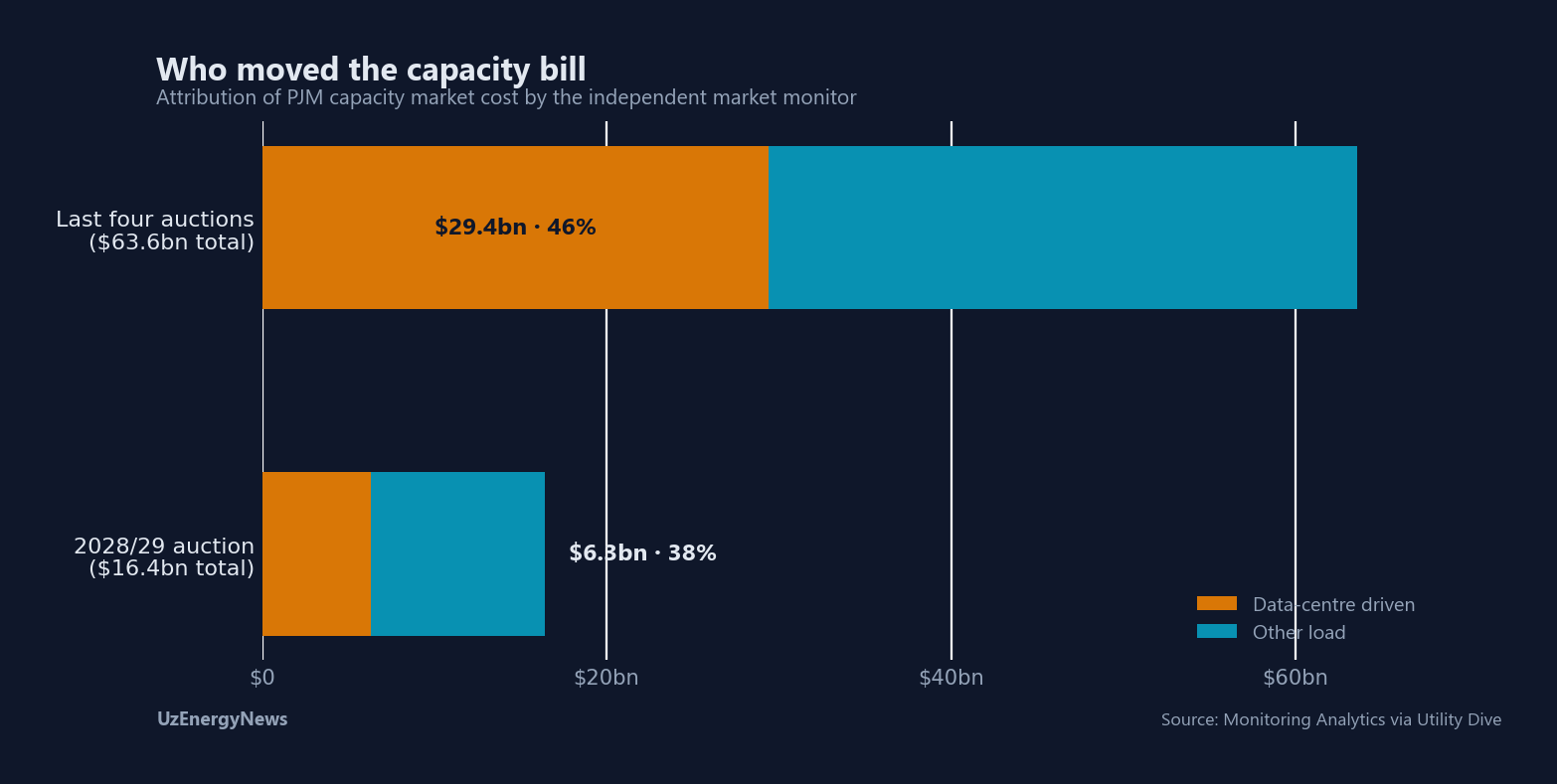
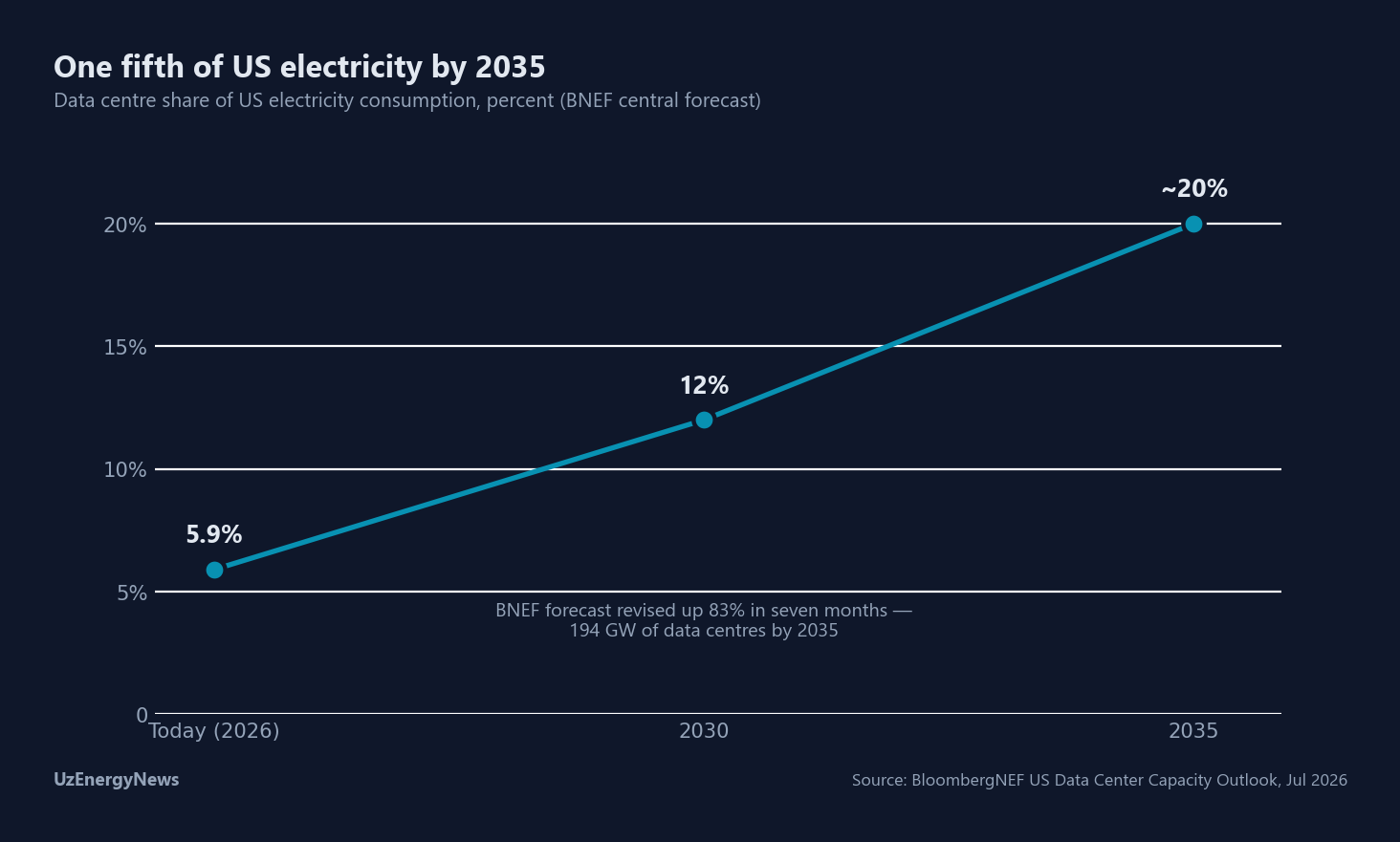
Weekly Insight #12 established that grid connection, not chip supply, sets the pace of the artificial-intelligence build-out. This edition takes up the question that follows: who pays. The numbers are no longer hypothetical — PJM's independent market monitor attributes 29.4 billion dollars of capacity cost across the last four auctions, 46 percent of the total, to data-centre load. In response, a rulebook is forming: Ohio requires large data centres to pay for at least 85 percent of subscribed capacity for up to twelve years whether they use it or not; Virginia's new tariff class demands take-or-pay commitments and collateral of 1.5 million dollars per megawatt; Georgia routes every load above 100 megawatts into a bespoke contract; Texas obliges new large loads to install remote-disconnection equipment. With BloombergNEF projecting data centres at one fifth of US electricity by 2035, the design choices being made now will decide whether the build-out is financed by its beneficiaries or by everyone else.
Every previous edition of this column's data-centre coverage ended at the meter: whether the grid can connect the load, and how long the queue is. This one starts there. Once a hyperscale campus is connected, it becomes a participant in a shared cost system built over a century on an assumption that no longer holds — that new load arrives gradually, in small increments, spread across a service territory. A single artificial-intelligence campus now arrives in gigawatt blocks, on timelines measured in quarters, with corporate owners whose market capitalisation exceeds the utility's by more than an order of magnitude. OpenAI's twenty-five-year, 3.2-gigawatt supply agreement with Georgia Power — announced in July for a campus whose investment will exceed 30 billion dollars — is a single contract equal to more than a fifth of Uzbekistan's national peak load. Microsoft expects to spend around 175 billion dollars on capital investment in calendar 2026 — a figure restated from roughly 190 billion after an accounting change, with the spending plan itself unchanged. The question every regulator now faces is not whether this load comes, but who carries the system costs it brings with it.
The bill is already arriving
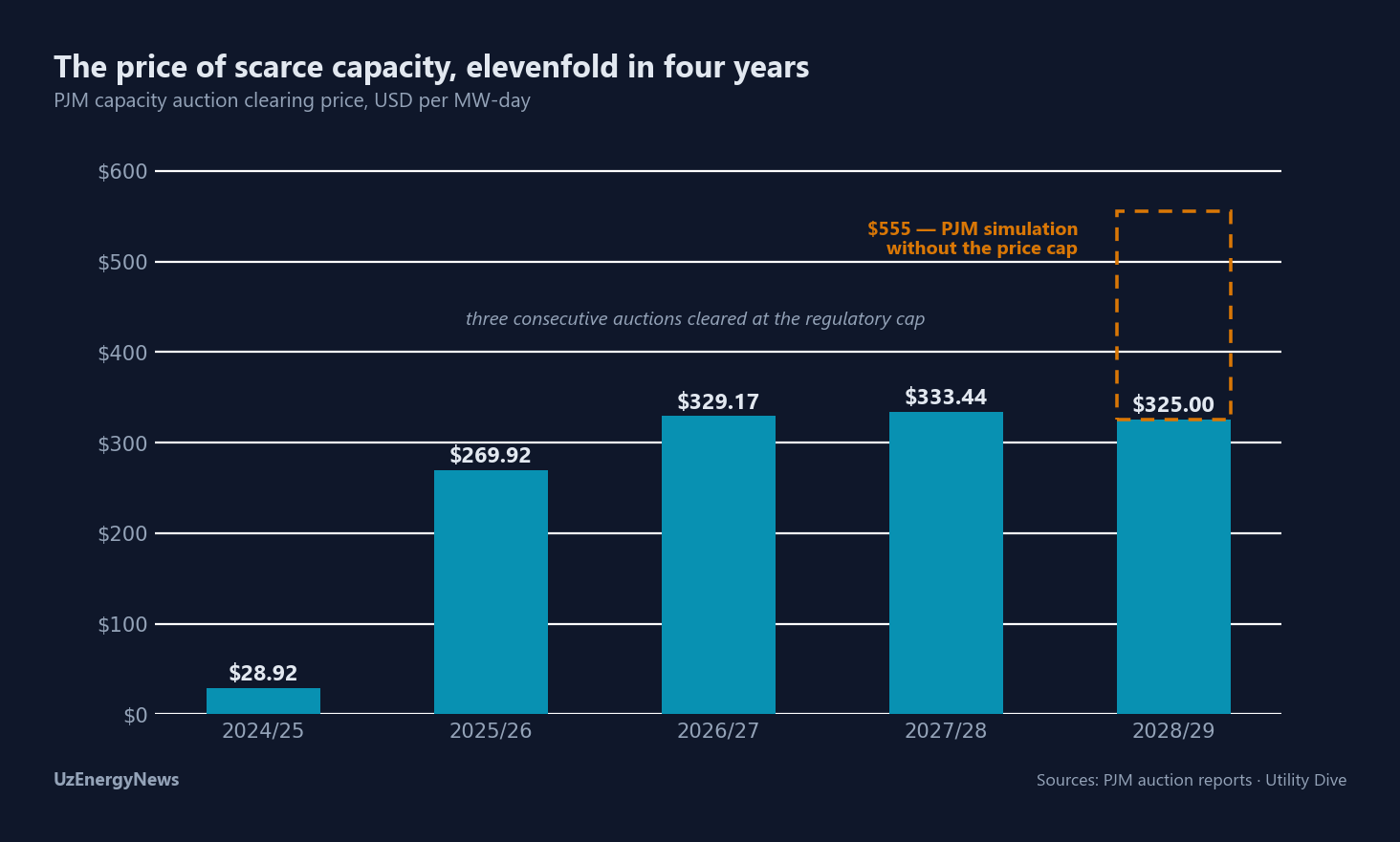
The clearest documented case remains the PJM Interconnection, the largest wholesale market in the United States. Its capacity auction — the mechanism that pays generators to be available — cleared at 28.92 dollars per megawatt-day for the 2024/25 delivery year and has since cleared at or near the regulatory price cap three times in a row: 329.17 dollars, then 333.44, then 325 for 2028/29, an auction that procured 138,318 megawatts for about 16.4 billion dollars and still fell 6,831 megawatts short of the reliability requirement. PJM's own simulation indicates the last auction would have cleared at 555 dollars without the cap. Attribution is documented rather than inferred: Monitoring Analytics, the market's independent monitor, calculates that data-centre load accounted for 29.4 billion of the 63.6 billion dollars of capacity cost across the last four auctions — 46 percent — including 6.3 billion of the 16.4 billion in the latest one. The pass-through is visible in retail bills: Pepco residential customers in Washington DC have paid about 21 dollars a month more since June 2025, roughly half of it capacity-driven, and analyst estimates — from Synapse Energy Economics at the conservative end to the Natural Resources Defense Council at the high end — put cumulative additional consumer cost across the region at 100 to 163 billion dollars by 2033. This is the political economy that tariff design now has to manage: costs caused disproportionately by one class of customer, socialised through mechanisms built for another era.
Why the old tariff book breaks
Classic rate design socialises network costs because its founding assumptions made that fair: load grew slowly, no single customer moved the system, and assets built for one generation of consumers were reliably used by the next. Hyperscale demand violates each assumption in turn. The loads are lumpy — tens or hundreds of megawatts at a single point — so the network reinforcements they trigger are traceable to specific customers in a way suburban growth never was. The loads are uncertain: BloombergNEF finds developers announce far more than they build, non-hyperscale projects take 8.4 years against 5.3 for the hyperscalers themselves, and speculative or duplicated requests inflate queues everywhere; constrained by the pace at which connections can physically be built, its base case still leaves a 19-gigawatt shortfall by 2035. And the loads are mobile in a way steel mills never were: a campus that faces an unattractive tariff in one state can be resited across a border within a planning cycle, which gives its owners bargaining power no previous industrial customer possessed. The result, if nothing changes, is a familiar asymmetry — if the load materialises, the developer profits; if it does not, the stranded network investment lands in everyone's bills. Tariff design for hyperscale demand is, at bottom, an exercise in reallocating that asymmetry.
The emerging rulebook
Within eighteen months, the outline of a new tariff architecture has appeared across jurisdictions that barely consulted each other, and its instruments are converging. The table summarises the leading cases.
| Jurisdiction | Trigger | Core mechanism | Term and security |
|---|---|---|---|
| AEP Ohio (PUCO, Jul 2025) | >25 MW new data centres | Pay for ≥85% of subscribed capacity whether used or not; 4-year ramp | Up to 12 years; exit fee of 3 years of minimum charges; financial assurance |
| Dominion Virginia GS-5 (SCC; from Jan 2027) | ≥25 MW | Take-or-pay: 85% of contracted network capacity, 60% of generation demand | 14-year contracts; collateral of $1.5 mn per MW |
| Georgia PSC (Jan 2025) | ≥100 MW | Mandatory bespoke contract: minimum bills, financial guarantees, commission pre-approval; standard tariffs closed | Long-term, negotiated |
| Texas SB6 (from Jun 2025) | Large loads (75 MW+, statutory) | Interconnection standards: tiered study fees of $100,000-$300,000, proof of site control; mandatory remote-disconnection equipment for firm load-shed | Statutory, ERCOT-wide |
| Ireland (CRU, Dec 2025) | New data centres, nationwide (over 10 MVA) | Bring-your-own-power: on-site generation or storage covering full demand, exportable to the grid | Binding connection condition |
| European Union (Dec 2025 guidance) | Connection queues generally | First-ready-first-served with maturity criteria, milestones and penalties | Framework, member-state rollout |
| Singapore (2026) | New data-centre capacity | Capacity allocated by government call rather than open connection | Administrative allocation |
Three design instruments recur. Minimum-take obligations — Ohio's 85 percent, Virginia's 85/60 split — convert a speculative load forecast into a bankable revenue stream, so that the customer, not the rate base, carries volume risk. Security instruments — exit fees, collateral at 1.5 million dollars per megawatt, proof of site control — filter serious projects from queue speculation. And operational conditions — Texas's remote-disconnection mandate, Ireland's bring-your-own-power rule, PJM's developing flexible-connection frameworks — price the load's contribution to system stress rather than only its energy. Notably, the direction of travel is not hostile to the industry: Georgia's regime was in place before Georgia Power signed the largest corporate supply deal in its history, and the first contracts under the new rules were highlighted in the utility's own filings as evidence the framework works. Clear allocation of risk, it turns out, is something hyperscale buyers will pay for.
Principles, and why this travels
Underneath the case-by-case detail, the emerging rulebook enforces one principle: cost causation. Whoever triggers a system cost should carry it — with the corollary that a customer who accepts curtailability, brings storage, or firms its own supply should pay less, because it causes less. Getting this right matters in both directions. Tariffs that under-recover socialise the build-out and invite the political backlash already visible in blocked projects and windfall-tax debates; tariffs that over-recover push the load behind the meter entirely — BloombergNEF counts 124 gigawatts of announced on-site gas capacity, just over half of it with a target commissioning date — which strands the network another way and removes the flexibility the system could otherwise have used. The debate is no longer confined to the United States. Any grid that courts hyperscale investment — and governments from the Gulf to Central Asia and Southeast Asia are courting it explicitly — will face the same sequence: a connection queue, a cost-allocation fight, and a tariff redesign. The jurisdictions that write the rulebook before the load arrives will keep both their investors and their household customers; those that improvise afterwards will be arbitrating between them for a decade. The lesson of the PJM numbers is that the meter starts running before the rules are written.
← Back to all analysisSources cited in text and figures: PJM Interconnection capacity auction reports for the 2024/25 to 2028/29 delivery years, with auction analysis reported by Utility Dive; Monitoring Analytics, PJM Independent Market Monitor (cost attribution, July 2026); Natural Resources Defense Council; Pepco billing data as reported in regional press; BloombergNEF — US Data Center Capacity Outlook (July 2026); Public Utilities Commission of Ohio order of 9 July 2025 and AEP Ohio settlement; Virginia State Corporation Commission and Dominion Energy GS-5 tariff filings (SCC fact sheet, February 2026; Forbes, June 2026); Georgia Public Service Commission rule of 23 January 2025 and Georgia Power filings; Texas Senate Bill 6 (2025) and PUCT draft rule 25.194; Commission for Regulation of Utilities, Ireland (December 2025); European Commission connection guidance and Electrification Action Plan (July 2026); OpenAI-Georgia Power supply agreement (July 2026); Microsoft FY26 fourth-quarter results call. Copyrighted material is not reproduced. Analysis by UzEnergyNews. Figures reflect public sources as of 5 August 2026.