Who Finances the Grid? Lenders, sovereigns and the capital that has to reach emerging-market networks
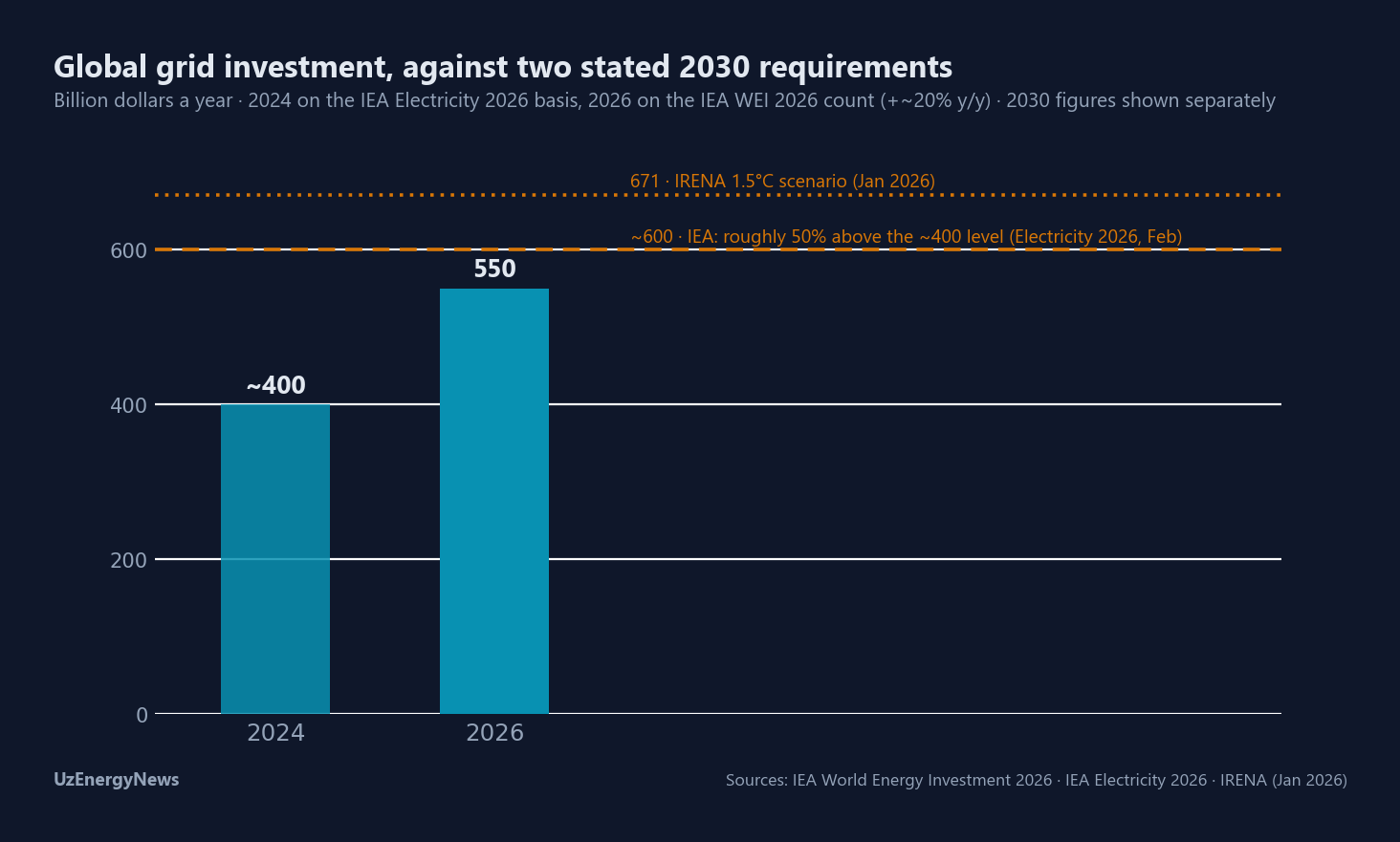
On 2 September, the European Bank for Reconstruction and Development (EBRD) signed a 207-million-dollar loan to Enerjisa Enerji for distribution-grid modernisation in Türkiye, backed by a guarantee under the European Union's European Fund for Sustainable Development Plus (EFSD+) — on the bank's description, the first electricity-distribution project under the programme's Hi-Bar guarantee window. It is one entry in a year of grid lending that also includes a 750-million-dollar World Bank loan to Türkiye's transmission operator TEİAŞ, a World Bank-led lending package of about 561 million dollars for Pakistan's transmission operator, an 80-billion-yen Japanese green loan to India's Power Grid Corporation, and the World Bank's first regional electricity-market programme for Central Asia. The sums sit against stated requirements: global grid investment reaches about 550 billion dollars in 2026 on the International Energy Agency's latest count, the agency puts the 2030 requirement roughly 50 per cent above its earlier measure of about 400 billion, and IRENA's 1.5°C scenario calls for 671 billion a year. Emerging and developing economies outside China receive less than 30 per cent of global energy investment, and their cost of capital runs two to three times advanced-economy levels. This edition sets out who is lending what, on which terms, and through which instruments — loans, guarantees and regulated-asset-base reforms.
The Enerjisa transaction — for the operator of the Başkent, AYEDAŞ and Toroslar distribution regions — carries a seven-year tenor with a Turkish-lira disbursement option, and arrives with a first-loss guarantee layer from the European Union attached. Multilateral money with a guarantee wrapper, aimed at the distribution and transmission networks of emerging markets, is the pattern of the year's ledger. This edition compiles that ledger, the investment-versus-requirement numbers it works against, and the cost-of-capital arithmetic that decides where private capital follows.
The numbers on investment and need
Global grid investment reaches about 550 billion dollars in 2026, up roughly 20 per cent year on year, within total energy investment of 3.4 trillion dollars of which electricity takes about 60 per cent (IEA World Energy Investment 2026, May). The agency's Electricity 2026 report, published in February on an earlier count of about 400 billion, put the 2030 requirement roughly 50 per cent higher; IRENA's January 2026 assessment puts 1.5°C-aligned needs at 671 billion a year. The two 2030 figures come from different institutions and scenarios and are shown separately in the chart; the step from 400 to 550 likewise reflects the IEA's updated count between its February and May publications, not a one-year jump in spending. Emerging and developing economies outside China receive less than 30 per cent of total energy investment and about 20 per cent of power-sector investment (IEA). More than 2,500 gigawatts of projects — renewables, storage and large loads including data centres — sit in connection queues; the IEA estimates 750-900 gigawatts could be unlocked through flexible or curtailable connection agreements and 450-700 gigawatts through grid-enhancing technologies for advanced-stage projects. Prices of key grid equipment, transformers and cables among them, have roughly doubled in five years (IEA Electricity 2026).
The lenders' ledger, October 2025 to September 2026
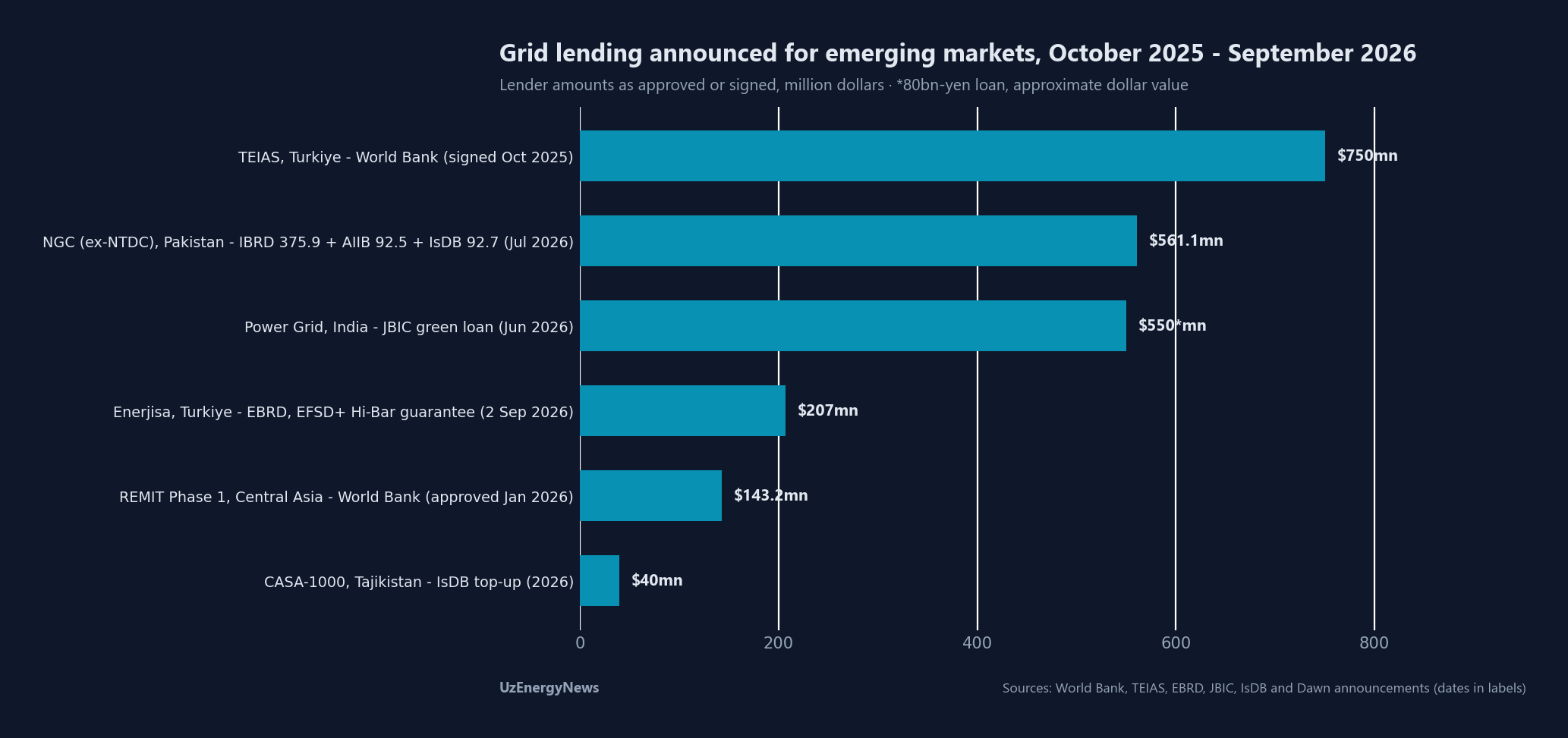
The year's largest single loan is the World Bank's to TEİAŞ: approved at 748 million dollars in August 2025 — 708 million from the International Bank for Reconstruction and Development (IBRD) plus Clean Technology Fund tranches — and signed at 750 million on 6 October 2025, against Türkiye's stated 28-billion-dollar transmission investment programme to 2035. In Pakistan, the World Bank board approved 375.9 million dollars on 8 July 2026, the first phase of its multiphase engagement with the National Grid Company — formerly NTDC, whose restructuring is itself a component of the project — alongside tranches from the Asian Infrastructure Investment Bank (92.5 million) and the Islamic Development Bank (92.7 million), a lender total of about 561 million for a 500-kilovolt corridor and reactive-power management. In India, the Japan Bank for International Cooperation and Japanese commercial banks signed an 80-billion-yen green loan — about 550 million dollars — on 17 June 2026 for Power Grid Corporation's Khavda-Nagpur high-voltage direct-current link; India's National Electricity Plan for transmission puts requirements at about 109.5 billion dollars to 2032. In Central Asia, the World Bank approved its Regional Electricity Market, Interconnectivity and Trade (REMIT) programme on 22 January 2026: an indicative 1.018-billion-dollar, ten-year engagement whose approved first phase — 143.2 million dollars for Kyrgyzstan, Tajikistan, Uzbekistan and the coordinating dispatch centre CDC Energia — targets cross-border trade of at least 15 terawatt-hours a year and a more-than-tripling of transfer capacity to 16 gigawatts. The distinction between commitment and approval runs through the ledger: Mission 300 for Africa carries pledges above 50 billion dollars, against 15 billion in directly committed project financing plus 4.5 billion in mobilised co-financing as of 16 June 2026, with more than 50 million people connected. Earlier, in May 2025, the World Bank lent 100 million dollars — with 50 million in co-financing — to Uzbekistan's regional distribution operator for 6,000 kilometres of low-voltage lines, 1,200 transformers and 150,000 smart meters. On the guarantee side, the Multilateral Investment Guarantee Agency's cumulative issuance passed 100 billion dollars in April 2026, including guarantees of up to 1.48 billion for a portfolio of up to 23 AMEA Power projects; at COP30 in Belém, the Asian Development Bank, the World Bank and ASEAN announced a power-grid financing initiative of more than 12 billion dollars.
| Borrower / programme | Lender(s) | Amount | Date | Instrument |
|---|---|---|---|---|
| TEİAŞ, Türkiye | World Bank (IBRD + Clean Technology Fund) | $750mn signed ($748mn approved) | Oct 2025 (approval Aug 2025) | Loan |
| National Grid Company (ex-NTDC), Pakistan | World Bank $375.9mn + AIIB $92.5mn + IsDB $92.7mn | ~$561mn lender total | Jul 2026 | Loans, multiphase first phase |
| Power Grid Corporation, India | JBIC + Japanese commercial banks | ¥80bn (~$550mn) | Jun 2026 | Green loan |
| Enerjisa Enerji, Türkiye | EBRD, with EU EFSD+ Hi-Bar guarantee | $207mn | 2 Sep 2026 | Loan + first-loss guarantee |
| REMIT, Central Asia | World Bank | $1.018bn indicative · Phase 1 $143.2mn approved | Jan 2026 | Multiphase programme |
| Regional distribution operator, Uzbekistan | World Bank | $100mn + $50mn co-financing | May 2025 | Loan |
| CASA-1000, Tajikistan | Islamic Development Bank | $40mn | 2026 | Top-up loan |
| AMEA Power portfolio (up to 23 projects) | MIGA | Up to $1.48bn | Apr 2026 | Guarantees |
| Mission 300, Africa | World Bank + African Development Bank + partners | >$50bn pledged · $15bn committed + $4.5bn mobilised | as of Jun 2026 | Pledge / programme |
| ASEAN Power Grid Financing Initiative | ADB + World Bank + ASEAN | >$12bn | Nov 2025 (COP30) | Initiative |
The cost-of-capital divide
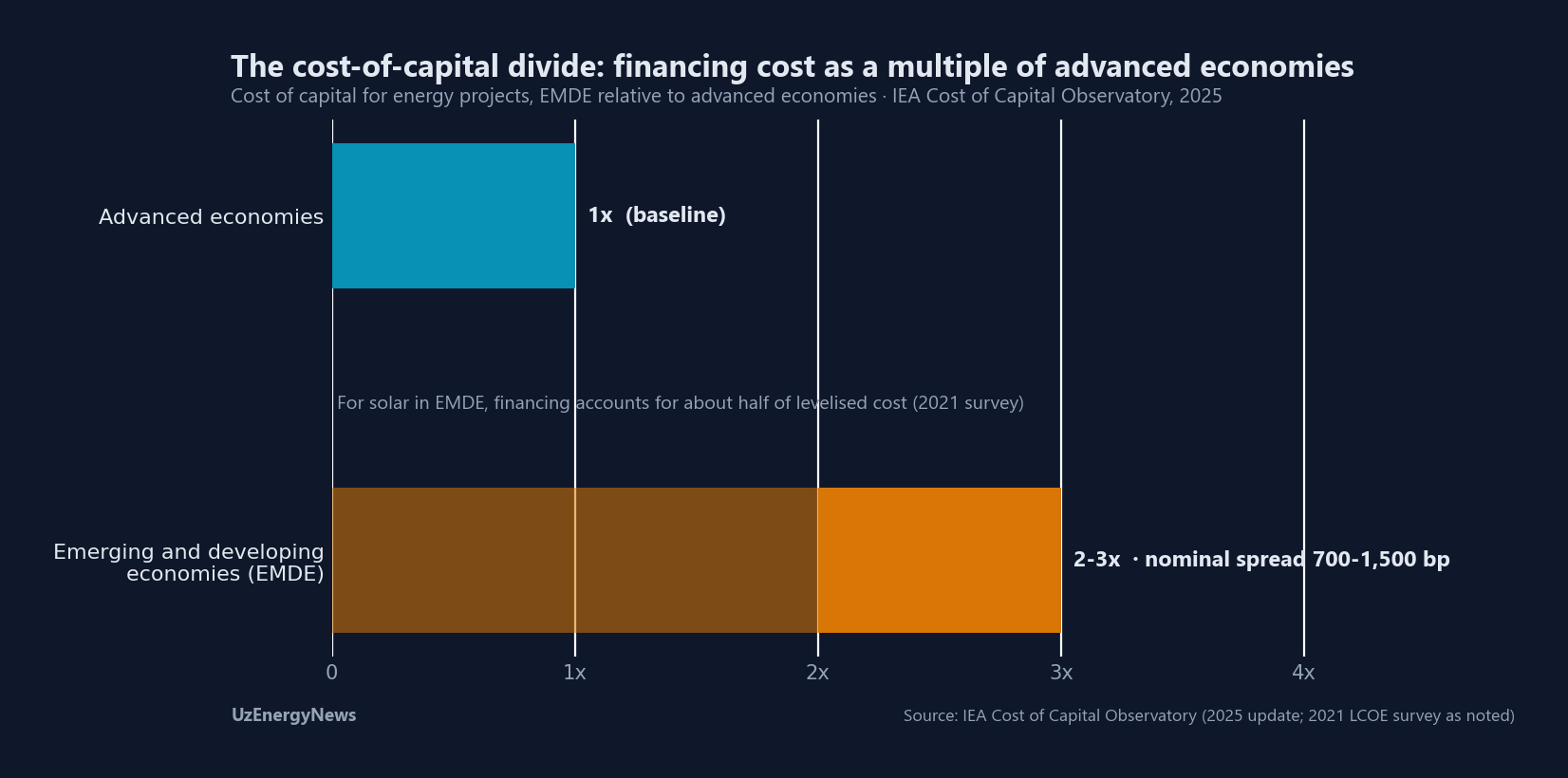
The IEA's Cost of Capital Observatory, in its 2025 update, puts the cost of capital for renewable and storage projects in emerging and developing economies at least twice advanced-economy levels, and for energy projects generally at two to three times, with economy-wide nominal financing costs 700-1,500 basis points above the United States and Europe. In its 2021 survey, financing accounted for about half of the levelised cost of solar in these economies, against 25-30 per cent in advanced markets. The 2025 survey of more than 1,700 projects found expectations split: about a quarter of respondents expected declines, more than half expected further increases. Regulation is one response: Uzbekistan's regulated-asset-base reform — whose first tariff decision took effect in August — is expected to carry a regulated post-tax return of 14-16 per cent, according to the Ministry of Economy and Finance (via Gazeta.uz, 27 August 2026), and the manager of the state-linked UzNIF portfolio argues that tariff liberalisation and full implementation of the regulated-asset-base model are the precondition for international capital to enter.
Operators, tenders and what to watch
Beyond lending, ownership and tendering models move capital into networks. India's Uttar Pradesh has moved two of its four distribution companies toward public-private partnership (2025-26). Uzbekistan's 2024 decree programme aims to transfer the management of regional distribution networks to private operators, with an investment target the government put at 4 billion dollars. The OECD's January 2026 working paper on transmission-grid financing points to competitively tendered independent transmission projects — Brazil's auctions and India's tariff-based competitive bidding — as the model most readily transferable to emerging markets. Watchpoints: the approval of REMIT's next phases; COP31 in Antalya on 9-20 November 2026, against the COP29 pledge of 25 million kilometres of grids and 1,500 gigawatts of storage capacity by 2030; Uzbekistan's full transition to regulated-asset-base tariffs, flagged for 2027-28; and the EFSD+ guarantee pipeline for further distribution transactions.
↩ Weekly Insight #9 — The Global Grid Investment Wave →Sources cited in text and figures: IEA World Energy Investment 2026 (May 2026); IEA Electricity 2026 (February 2026); IRENA (January 2026); IEA Cost of Capital Observatory (2025 update; 2021 survey as noted); EBRD press release (2 September 2026); World Bank press releases (TEİAŞ approval, August 2025; REMIT, 22 January 2026; Uzbekistan distribution, 15 May 2025; Pakistan National Grid Company, 8 July 2026; Mission 300, 16 June 2026); MIGA (9 April 2026); TEİAŞ (6 October 2025); JBIC (17 June 2026); Press Information Bureau of India (National Electricity Plan-Transmission); Gazeta.uz (27 August 2026); gov.uz; OECD, Transmission Grid Financing (January 2026); Global Renewables Alliance (COP30 package, November 2025). Copyrighted material is not reproduced. Analysis by UzEnergyNews.