IEA Renewables 2026, Published on 6 November 2026, Forecasts More Than 4,770 GW of Renewable Capacity Additions Over 2026-2031, 57 Per Cent More Than in the Previous Six Years; Additions in 2026 Are Forecast to Be 11 Per Cent Lower Than in 2025
Solar Accounts for More Than Three-Quarters of the Growth; China's Share of Growth Falls From 61 Per Cent in 2025 to About 53 Per Cent; Technical Curtailment of Wind and Solar Output Could Exceed 800 TWh in 2031, Against Almost 200 TWh in 2025, and Advanced-Stage Renewable and Storage Projects Awaiting Grid Connection Total 3,000 GW; the Liquid Biofuel Growth Forecast Is Revised Up by 40 Per Cent
The International Energy Agency (IEA) published Renewables 2026, its annual report on renewable energy markets, on 6 November 2026. The report forecasts more than 4,770 GW of renewable capacity additions over 2026-2031, 57 per cent more than over the previous six years and more than 80 per cent of global power capacity additions in the period. Additions in 2026 are forecast to be 11 per cent lower than in 2025. Solar accounts for more than three-quarters of the growth, and onshore wind capacity reaches 2,040 GW in 2031. China's share of growth falls from 61 per cent in 2025 to about 53 per cent over the forecast period, and additions in emerging and developing economies outside China match those in advanced economies for the first time; the forecasts for the United States, sub-Saharan Africa and Asia-Pacific excluding China are revised up, and growth in India is 2.6 times that of the previous period. For 2031 the executive summary and the heading of the renewable electricity chapter give a renewable share of almost 45 per cent of global electricity generation, and the text of the chapter gives 43 per cent. Technical curtailment of wind and solar output in key markets could exceed 800 TWh in 2031, against almost 200 TWh in 2025, and advanced-stage renewable and storage projects awaiting grid connection total 3,000 GW. The liquid biofuel growth forecast is revised up by 40 per cent compared with Renewables 2025. In the IEA's Eurasia region, the renewable share of generation rises from 19 per cent to 23 per cent; Uzbekistan is forecast to add more than 14 GW of renewable capacity over 2026-2031, 78 per cent more than in 2020-2025.
The International Energy Agency (IEA) published Renewables 2026, its annual report on renewable energy markets, on 6 November 2026. The report covers hydropower, solar, wind, geothermal, biofuels, biogas and renewable heat and gives forecasts to 2031. The IEA press release of the same date is titled 'Energy security concerns spur faster renewables growth across a widening constellation of countries' and cites the war involving Iran that began in late February 2026 and the crisis in the Strait of Hormuz among the reasons for increased interest in renewables. The release quotes IEA Executive Director Fatih Birol as saying that “it's mainly energy security that is driving renewables' expansion” and that “The new chapter of the renewables growth story is a truly global one”. The figures in this article are taken from the report page, the online chapters of the report, the full report (PDF) and the press release unless another source is named.
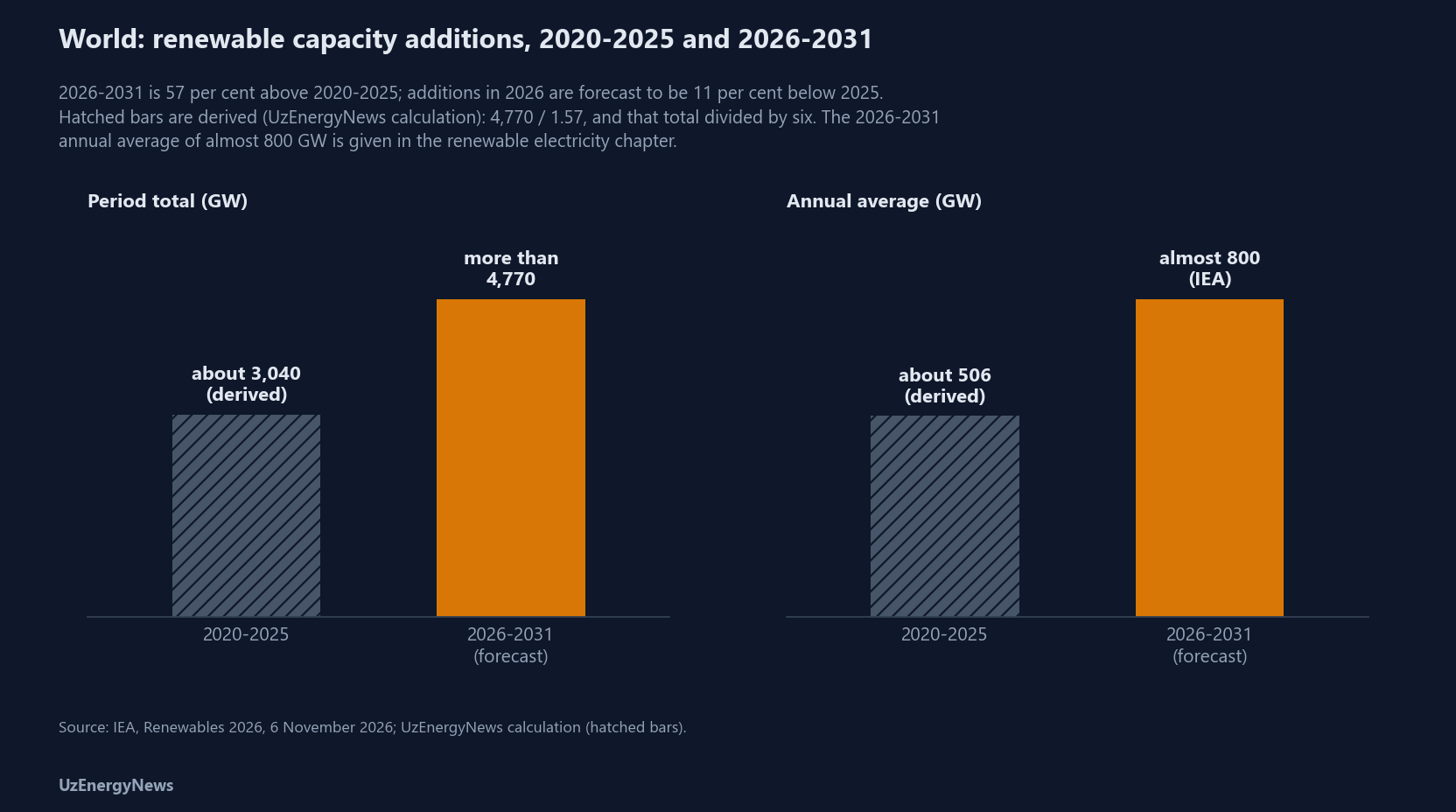
Global capacity additions, 2026-2031
The report forecasts more than 4,770 GW of renewable capacity additions over 2026-2031; the executive summary and the press release give the figure as almost 4,800 GW. The total is 57 per cent above the additions of the previous six years, which the press release gives as almost 60 per cent; dividing 4,770 GW by 1.57 gives about 3,040 GW for 2020-2025, an average of about 506 GW a year (UzEnergyNews calculation). The renewable electricity chapter gives average annual additions of almost 800 GW a year over 2026-2031. According to the executive summary and the press release, additions in emerging and developing economies outside China match those in advanced economies over the forecast period for the first time; over 2020-2025 these economies expanded at half the rate of advanced economies. Renewables account for more than 80 per cent of global power capacity additions over the period. The report forecasts additions in 2026 to be 11 per cent lower than in 2025; according to the report, this ends a run of 21 consecutive years in which annual additions set a new record. Renewable electricity capacity rises by about 85 per cent between 2025 and 2031. The forecast for 2026-2030 is 2 per cent, or 75 GW, higher than in Renewables 2025.
In the main case, global renewable capacity reaches about 9,710 GW in 2030, 2.6 times the 2022 level, and the goal agreed at the 28th Conference of the Parties to the UN Framework Convention on Climate Change (COP28) of tripling renewable capacity from the 2022 level is reached around 2032. In the report's accelerated case, renewable capacity growth over the forecast period is 20 per cent higher than in the main case; capacity in 2030 reaches 2.8 times the 2022 level, or 90 per cent of the tripling goal, and tripling is reached in 2031. For 2025 the International Renewable Energy Agency (IRENA) reported additions of 692 GW and total capacity of 5,149 GW, an increase of 15.5 per cent, with 511 GW of solar additions, according to reports by pv magazine and Joy Online on its Renewable Capacity Statistics 2026. IRENA and the IEA use different methods, and the two series are not directly comparable.
Solar, wind, hydropower and other technologies
Solar accounts for more than three-quarters of the growth. Utility-scale solar adds 2,075 GW and distributed solar 1,530 GW over the forecast period, a combined 3,605 GW or 76 per cent of the 4,770 GW total (UzEnergyNews calculation). The pace of off-grid solar growth over 2026-2031 is 2.5 times that of 2020-2025, with almost 80 GW of off-grid capacity installed through 2031, and the executive summary states that rooftop solar has improved electricity access and services for at least 70 million households since 2022. According to the executive summary, solar generation overtakes hydropower generation in 2029; solar reaches 16 per cent of global electricity generation in 2031. Onshore wind capacity grows by more than 70 per cent to 2,040 GW in 2031. The offshore wind forecast is revised down, in Europe because of failed or repeatedly delayed tenders and in China because of cost increases associated with the move to competitive auctions. For China, the renewable electricity chapter links upward revisions to the hydropower and concentrated solar power (CSP) forecasts with measures to ease system integration, including accelerated pumped-storage approvals and CSP targets announced in December 2025; for India it states that pumped-storage hydropower is gaining momentum because of more efficient administrative processes. The online chapters consulted by UzEnergyNews do not give a GW value for hydropower additions over 2026-2031.
Regional distribution
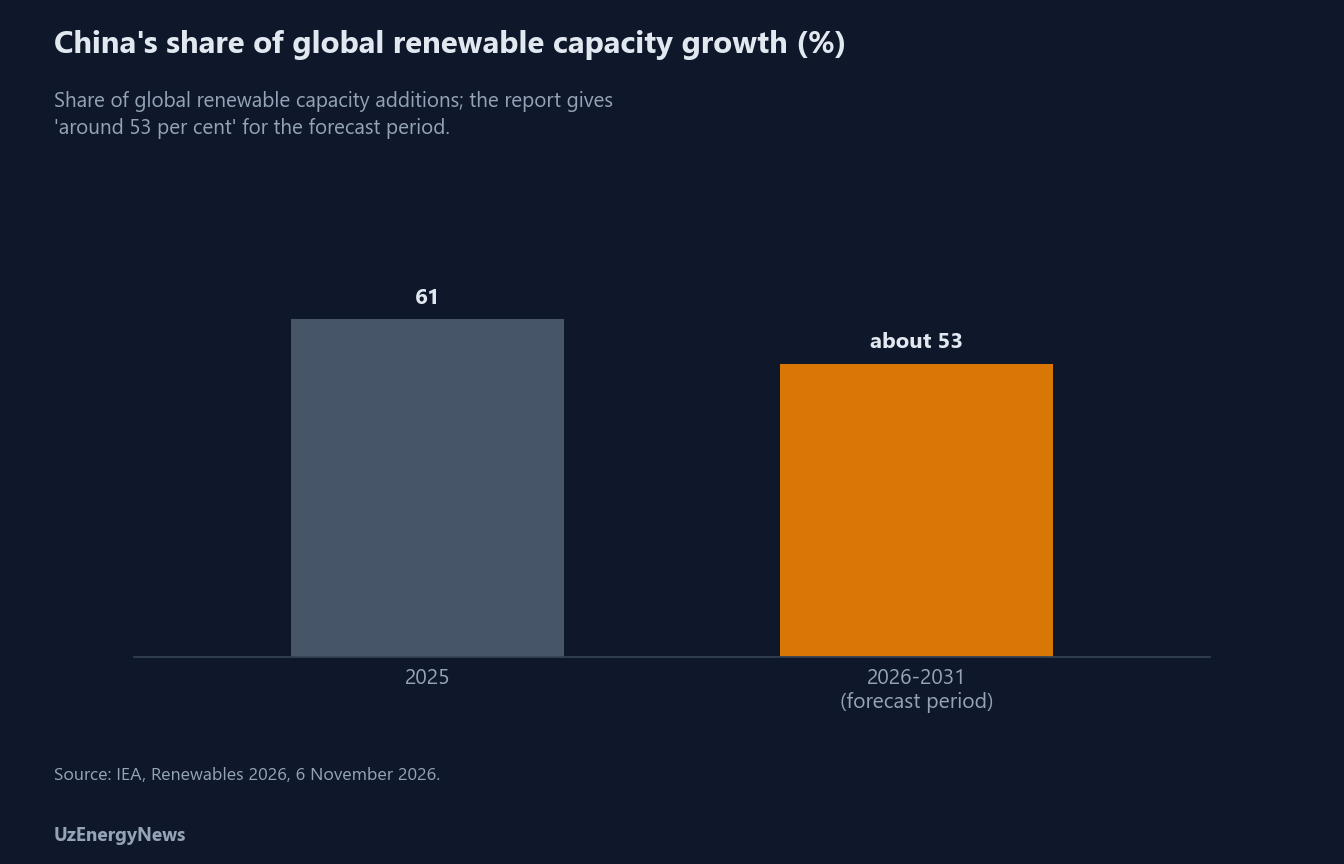
According to the full report, China's share of global renewable capacity growth was 61 per cent in 2025 and falls to around 53 per cent over the forecast period; China adds almost 2,520 GW over 2026-2031, almost 50 per cent more than in 2020-2025. The China forecast is revised down by about 5 per cent, or 116 GW. Solar additions in China fell by about 55 per cent year on year in January-September 2026; the report attributes the fall to the move from fixed tariffs to auctions. China's additions in 2031 are 13 per cent below the 2025 level. China's 15th Five-Year Plan for Renewable Energy Development, released in July 2026, sets an indicative cumulative target of at least 2,800 GW of wind and solar capacity (AC) by 2030, and the report's main case exceeds this target by almost 30 per cent.
In India, growth over the forecast period is 2.6 times that of the previous period; India's contribution to global renewable capacity growth almost doubles to nearly 8.5 per cent, and India becomes the second-largest growth market. India's share of global solar module manufacturing roughly doubles to 17 per cent. The forecast for the United States is revised up by about 40 per cent, and by 45 per cent for solar. Asia-Pacific excluding China adds more than 840 GW, after an upward revision of 15 per cent. The forecast for sub-Saharan Africa is revised up by 54 per cent. Renewable capacity in the Middle East and North Africa (MENA) more than doubles, and Saudi Arabia accelerates its renewable expansion fivefold between 2026 and 2031; according to the report, the Association of Southeast Asian Nations (ASEAN), MENA and sub-Saharan Africa collectively triple their pace of renewable capacity growth. Annual additions outside China increase by 27 per cent between 2025 and 2031.
Eurasia and Central Asia
In the report's Eurasia region, the renewable share of electricity generation rises from 19 per cent to 23 per cent over the forecast period, with hydropower at about 17 per cent. The report's regional forecasts chapter gives a country profile for Uzbekistan: renewable capacity additions of more than 14 GW over 2026-2031, 78 per cent more than in 2020-2025; annual additions of more than 3 GW in 2025, similar to the 2024 level, and an average of about 2.4 GW a year over 2026-2031. Solar accounts for 75 per cent of the additions, onshore wind for 20 per cent and hydropower for 6 per cent. The Uzbekistan forecast is revised up by almost 70 per cent compared with Renewables 2025: solar by 126 per cent and hydropower by 13 per cent, while onshore wind is revised down by 5 per cent. According to the profile, about 1 GW of small-scale solar was installed in 2025 and more than 1.2 GW of energy storage capacity was commissioned in the same year; in the accelerated case, Uzbekistan's additions are about 40 per cent higher than in the main case. The profile cites the targets of 25 GW of renewable capacity and a 54 per cent renewable energy share by 2030, and lists grid and network constraints and delays in land allocation and approvals as the main challenges. The online chapters do not give country profiles for Kazakhstan or Türkiye. According to IRENA statistics reported by The Astana Times on 18 May 2026, Uzbekistan's renewable capacity rose from 6,079 MW to 10,027 MW in 2025, an increase of 65 per cent, including 5,934 MW of solar and 1,652 MW of wind, and renewables accounted for 36.1 per cent of Uzbekistan's installed capacity. The same report gives Kazakhstan's renewable capacity as 6,084 MW, or 22.8 per cent of installed capacity.
Generation share, curtailment and grid connection
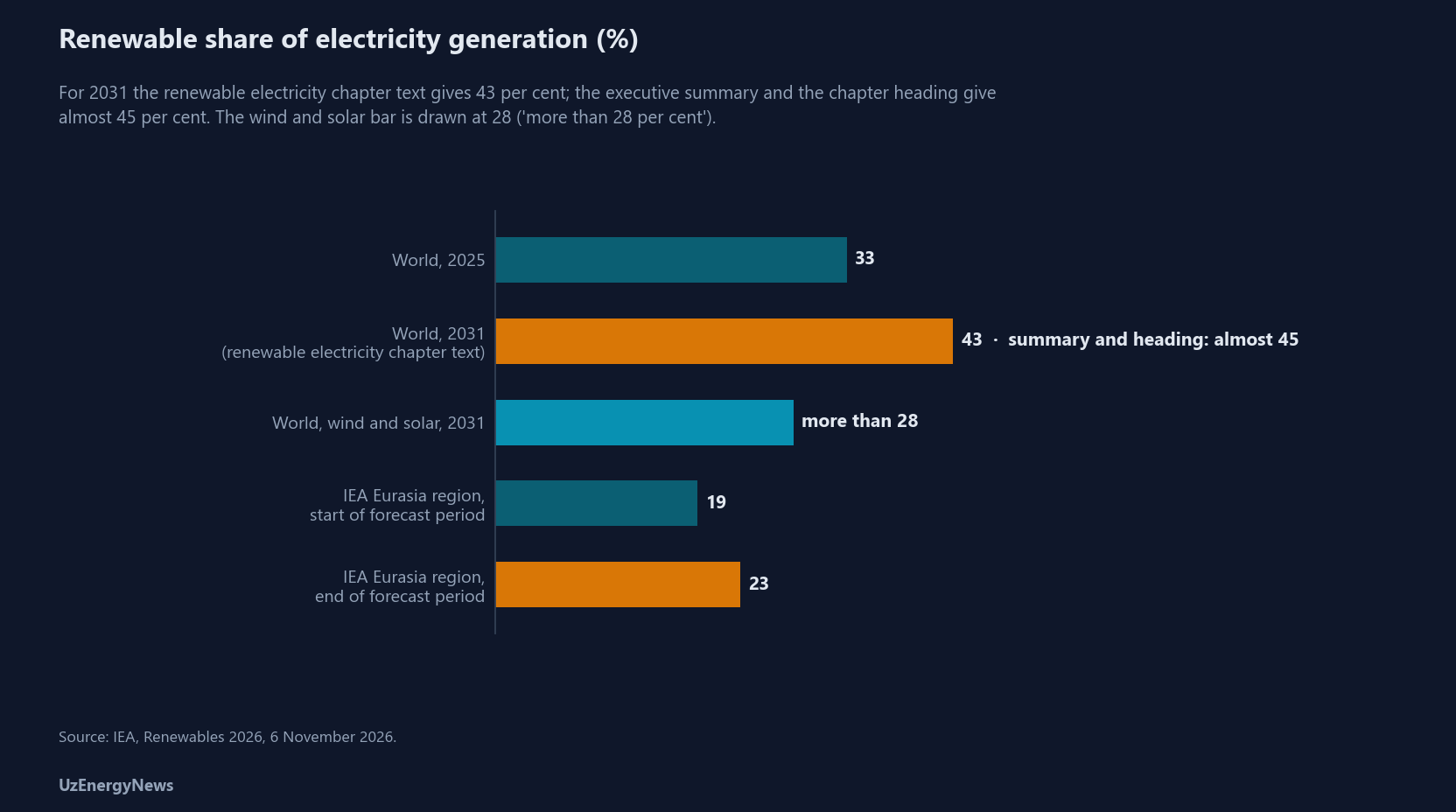
The report gives two values for the renewable share of global electricity generation in 2031. The executive summary and the heading of the renewable electricity chapter give almost 45 per cent; the text of the chapter gives an increase from 33 per cent in 2025 to 43 per cent by 2031 in the main case. Wind and solar together exceed 28 per cent of generation in 2031, and in 17 countries the share of variable renewables exceeds 50 per cent.
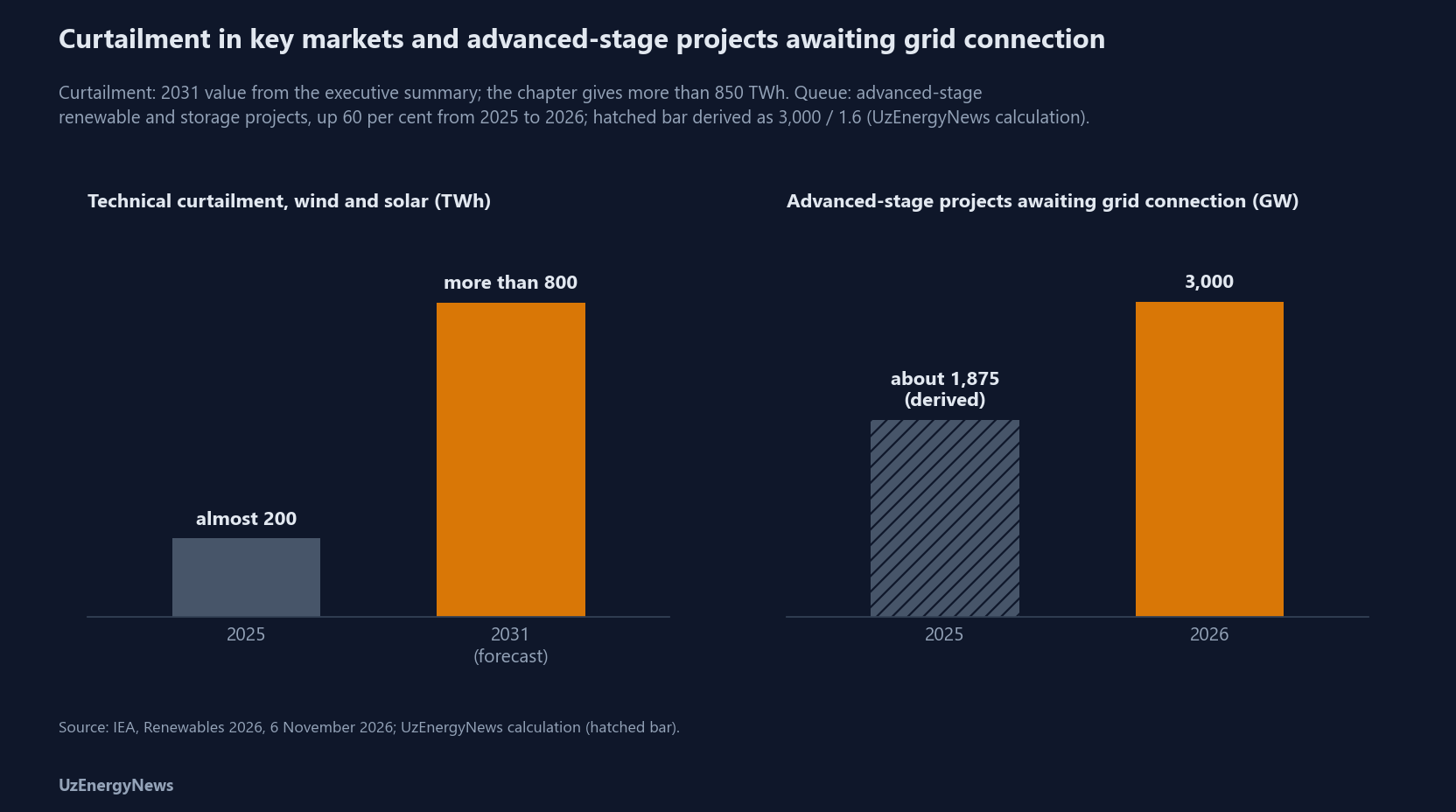
Technical curtailment of wind and solar output in key markets almost doubled in both 2024 and 2025 and reached almost 200 TWh in 2025. The executive summary gives more than 800 TWh for 2031, almost 8 per cent of variable renewable generation; the renewable electricity chapter of the full report gives more than 850 TWh, almost five times the 2025 level. Advanced-stage renewable energy and storage projects awaiting grid connection increased by 60 per cent between 2025 and 2026 to 3,000 GW, against about 1,875 GW in 2025 (UzEnergyNews calculation); according to the executive summary, battery storage and hybrid project applications account for the entire increase. The press release states that the 3,000 GW is four times the wind and solar capacity connected in 2025. According to the report, connection queue reforms in India, the United Kingdom and the United States removed almost half of early-stage standalone wind and solar projects from the queues. According to the executive summary, behind-the-meter battery capacity increases almost sixfold to more than 670 GWh by 2031, when more than one-third of home solar systems include a battery, and the generation cost of hybrid projects is below 75 US dollars per MWh in many regions.
Biofuels, transport, heat and biogas
The liquid biofuel growth forecast is revised up by 40 per cent compared with Renewables 2025. Biofuel demand rises from 198 billion litres (5 EJ) to 251 billion litres (6.6 EJ), an increase of 27 per cent in volume and 32 per cent in energy content (UzEnergyNews calculation); in the accelerated case demand reaches 333 billion litres. Renewable energy use in transport rises from 5.5 EJ to about 9 EJ and meets 6 per cent of transport energy demand; electric vehicles account for 45 per cent of the increase and road biofuels for 35 per cent. Brazil accounts for 40 per cent and India for 25 per cent of ethanol growth, the United States for 65 per cent of renewable diesel growth and Indonesia for 70 per cent of biodiesel growth. Biofuel feedstock demand rises from 650 million tonnes to more than 850 million tonnes. In heat, the renewable share rises from 15 per cent to 19 per cent. Biogas production increases by almost one-fifth by 2031, driven entirely by biomethane; the biomethane share of biogas production rises from 22 per cent to 35 per cent, and biomethane production in India increases about ninefold.
Solar manufacturing and energy security
According to the executive summary, more than 90 per cent of major Chinese solar manufacturers reported losses in 2026, and more than 70 companies have filed for bankruptcy since 2024. India is expected to be the only country outside China able to manufacture all solar components at scale by 2031. The report describes the wind supply chain as geographically more diversified than the solar supply chain. The online chapters do not give module prices or manufacturing capacity utilisation rates. The report estimates that without renewable growth since 2010, fossil fuel demand in 2025 would have been about 8 per cent, or 41 EJ, higher, including about 615 million tonnes of coal equivalent, or 43 per cent of the avoided fossil fuel demand, about 515 billion cubic metres of additional natural gas and 2.4 million barrels a day of additional oil. Cumulative fossil fuel savings over 2010-2025 total 275 EJ.
Key figures and source notes
Renewables 2026 forecasts more than 4,770 GW of renewable capacity additions over 2026-2031, 57 per cent above 2020-2025, with China's share of growth at about 53 per cent and additions in Uzbekistan of more than 14 GW. For 2031 the report gives a renewable share of generation of almost 45 per cent in the executive summary and the chapter heading and 43 per cent in the chapter text, and technical curtailment of more than 800 TWh in the executive summary and more than 850 TWh in the renewable electricity chapter. Advanced-stage renewable and storage projects awaiting grid connection total 3,000 GW, and the liquid biofuel growth forecast is revised up by 40 per cent. The online chapters consulted by UzEnergyNews do not give GW values for hydropower or pumped-storage additions over 2026-2031. IRENA and IEA capacity statistics use different methods. The UzEnergyNews calculations in this article are derived from report values and are not IEA figures.