Global Carbon Budget 2026, Published on 10 November 2026, Projects Fossil CO2 Emissions of 38.2 Billion Tonnes in 2026, 0.4 Per Cent Lower Than in 2025; Total CO2 Emissions Including Land-Use Change Are Projected at 43.3 Billion Tonnes
Oil Emissions Are Projected to Fall by 1.9 Per Cent and Gas Emissions by 0.3 Per Cent, and Coal Emissions to Rise by 0.6 Per Cent; Emissions Are Projected to Fall by 0.9 Per Cent in China and to Rise by 4.4 Per Cent in India; Atmospheric CO2 Is Projected at 427.7 ppm, and the Remaining Carbon Budget for 1.5°C Is Given as 150 Billion Tonnes of CO2
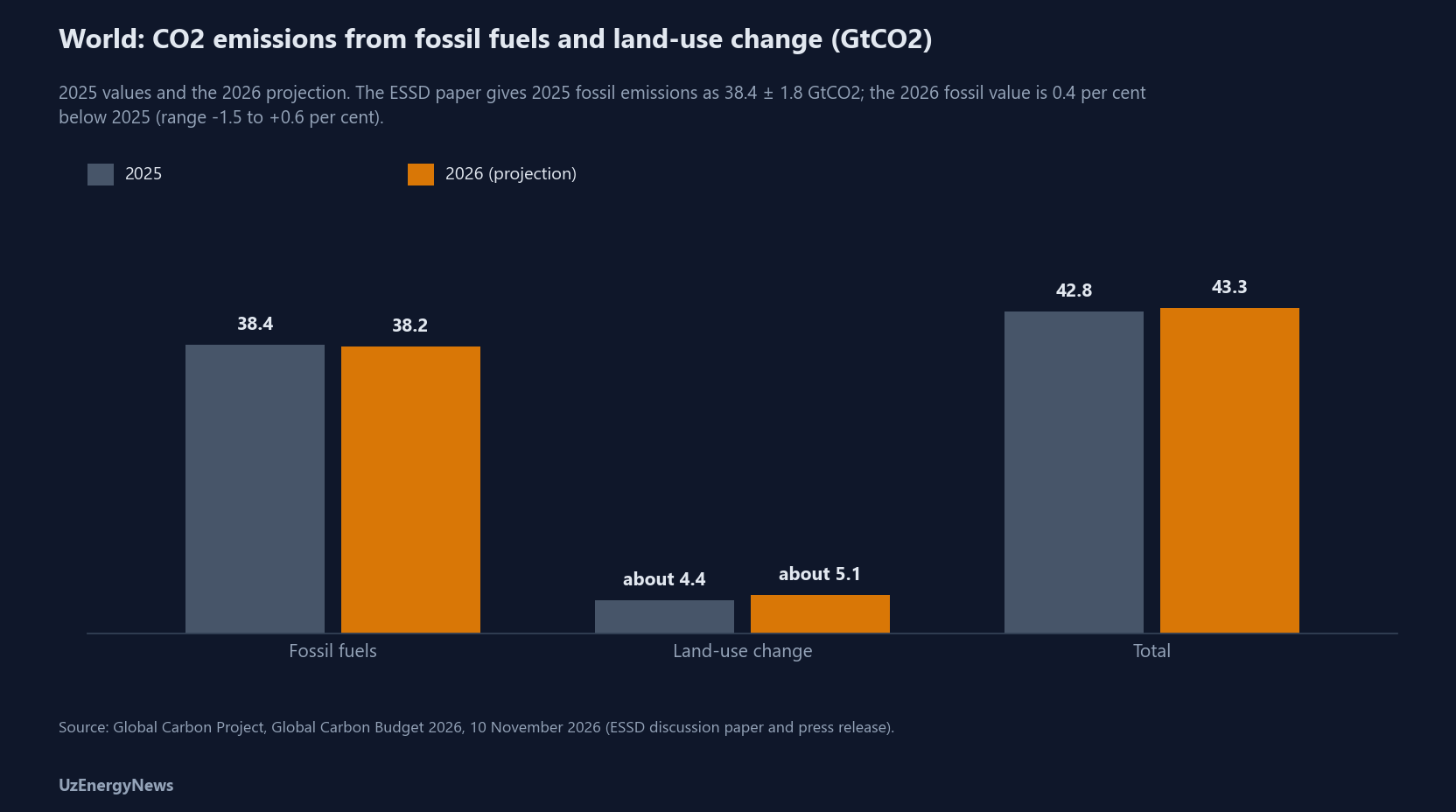
The Global Carbon Project published Global Carbon Budget 2026, the 21st annual edition of its assessment of the global carbon cycle, on 10 November 2026. The assessment, prepared by more than 140 scientists from more than 90 institutions, projects global fossil CO2 emissions of 38.2 billion tonnes of CO2 (GtCO2) in 2026, 0.4 per cent lower than in 2025, with a projection range of minus 1.5 per cent to plus 0.6 per cent. Oil emissions are projected to fall by 1.9 per cent and gas emissions by 0.3 per cent, and coal emissions to rise by 0.6 per cent. Emissions are projected to fall by 0.9 per cent in China, 1.3 per cent in the United States, 1.5 per cent in the European Union and 1.0 per cent in Japan, and to rise by 4.4 per cent in India. Emissions from land-use change are projected at about 5.1 GtCO2 in 2026, against about 4.4 GtCO2 in 2025, and total CO2 emissions from fossil fuels and land-use change at 43.3 GtCO2, against 42.8 GtCO2 in 2025. Atmospheric CO2 concentration is projected to rise by 2.2 parts per million (ppm) to 427.7 ppm in 2026, 54 per cent above the level of about 278 ppm in 1750. The remaining carbon budget for limiting warming to 1.5°C is given as 150 GtCO2, which the press release equates to less than four years of emissions at the current rate.
The Global Carbon Project published Global Carbon Budget 2026, the 21st annual edition of its assessment of the global carbon cycle, on 10 November 2026. The assessment is presented in a discussion paper in the journal Earth System Science Data (ESSD), 'Global Carbon Budget 2026' (DOI 10.5194/essd-2026-895), with 144 authors; according to the press release, more than 140 scientists from more than 90 institutions contributed. The paper was received on 30 October 2026, its public discussion opened on 10 November 2026 and remains open until 17 December 2026, and the values in the paper are subject to peer review. The underlying data are published by the Integrated Carbon Observation System (ICOS) under DOI 10.18160/GCP-2026. The work is coordinated by the Global Carbon Budget Office at the University of Exeter. A companion paper led by the University of East Anglia (UEA) was published in Nature Climate Change under the title 'A further acceleration of clean energy is needed for global CO2 emissions to peak and decline'. The figures in this article are taken from the press release, the ESSD discussion paper, the Global Carbon Budget 2026 frequently asked questions (FAQ) page and the news page of the University of Exeter unless another source is named.
Global fossil and total CO2 emissions, 2025-2026
Global fossil CO2 emissions are projected at 38.2 GtCO2 in 2026, 0.4 per cent lower than in 2025. The ESSD paper gives the projection range as minus 1.5 per cent to plus 0.6 per cent. The paper gives fossil CO2 emissions of 10.5 ± 0.5 GtC a year (38.4 ± 1.8 GtCO2) in 2025, 1.2 per cent higher than in 2024, where GtC is billion tonnes of carbon; the value includes the cement carbonation sink of 0.2 GtC a year. The final ESSD article of the 2025 edition (volume 18, page 3211, 2026) had projected 2025 fossil emissions at 38.1 GtCO2, an increase of 1.0 per cent (range 0.2 to 1.7 per cent); the 2026 edition revises the 2025 value to 38.4 GtCO2, and this article uses the 2026 edition values. Total CO2 emissions from fossil fuels and land-use change are given as 42.8 GtCO2 in 2025 and 43.3 GtCO2 in 2026. On these values, fossil emissions account for 88.2 per cent of total CO2 emissions in 2026 (UzEnergyNews calculation). According to the press release, total CO2 emissions grew by 0.3 per cent a year over 2016-2025, against 1.7 per cent a year over the previous decade. The University of Exeter news page quotes the director of the Global Carbon Budget Office at the University of Exeter as saying that “a reduction driven partly by geopolitical shocks is not a sustainable climate solution”, and a research professor at the CICERO Center for International Climate Research as saying that “A drop in emissions in one year is not a peak unless it is driven by structural change.”
Emissions by fuel
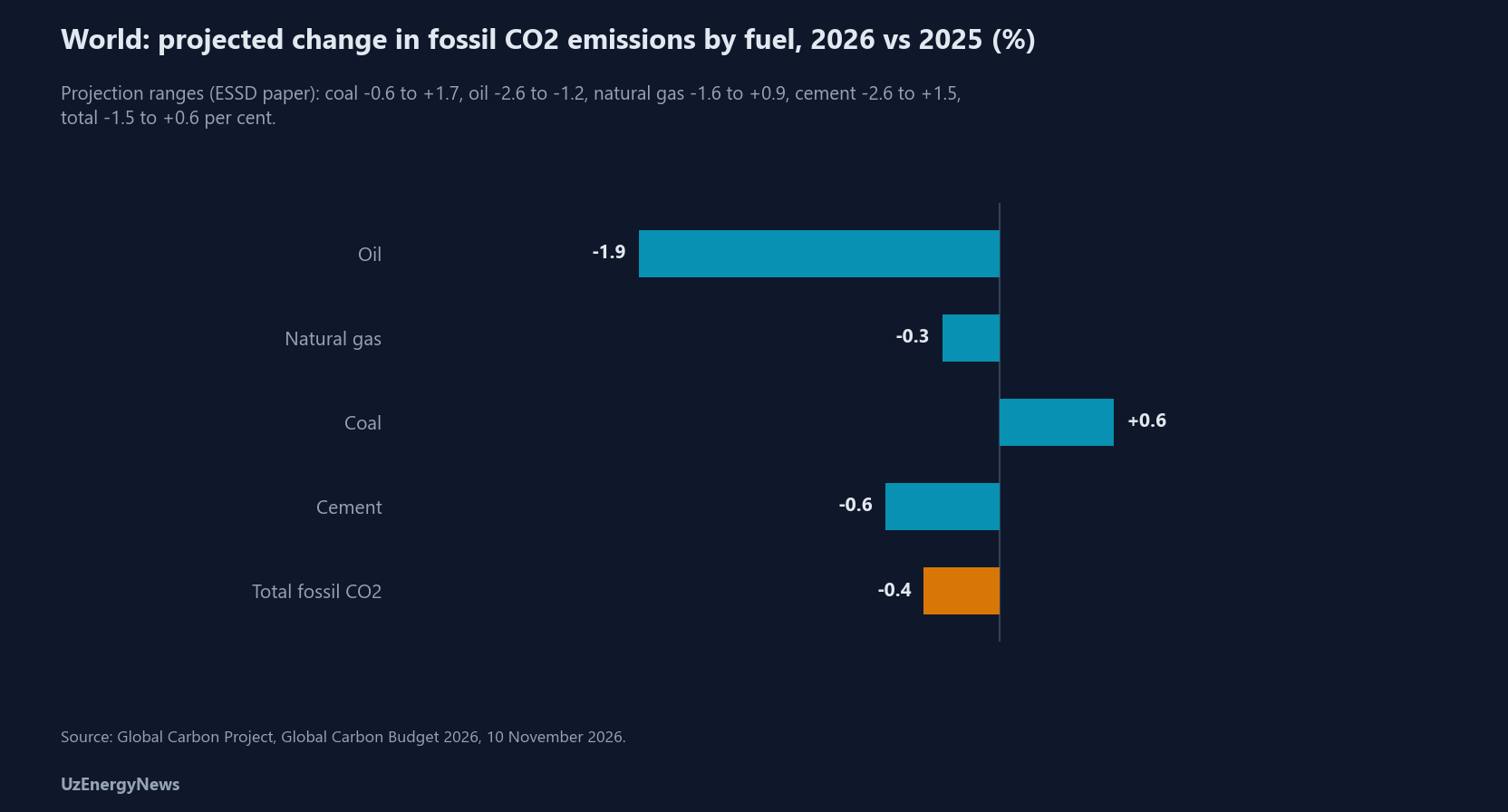
Oil emissions are projected to fall by 1.9 per cent in 2026 and gas emissions by 0.3 per cent, and coal emissions to rise by 0.6 per cent; the ESSD paper projects cement emissions to fall by 0.6 per cent. The press release describes the fall in global oil emissions as likely a short-term response to the energy shock triggered by the conflict involving Iran. The ESSD paper gives projection ranges of minus 0.6 to plus 1.7 per cent for coal, minus 2.6 to minus 1.2 per cent for oil, minus 1.6 to plus 0.9 per cent for gas and minus 2.6 to plus 1.5 per cent for cement.
Emissions by country and region
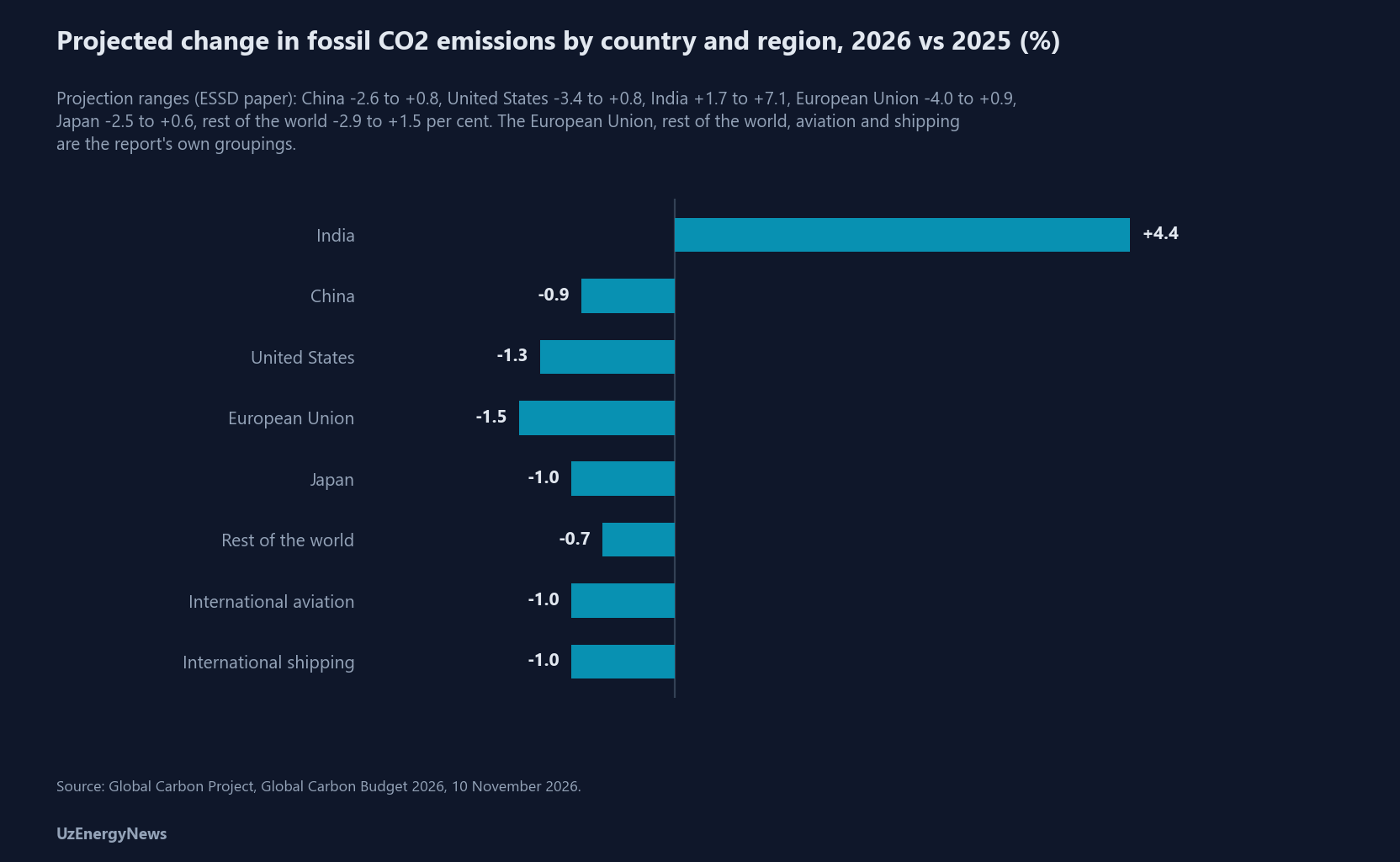
Emissions in China are projected to fall by 0.9 per cent in 2026, with coal emissions rising by 0.3 per cent; China accounts for 32 per cent of global fossil emissions and, according to the press release, for half of the emissions avoided globally by renewables and electric vehicles. Emissions in the United States are projected to fall by 1.3 per cent, mostly from coal, after coal emissions rose sharply in 2025, which the press release links to high natural gas prices and cold weather. Emissions are projected to fall by 1.5 per cent in the European Union and by 1.0 per cent in Japan. Emissions in India are projected to rise by 4.4 per cent, against an average of 3.5 per cent a year over the past decade. Emissions in the rest of the world are projected to fall by 0.7 per cent; according to the press release, the largest component of the decline is in oil, likely driven by increased prices and global supply constraints. Emissions from international aviation are projected to fall by 1.0 per cent, partly because of reduced activity in the Middle East, and emissions from international shipping by 1.0 per cent. The ESSD paper gives 2026 emissions of about 5.0 GtCO2 for the United States, 3.3 GtCO2 for India, 2.4 GtCO2 for the European Union, 1.0 GtCO2 for Japan, 13.6 GtCO2 for the rest of the world and 1.2 GtCO2 for international aviation and shipping combined; for China it gives about 12.3 GtCO2 in its sentence on the 2026 projection, with the value labelled 2025. The ESSD paper gives projection ranges of minus 2.6 to plus 0.8 per cent for China, minus 3.4 to plus 0.8 per cent for the United States, plus 1.7 to plus 7.1 per cent for India, minus 4.0 to plus 0.9 per cent for the European Union, minus 2.5 to plus 0.6 per cent for Japan and minus 2.9 to plus 1.5 per cent for the rest of the world. In the Global Carbon Project's national fossil CO2 emissions dataset (version 2026, territorial emissions), 2025 emissions are 34.55 million tonnes of carbon (MtC) for Uzbekistan, 84.61 MtC for Kazakhstan, 132.62 MtC for Türkiye and 482.17 MtC for Russia; multiplied by the dataset's factor of 3.664, these equal about 126.6, 310.0, 485.9 and 1,766.7 MtCO2 (UzEnergyNews conversion), against about 122.1, 290.8, 467.8 and 1,788.5 MtCO2 in 2024.
Land-use change emissions and carbon sinks
The ESSD paper gives emissions from land-use change of 1.2 ± 0.7 GtC in 2025, about 4.4 GtCO2. The press release gives about 5.1 GtCO2 for 2026 and attributes the increase to peat fires and forest degradation in Southeast Asia associated with dry conditions linked to the onset of El Niño. According to the press release, permanent deforestation averaged about 3.8 GtCO2 a year over 2016-2025, and reforestation and afforestation offset about half of this amount; removals by reforestation and afforestation in China, the EU-27 and the United States total 0.8 GtCO2 a year. For 2025, the ESSD paper gives an ocean sink of 3.2 ± 0.7 GtC, a land sink of 3.6 ± 0.9 GtC and a budget imbalance of 0.5 GtC. According to the press release and the FAQ page, the land sink returned to its previous level after weakening during the 2023-2024 El Niño, and the FAQ page states that the effect of the 2026 El Niño is expected in the year following 2026.
Atmospheric CO2 concentration
The ESSD paper gives an average atmospheric CO2 concentration of 425.6 ± 0.1 ppm in 2025. The concentration is projected to rise by 2.2 ppm to 427.7 ppm in 2026, 54 per cent above the level of about 278 ppm in 1750. The atmospheric CO2 growth rate in 2025 is given as 4.4 GtC a year, or 2.06 ppm a year, 3.6 GtC below the record growth rate of 2024.
Remaining carbon budget
The ESSD paper gives the remaining carbon budget from the beginning of 2027, at a 50 per cent likelihood, as 40 GtC (150 GtCO2) for limiting warming to 1.5°C, 140 GtC (510 GtCO2) for 1.7°C and 280 GtC (1,035 GtCO2) for 2°C, corresponding to about 3, 12 and 24 years at the 2026 level of total anthropogenic CO2 emissions. The ESSD paper, the press release and the FAQ page equate the 150 GtCO2 to less than four years of emissions at the 2026 rate. The final ESSD article of the 2025 edition (volume 18, page 3211, 2026) gave remaining budgets from the start of 2026 at a 50 per cent likelihood of 170 GtCO2 for 1.5°C, 525 GtCO2 for 1.7°C and 1,055 GtCO2 for 2°C; the 2026 edition values are 20, 15 and 20 GtCO2 lower, with start dates one year apart (UzEnergyNews calculation).
Decade trends, clean energy and carbon removal
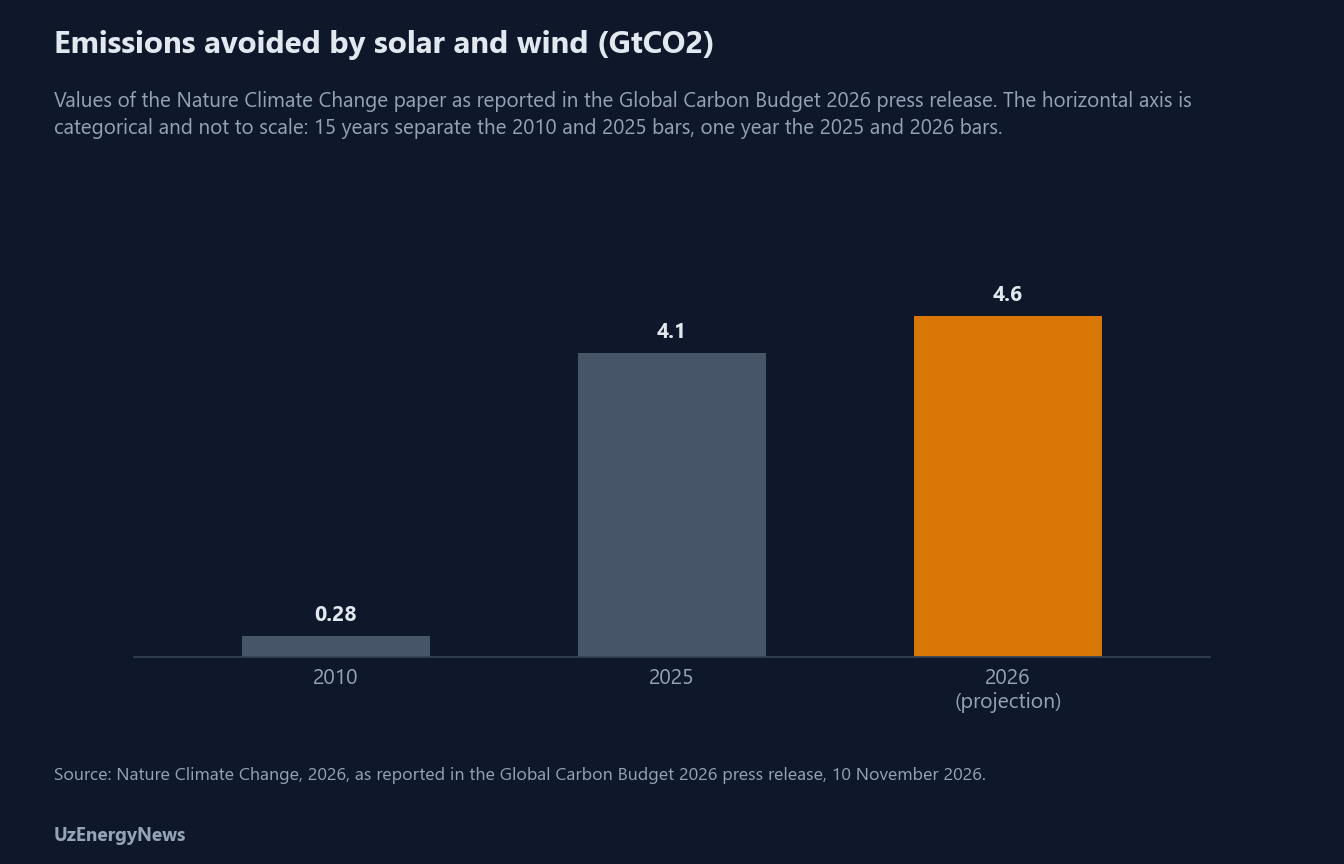
According to the FAQ page, 40 economies significantly reduced fossil CO2 emissions while their economies grew over 2016-2025, against 22 over 2006-2015; these 40 economies account for 26 per cent of current global fossil CO2 emissions. According to the press release, the Nature Climate Change paper finds that 59 countries emitted less in 2025 than in 2019 while their economies grew; the FAQ page notes that not all of these trends are statistically significant. According to the press release, the Nature Climate Change paper finds that emissions avoided by solar and wind rose from 0.28 GtCO2 in 2010 to 4.1 GtCO2 in 2025 and are projected at 4.6 GtCO2 in 2026; according to the FAQ page, solar and wind account for about 95 per cent of the emissions avoided by solar, wind and electric vehicles in 2025, in roughly equal proportion. The press release states that about two-thirds of the growth in energy demand is currently being met by solar, wind and electric vehicles. According to the FAQ page, electric vehicles other than cars, mainly buses and trucks in China, account for about 30 per cent of the emissions avoided by electric vehicles. According to the University of Exeter news page, the Nature Climate Change paper estimates that 64 to 79 per cent of the emissions from new energy demand will be offset by new solar and wind power and electric vehicles up to the end of 2028. The University of Exeter news page quotes a Royal Society research professor at UEA as saying that “Clean technologies are making a real difference in reducing global emissions.” According to the press release and the FAQ page, novel carbon dioxide removal methods offset less than 30 minutes of annual fossil emissions; the University of Exeter news page quotes a professor at Ludwig Maximilian University of Munich (LMU) as saying that “Alongside reducing emissions, we need to scale up CO2 removal to reach greenhouse gas neutrality.”
Key figures and source notes
Global Carbon Budget 2026 projects fossil CO2 emissions of 38.2 GtCO2 in 2026, 0.4 per cent lower than in 2025, with a range of minus 1.5 per cent to plus 0.6 per cent; oil emissions are projected to fall by 1.9 per cent and gas emissions by 0.3 per cent, and coal emissions to rise by 0.6 per cent and cement emissions to fall by 0.6 per cent. Land-use change emissions are projected at about 5.1 GtCO2 and total CO2 emissions at 43.3 GtCO2. Atmospheric CO2 is projected at 427.7 ppm, and the remaining carbon budgets from the beginning of 2027 at a 50 per cent likelihood are given as 150 GtCO2 for 1.5°C, 510 GtCO2 for 1.7°C and 1,035 GtCO2 for 2°C. The national dataset gives 2025 emissions of about 126.6 MtCO2 for Uzbekistan, 310.0 MtCO2 for Kazakhstan, 485.9 MtCO2 for Türkiye and 1,766.7 MtCO2 for Russia (UzEnergyNews conversion from MtC). The ESSD paper is a discussion paper under open review until 17 December 2026. The UzEnergyNews calculations in this article (the fossil share of total emissions, the differences between editions and the MtC to MtCO2 conversions) are derived from Global Carbon Budget values and are not Global Carbon Project figures.