United States Minimum Import Prices for Solar Modules from 4 December 2026: global module prices, supply concentration, trade measures and installed costs
Presidential Proclamation 11052, signed on 6 August 2026, sets minimum import prices of 0.38 dollars per watt for solar modules and 0.22 dollars per watt for solar cells, together with an additional ad valorem duty of 15 per cent, for goods entered into the United States from 4 December 2026. In the week of 15 to 21 October 2026, InfoLink recorded an average free-on-board (FOB) price of 0.115 dollars per watt for China-made TOPCon modules sold to European projects and 0.27 dollars per watt for Southeast Asia-made modules sold to United States projects. China accounted for 79 per cent of global module production in 2025, according to the Photovoltaic Power Systems Programme of the International Energy Agency (IEA PVPS). In the second quarter of 2026, the module accounted for about 31 per cent of the installed price of a United States utility-scale system with single-axis tracking (calculated).
This edition sets out the terms of the United States measure, price assessments for modules, cells and polysilicon to 21 October 2026, the distribution of production and capacity by segment, the other trade measures applied to United States solar imports in 2026, and the share of the module in United States installed system prices. Terms of the measure are taken from the text of the proclamation as published in the Federal Register and by the American Presidency Project, and from law-firm summaries; prices are taken from price reporting agencies and market data providers. Where a figure is available only through secondary reporting, or where sources differ, the text states this. Figures marked "calculated" are derived by UzEnergyNews from the cited figures.
Terms of Proclamation 11052
On 6 August 2026, the President of the United States signed Proclamation 11052, "Adjusting Imports of Polysilicon and Its Derivatives Into the United States", under Section 232 of the Trade Expansion Act of 1962. The proclamation was published in the Federal Register on 11 August 2026 as document 2026-16400 and applies to goods entered from 12:01 a.m. Eastern Time on 4 December 2026. It sets minimum import prices at four stages of the crystalline silicon supply chain and imposes an additional ad valorem duty of 15 per cent. For imports from the United Kingdom (UK), the additional duty is 10 per cent (clause 5(c) of the proclamation). For imports from the European Union (EU), Japan, South Korea, Taiwan, Switzerland and Liechtenstein, the combined rate of the ordinary customs duty and the Section 232 duty is set equal to 15 per cent (clause 5(b)).
Table 1. Minimum import prices under clause 1(a) of Proclamation 11052, applicable from 4 December 2026
| Product | Minimum import price | Additional ad valorem duty |
|---|---|---|
| Polysilicon | 21 dollars per kilogram | None (minimum import price only; clause 4 of the proclamation and Annexes I and II, as read by InfoLink and Anza) |
| Ingots and wafers | 100 dollars per kilogram | 15% (UK 10%; combined rate set equal to 15% for EU, Japan, South Korea, Taiwan, Switzerland, Liechtenstein) |
| Cells | 0.22 dollars per watt | as above |
| Modules | 0.38 dollars per watt | as above |
Source: Proclamation 11052, Federal Register document 2026-16400, and text as published by the American Presidency Project (University of California, Santa Barbara); Hunton Andrews Kurth summary.
Clause 1(a) of the proclamation sets the minimum import prices; clause 2 applies them from 4 December 2026. Clause 4 applies the additional duty of 15 per cent to polysilicon ingots and polysilicon derivatives specified in Annexes I and II of the proclamation, and paragraph 8 of the preamble reports the Secretary's recommendation of a duty on "downstream polysilicon derivatives". Clause 4 does not list raw polysilicon; InfoLink and Anza report that raw polysilicon is subject to the minimum import price only.
From 4 December 2026, the minimum price will be administered through importer certification (clause 2 of the proclamation). The importer will certify either that the first arm's-length sale in the United States is at or above the minimum price, or that the goods are supplied under fixed terms of a contract entered into before 6 August 2026. Where no certification is made, a specific duty equal to the full minimum price will apply. Where a certification is made and the entered value is below the minimum price, a specific duty equal to the difference will apply. Clause 1(b) authorises the Secretary of Commerce to adjust the minimum prices "from time to time". Clause 6 authorises the Secretary of Commerce to establish a programme to incentivise investment in United States production of polysilicon, ingots, wafers and cells; onshoring plans submitted under the programme must include a commitment that construction will start by 20 January 2029 (clause 6(a)).
The measure follows the expiry, on 7 February 2026, of the safeguard duties imposed under Section 201 of the Trade Act of 1974 (Hunton Andrews Kurth). The Department of Commerce initiated the Section 232 investigation on 1 July 2025 (Federal Register document 2025-13345, 16 July 2025). Products covered by the proclamation are excluded from the duties of 10 to 12.5 per cent applied to 60 economies under the Section 301 forced-labour action in force from 24 July 2026.
For the period between signature and 4 December 2026, the Department of Commerce applies a temporary rule against stockpiling, in force from 22 September to 3 December 2026 (Federal Register document 2026-19537, published 24 September 2026; the rule gives 22 September 2026, the day it was filed for public inspection, as its effective date). New importers of record registered with US Customs and Border Protection on or after 6 August 2026 are limited, absent approval from the Department of Commerce, to weekly volumes of 55 modules, 2,000 cells, 12 kilograms of polysilicon and 7 kilograms of doped silicon wafers; each limit applies to its own tariff subheading (Federal Register document 2026-19537, Table 1; Morgan Lewis, 5 October 2026).
The proclamation states that the United States share of global polysilicon capacity fell from 50 per cent in 2005 to under 2 per cent in 2024, that the United States is "virtually entirely dependent" on imported ingots, wafers and cells, and that global polysilicon inventory reached "400,000 tons" at the end of 2024.
Module, cell and polysilicon prices to 21 October 2026
InfoLink's price survey for the week of 15 to 21 October 2026 records an average FOB price of 0.115 dollars per watt, within a range of 0.098 to 0.133 dollars per watt, for China-made modules using tunnel oxide passivated contact (TOPCon) cells sold to European projects. Table 2 sets this and other assessments from the same week against the minimum prices in Proclamation 11052; prices for the Chinese domestic market are in renminbi (RMB).
Table 2. Price assessments for the week of 15 to 21 October 2026 and the minimum import prices
| Product and market | Delivery basis | Price (average) | Minimum import price | Minimum import price as a multiple of the assessment (times, calculated) |
|---|---|---|---|---|
| TOPCon module, China-made, European projects | FOB | 0.115 $/W (range 0.098–0.133) | 0.38 $/W | 3.30× |
| TOPCon module, India-assembled | FOB | 0.135 $/W | 0.38 $/W | 2.81× |
| TOPCon module, Southeast Asia-made, United States projects | FOB | 0.27 $/W | 0.38 $/W | 1.41× |
| TOPCon module, United States-assembled | Delivered duty paid (DDP) | 0.31 $/W | not applicable (module not imported; from 4 December 2026 the cell minimum price of 0.22 $/W will apply to imported cells) | not calculated |
| TOPCon module, China domestic market | Domestic | RMB 0.719/W | not applicable | not calculated |
| TOPCon cell, China export | FOB | 0.046 $/W | 0.22 $/W | 4.78× |
| Mono-grade polysilicon, non-China origin (USD) | not stated by the source | 18.5 $/kg (range 11.0–26.7) | 21 $/kg | not calculated |
| Polysilicon, China | Domestic | RMB 40/kg | 21 $/kg | not calculated |
Source: InfoLink spot price survey, week of 15 to 21 October 2026; Proclamation 11052. Ratios calculated by UzEnergyNews. From 4 December 2026 the minimum import price will apply to the first arm's-length sale in the United States, while FOB prices exclude freight, insurance and duties; the comparison is therefore not on a common delivery basis. Renminbi prices are not converted. InfoLink's dollar polysilicon price refers to polysilicon of non-China origin; the source does not state its delivery basis, and no ratio is calculated for it.
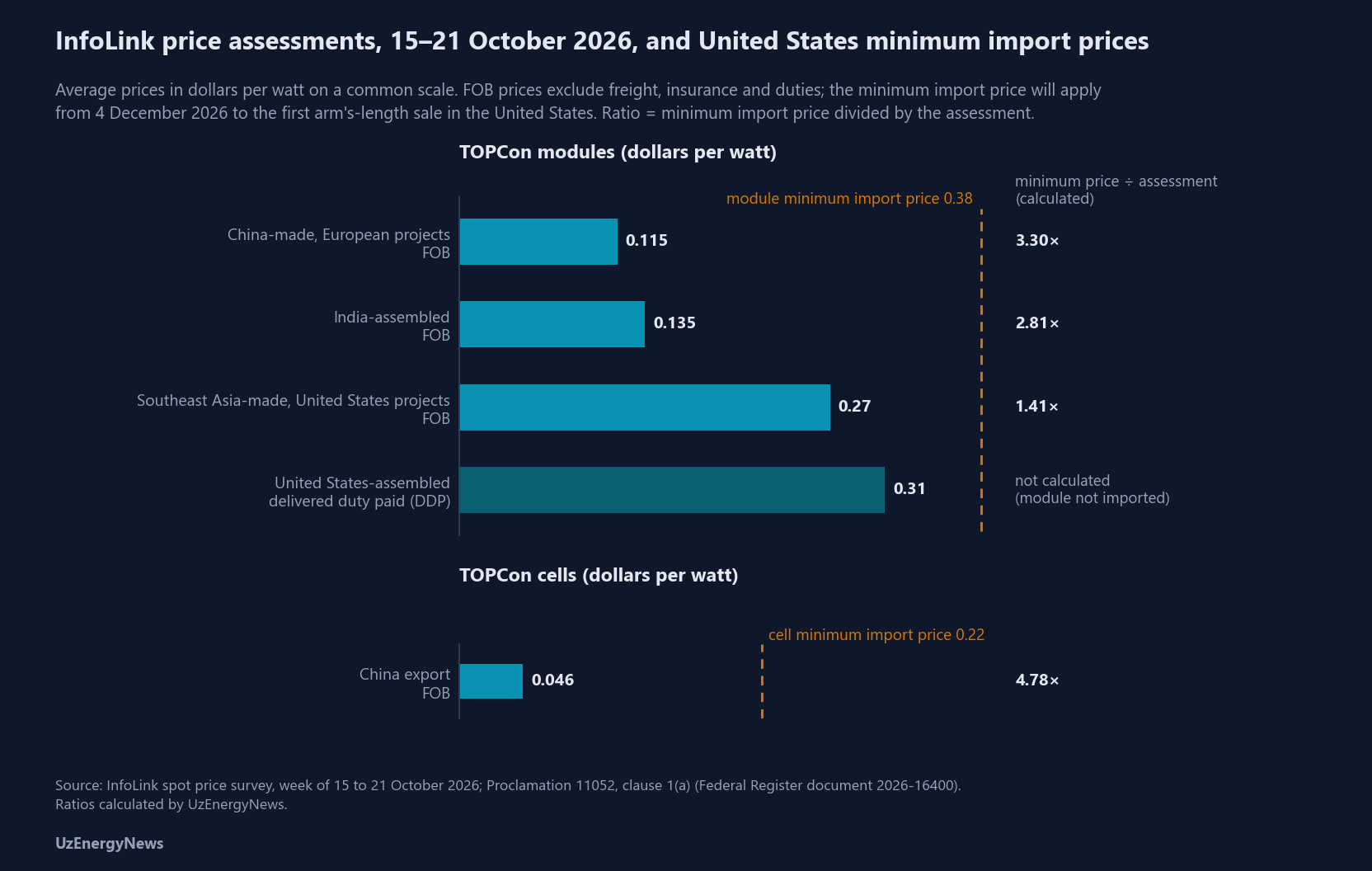
The Chinese Module Marker of the Oil Price Information Service (OPIS) for TOPCon modules below 645 watts, FOB China, was assessed at 0.109 dollars per watt on 28 July 2026, within a spot range of 0.104 to 0.119 dollars per watt (pv magazine, 31 July 2026).
China ended its 9 per cent export value-added tax rebate on photovoltaic products from 1 April 2026. The decision was announced on 9 January 2026; the rebate had been reduced from 13 to 9 per cent at the end of 2024. According to InfoLink, FOB prices for TOPCon modules moved from about 0.10 to about 0.115 dollars per watt after the change.
Anza, a provider of United States module pricing data, reported median prices on 5 August 2026 of 27.1 cents per watt for imported modules, 30 cents per watt for modules assembled in the United States with imported cells, and 47 cents per watt for modules assembled with United States cells. Its expected minimum prices after the measure takes effect are 38 cents (+40 per cent), 43 cents and 56 to 62 cents per watt respectively. InfoLink expects prices of United States-assembled modules to rise above 0.40 dollars per watt.
For the second quarter of 2026, Wood Mackenzie and the Solar Energy Industries Association (SEIA) put United States module prices at 0.37 dollars per watt for distributed projects, 16 per cent lower than a year earlier, and at 0.33 dollars per watt for utility-scale projects, 2 per cent lower than a year earlier; these figures are cited from the summary published by mgrid on 25 September 2026.
Polysilicon prices were about 39 dollars per kilogram in 2022 and below 4.50 dollars per kilogram at the end of 2024 (Anza, secondary source). IEA PVPS gives a polysilicon spot price of 4.83 dollars per kilogram at the beginning of January 2025 and 6.5 dollars per kilogram at the end of December 2025 (Trends in Photovoltaic Applications 2026, p. 46); the Anza and IEA PVPS figures are taken from different sources and differ. The quarterly solar industry update of the National Laboratory of the Rockies (NLR, formerly the National Renewable Energy Laboratory) puts the global module price at about 0.09 dollars per watt in the third quarter of 2025, against about 0.27 dollars per watt in the United States.
Production and capacity by segment
The IEA PVPS report Trends in Photovoltaic Applications 2026 gives the production and capacity figures for 2025 shown in Table 3. For polysilicon, the report gives tonnes; Table 3 converts them to gigawatts (calculated).
Table 3. Global photovoltaic manufacturing, production and capacity by segment, 2025 (gigawatts)
| Segment | Production | Capacity | Production as share of capacity (calculated) |
|---|---|---|---|
| Polysilicon (converted from tonnes; includes semiconductor-grade) | 743 (calculated) | 1,820 (calculated) | 40.8% |
| Wafers | 742 | 1,319 | 56.3% |
| Cells | 779 | 1,405 | 55.4% |
| Modules | 722 | about 1,531 | 47.2% |
Source: IEA PVPS, Trends in Photovoltaic Applications 2026 (Report IEA-PVPS T1-50:2026), pp. 44–48. Polysilicon: the report gives 2025 production of 1.485 million tonnes and year-end capacity of 3.64 million tonnes per year, both including semiconductor-grade polysilicon (p. 45); converted to gigawatts by UzEnergyNews at the specific silicon consumption of 2.0 grams per watt given in the same report (p. 46). The report estimates polysilicon production for solar cells at approximately 1.41 million tonnes in 2025 (p. 45), about 705 gigawatts at the same consumption (calculated). Shares calculated by UzEnergyNews.
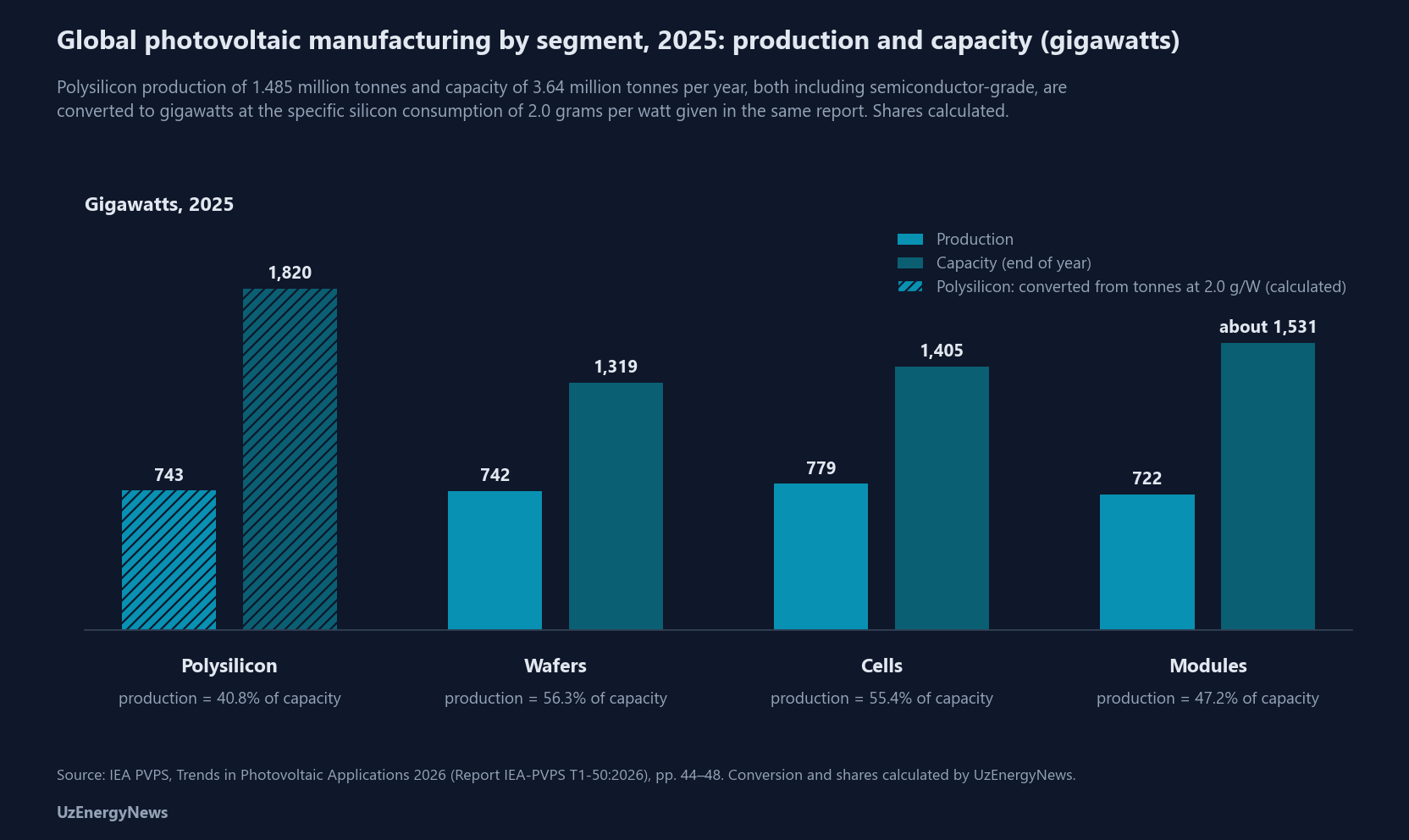
China accounted for 79 per cent of global module production in 2025, against 86 per cent in 2024, and for 71 per cent of module manufacturing capacity (IEA PVPS, p. 44). In 2025, China's shares of global production were 92 per cent for polysilicon (1.37 of 1.485 million tonnes, p. 45), 96.6 per cent for wafers (719.3 of 742 gigawatts, p. 46) and 88.4 per cent for cells (689 of 779 gigawatts, calculated, p. 48). In Renewables 2025, the IEA expects China to hold 75 to 95 per cent of the supply chain in 2030, depending on the segment, and about 35 per cent of new factories to be built outside China (as reported by TaiyangNews).
InfoLink reports capacity of 1,200 to 1,700 gigawatts in each segment of the chain, cell plant utilisation below 50 per cent, and polysilicon inventory of 730,000 to 790,000 tonnes, equivalent to more than six months of demand. The proclamation cites global polysilicon inventory of 400,000 tons at the end of 2024; the two figures refer to different dates and are taken from different sources. The InfoLink capacity range and cell utilisation are also taken from a different source and refer to a different date from the IEA PVPS values for 2025 in Table 3 (cell production at 55.4 per cent of capacity; polysilicon capacity of 1,820 gigawatts, converted from tonnes).
For the United States, InfoLink puts manufacturing capacity before the proclamation at about 29 gigawatts of polysilicon, 5.3 gigawatts of wafers, 9.3 gigawatts of cells and 92.8 gigawatts of modules, including First Solar. SEIA puts United States module manufacturing capacity at 60.1 gigawatts at the end of the third quarter of 2025 (Solar Market Insight Report Q4 2025); the InfoLink and SEIA figures refer to different dates and are compiled on different bases.
Other United States trade measures on solar imports
United States imports in 2025 amounted to about 33 gigawatts of modules and 21 gigawatts of cells, according to Solar Power World's analysis (23 February 2026) of DataWeb data of the United States International Trade Commission (USITC). The main origins of modules were Indonesia, Laos and India. Module imports from Cambodia fell from 4.5 gigawatts in 2024 to 3.3 megawatts in 2025 (the source gives the 2024 value in gigawatts and the 2025 value in megawatts). In the first quarter of 2026, S&P Global reports the following shares of United States module imports: Indonesia 40.6 per cent, the Philippines 24.8 per cent, Ethiopia 9.2 per cent, Laos 4.6 per cent and Vietnam 4.6 per cent.
Imports from Cambodia, Malaysia, Thailand and Vietnam fell from 12.2 billion dollars in 2023 to 1.3 billion dollars in 2025, following the earlier anti-dumping and countervailing duty case on those four countries (pv magazine USA, 11 September 2026). The final determinations of the Department of Commerce in the anti-dumping and countervailing duty cases on solar cells and modules from India, Indonesia and Laos are dated 10 September 2026 and were published in the Federal Register on 16 September 2026.
Table 4. Final determinations of the Department of Commerce, dated 10 September 2026
| Country | Anti-dumping duty | Countervailing (anti-subsidy) duty |
|---|---|---|
| India | 123.04% | 126.09% |
| Indonesia | 94.36% | 73.20–173.70% |
| Laos | 65.43% | 82.03–153.67% |
Source: Department of Commerce, final determinations published in the Federal Register on 16 September 2026, documents 2026-18945 and 2026-18947 (India), 2026-18939 and 2026-18940 (Indonesia), 2026-18941 and 2026-18942 (Laos). Anti-dumping rates are weighted-average dumping margins; the ranges for Indonesia and Laos cover company-specific countervailing duty rates.
The USITC made affirmative final injury determinations in the India, Indonesia and Laos cases on 14 October 2026. Department of Commerce orders are expected on 2 November 2026, and the USITC report is due on 23 November 2026. Petitioners in the case have stated that imports from Ethiopia rose by more than 3,000 per cent over 12 months and that a Department of Commerce inquiry concerning Ethiopia is under way (Utility Dive, 15 October 2026; mgrid, 16 October 2026).
Solar products of Chinese origin are subject to a Section 301 duty of 50 per cent; an analysis by Troutman Pepper Locke puts the combined rate on such products, with other duties added, above 65 per cent. Under the federal tax credits for clean electricity investment and production (sections 48E and 45Y of the Internal Revenue Code), projects qualify if construction started by 4 July 2026 or if they are placed in service by 31 December 2027; restrictions on suppliers linked to China, defined as "specified foreign entities", apply from 2026 (SEIA).
Earlier minimum import price arrangement: European Union, 2013 to 2018
In 2013, the European Union accepted a price undertaking from Chinese module exporters in place of anti-dumping and countervailing duties. The minimum price under the undertaking was lowered gradually over its term. The measures lapsed at midnight on 3 September 2018 (pv magazine, 31 August 2018).
Module share of United States installed system prices
Wood Mackenzie and SEIA put United States installed system prices in the second quarter of 2026 at 3.36 dollars per watt for residential systems (−1.4 per cent year on year), 1.77 dollars per watt for commercial systems (+5.6 per cent), 0.95 dollars per watt for utility-scale fixed-tilt systems (+0.9 per cent) and 1.06 dollars per watt for utility-scale systems with single-axis tracking (+2.0 per cent); the same summary records a 15 per cent increase in logistics costs (mgrid, 25 September 2026; pv magazine, 24 September 2026). Table 5 relates these installed prices to the module prices for the same quarter and shows the effect of a module price of 0.38 dollars per watt, the minimum import price, on two bases: from the United States module price for the second quarter of 2026 (0.33 dollars per watt for utility-scale and 0.37 dollars per watt for distributed projects) and from the Southeast Asia FOB price for United States projects (0.27 dollars per watt).
Table 5. Module share of installed price and effect of a module price of 0.38 dollars per watt, United States, second quarter of 2026
| Segment | Installed price ($/W) | Module price used ($/W) | Module share (calculated) | Increase to 0.38 $/W as share of installed price: from United States second-quarter price / from Southeast Asia FOB price (calculated) |
|---|---|---|---|---|
| Residential | 3.36 | 0.37 (distributed) | 11.0% | +0.3% / +3.3% |
| Commercial | 1.77 | 0.37 (distributed) | 20.9% | +0.6% / +6.2% |
| Utility-scale, fixed tilt | 0.95 | 0.33 (utility-scale) | 34.7% | +5.3% / +11.6% |
| Utility-scale, single-axis tracking | 1.06 | 0.33 (utility-scale) | 31.1% | +4.7% / +10.4% |
Sources: Wood Mackenzie and SEIA, second quarter of 2026, as summarised by mgrid (25 September 2026) and pv magazine (24 September 2026); InfoLink; Proclamation 11052. Calculated by UzEnergyNews. The first value applies the increase from the United States second-quarter module price to 0.38 dollars per watt (0.01 dollars per watt for distributed, 0.05 dollars per watt for utility-scale); the second applies the increase of 0.11 dollars per watt from the Southeast Asia FOB price (0.27 to 0.38) and combines an FOB price with installed prices. The second value assumes a module price of 0.27 dollars per watt in the installed price, while the module share column uses the United States second-quarter module price. Both values treat all modules as subject to the module minimum price of 0.38 dollars per watt; for modules assembled in the United States from imported cells, the cell minimum price of 0.22 dollars per watt will apply to the imported cells instead. Both values assume full pass-through to the installed price and exclude the 15 per cent ad valorem duty. Industry estimates cited by ETW Energy give an increase of 3 to 5 per cent for residential systems.
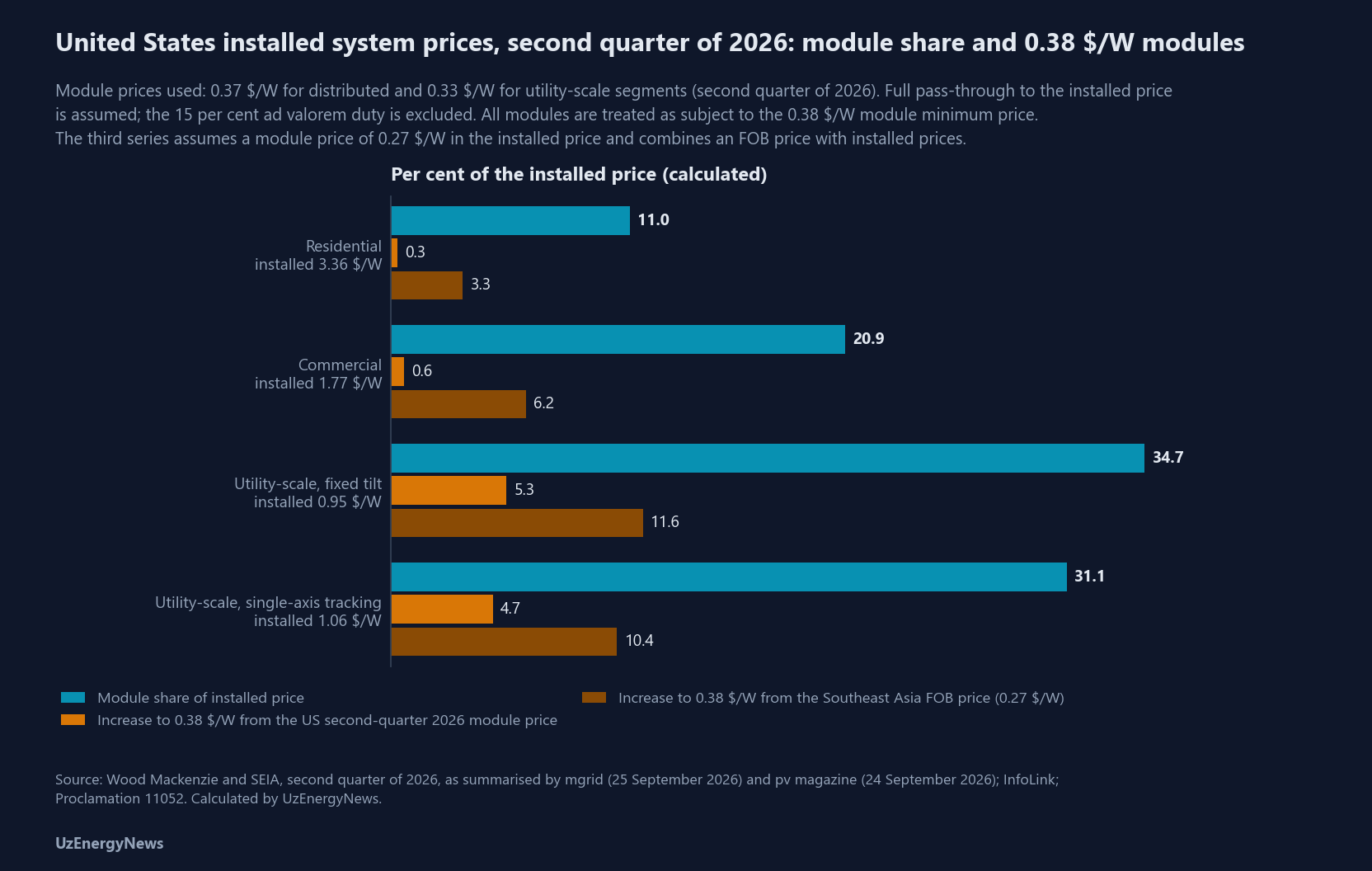
Lawrence Berkeley National Laboratory (LBNL) puts the capacity-weighted installed cost of United States utility-scale photovoltaic projects that entered service in 2025 at 1.69 dollars per watt on an alternating-current basis, or 1.31 dollars per watt on a direct-current basis, 2 per cent above the 2024 value of 1.65 dollars per watt and 72 per cent below 2010; LBNL describes the 2024 and 2025 estimates as preliminary (Utility-Scale Solar, 2026 edition, October 2026). The International Renewable Energy Agency (IRENA) puts the global weighted-average installed cost of utility-scale solar photovoltaics in 2024 at 691 dollars per kilowatt and the levelised cost of electricity at 0.043 dollars per kilowatt-hour (Renewable Power Generation Costs in 2024). InfoLink expects the effect on project investment to be limited because the module is no longer the largest cost item.
Global demand estimates for 2025 and 2026
InfoLink puts global photovoltaic demand at 685 gigawatts (direct current) in 2025 and forecasts 509 to 597 gigawatts in 2026, a change of −13 to −26 per cent. For China, InfoLink gives 368 gigawatts in 2025 and a forecast of 220 to 232 gigawatts in 2026. IEA PVPS gives 415 gigawatts for China and about 690 gigawatts for the world in 2025; the two sources differ on the Chinese figure for 2025.
Scheduled dates
| Date | Event | Source |
|---|---|---|
| 2 November 2026 | Department of Commerce orders expected in the India, Indonesia and Laos cases | Utility Dive; mgrid |
| 23 November 2026 | USITC report due in the same cases | Utility Dive; mgrid |
| 3 December 2026 | Last day of the temporary anti-stockpiling rule | Federal Register 2026-19537 |
| 4 December 2026, 12:01 a.m. Eastern Time | Minimum import prices and additional duty under Proclamation 11052 apply | Proclamation 11052 |
| 31 December 2027 | Placed-in-service deadline for 48E and 45Y tax credits (projects without construction start by 4 July 2026) | SEIA |
| 20 January 2029 | Deadline for the construction start commitment in onshoring plans (clause 6(a)) | Proclamation 11052 |
Summary of measured quantities
| Series | Value | Period | Source |
|---|---|---|---|
| United States minimum import price, modules / cells | 0.38 / 0.22 $/W | from 4 December 2026 | Proclamation 11052 |
| United States minimum import price, polysilicon / ingots and wafers | 21 / 100 $/kg | from 4 December 2026 | Proclamation 11052 |
| Additional ad valorem duty, ingots and wafers / cells / modules | 15% (UK 10%; combined rate set equal to 15% for six partners); none on polysilicon | from 4 December 2026 | Proclamation 11052 (clause 4 and Annexes; InfoLink, Anza reading) |
| TOPCon module, China-made, FOB | 0.115 $/W | 15–21 October 2026 | InfoLink |
| TOPCon module, Southeast Asia-made for United States projects, FOB | 0.27 $/W | 15–21 October 2026 | InfoLink |
| TOPCon module, United States-assembled, DDP | 0.31 $/W | 15–21 October 2026 | InfoLink |
| China share of global module production | 79% (2025); 86% (2024) | 2024–2025 | IEA PVPS, Trends 2026, p. 44 |
| China share of polysilicon / wafer / cell production | 92% / 96.6% / 88.4% (cell share calculated) | 2025 | IEA PVPS, Trends 2026, pp. 45–48 |
| Global module production / capacity | 722 / about 1,531 GW | 2025 | IEA PVPS, Trends 2026, p. 44 |
| United States imports, modules / cells | about 33 / 21 GW | 2025 | Solar Power World, USITC DataWeb |
| Module share of installed price, utility-scale single-axis | 31.1% (calculated) | second quarter of 2026 | Wood Mackenzie and SEIA via mgrid and pv magazine |
| Global demand | 685 GW (2025); 509–597 GW (2026 forecast) | 2025–2026 | InfoLink |