Türkiye's National Energy 2040 Presentation of 5 November 2026 Gives 281 GW of Installed Capacity and 680 TWh of Electricity Demand for 2040, Against 123 GW and 365 TWh in 2025; the 2022 National Energy Plan Set 189.7 GW and 510.5 TWh for 2035
Solar Capacity Rises From 26 GW to 112 GW and Wind From 15 GW to 63 GW; Nuclear Reaches 10 GW and Battery Storage 140 GWh; Oil Consumption Is 718,000 Barrels a Day in 2040 Against 1,192,000 Under Current Policies; the Presentation Shows a 500 Billion Dollar Investment Total and an Item of 190 Billion Dollars for Installed Capacity
Türkiye's Ministry of Energy and Natural Resources launched Milli Enerji 2040 (National Energy 2040) in Istanbul on 5 November 2026 and published the launch presentation, a 16-page file, on its website with a news release of the same date. For 2040 the presentation gives electricity demand of 680 TWh, against 365 TWh in 2025 and 551 TWh under a Current Policies scenario; installed capacity of 281 GW against 123 GW; and a renewable share of installed capacity of 77 per cent against 63 per cent. Solar capacity rises to 112 GW, wind to 63 GW including 6 GW offshore, and nuclear to 10 GW; the presentation also lists 140 GWh of battery storage. Oil consumption is 718,000 barrels a day in 2040 against 1,192,000 under Current Policies, and natural gas consumption 57 billion cubic metres against 77 billion. The presentation shows an investment total of 500 billion dollars and investment items of 190 billion dollars for installed capacity, 100 billion dollars for wind and solar, 36 billion dollars for transmission, 80 billion dollars for distribution, 28 billion dollars for storage, interconnection and demand-side items and 210 billion dollars for state companies; it does not show how the items make up the total. The previous National Energy Plan, first reported in January 2023, set 189.7 GW and 510.5 TWh for 2035. Several press reports of the launch give values that differ from the presentation. COP31, the 31st Conference of the Parties to the UN Framework Convention on Climate Change, opens in Antalya on 9 November 2026.
Türkiye's Ministry of Energy and Natural Resources launched Milli Enerji 2040 (National Energy 2040) in Istanbul on 5 November 2026. The Ministry published the launch presentation, a 16-page file, on its website with its news release of the same date, 'İşte Türkiye'nin 2040 Enerji Hedefleri' (Türkiye's 2040 Energy Targets); the presentation file is listed under the Ministry's National Energy Plan reports, and the slide numbers in this article refer to its pages. The presentation compares 2025 values with two cases for 2040, a Current Policies scenario and the National Energy 2040 plan, for primary energy demand, electricity demand and oil and natural gas consumption. Installed generation capacity rises from 123 GW in 2025 to 281 GW in 2040, and the renewable share of installed capacity from 63 per cent to 77 per cent. The figures in this article are taken from the presentation unless another source is named.
Electricity demand and electrification
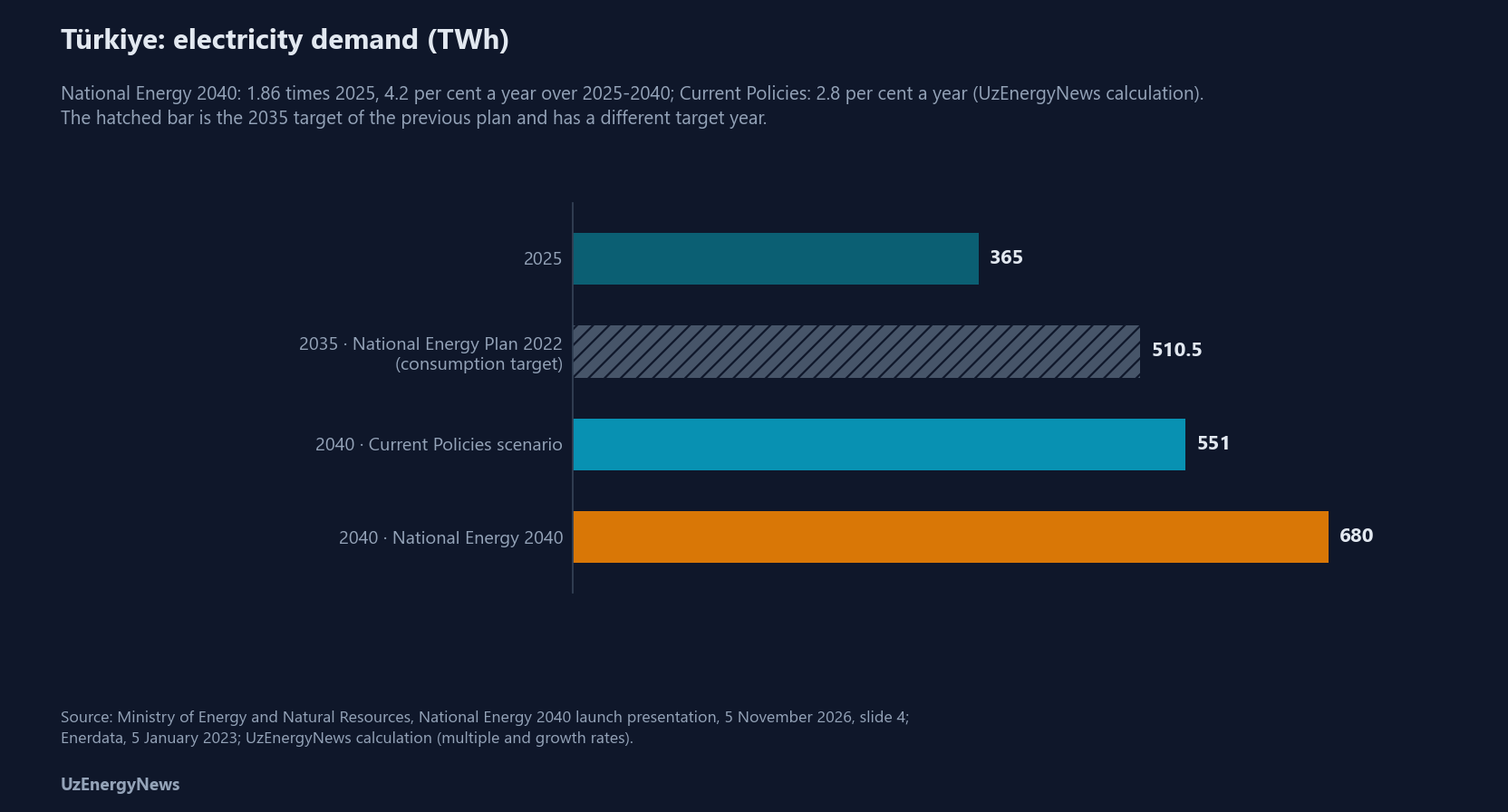
The presentation gives electricity demand of 365 TWh in 2025. For 2040 it gives 551 TWh under Current Policies and 680 TWh under National Energy 2040. The plan value is 1.86 times the 2025 level, an average annual increase of 4.2 per cent over 2025-2040, against 2.8 per cent a year in the Current Policies scenario; the plan value is 129 TWh, or 23 per cent, above the Current Policies value (UzEnergyNews calculation). Primary energy demand is 171 million tonnes of oil equivalent (Mtoe) in 2025; for 2040 the presentation gives 230 Mtoe under Current Policies and 199 Mtoe under National Energy 2040. The presentation lists five sources of new electricity demand in 2040: electric vehicles 90 TWh, data centres 55 TWh, electrolysers 20 TWh, heat pumps 8 TWh and water treatment 5 TWh. It gives an electrification rate of 36 per cent for 2040 and does not state the denominator of the rate or a value for an intermediate year. The presentation sets a 40 per cent reduction in primary energy intensity over 2025-2040 and cumulative savings of 240 billion dollars.
According to Bigpara, reporting Anadolu Agency, Energy and Natural Resources Minister Alparslan Bayraktar gave 2040 electrification rates of 24 per cent in transport, 33 per cent in industry and 30 per cent in the residential sector, and said that an electrification level of 35 per cent for 2035 would be presented at COP31, the 31st Conference of the Parties to the UN Framework Convention on Climate Change. The presentation gives per capita electricity consumption of 7,500 kWh a year in 2040 and does not state a population value. CNBC-e reported on 5 November 2026 a 2040 population of 91.5 million, citing the Turkish Statistical Institute (TÜİK); dividing 680 TWh by 91.5 million gives about 7,430 kWh (UzEnergyNews calculation). CNBC-e gives the economic growth assumption as an average of 4.4 per cent a year, citing the Presidency of Strategy and Budget; Bloomberg HT gives 4 per cent.
Generation capacity: solar, wind and nuclear
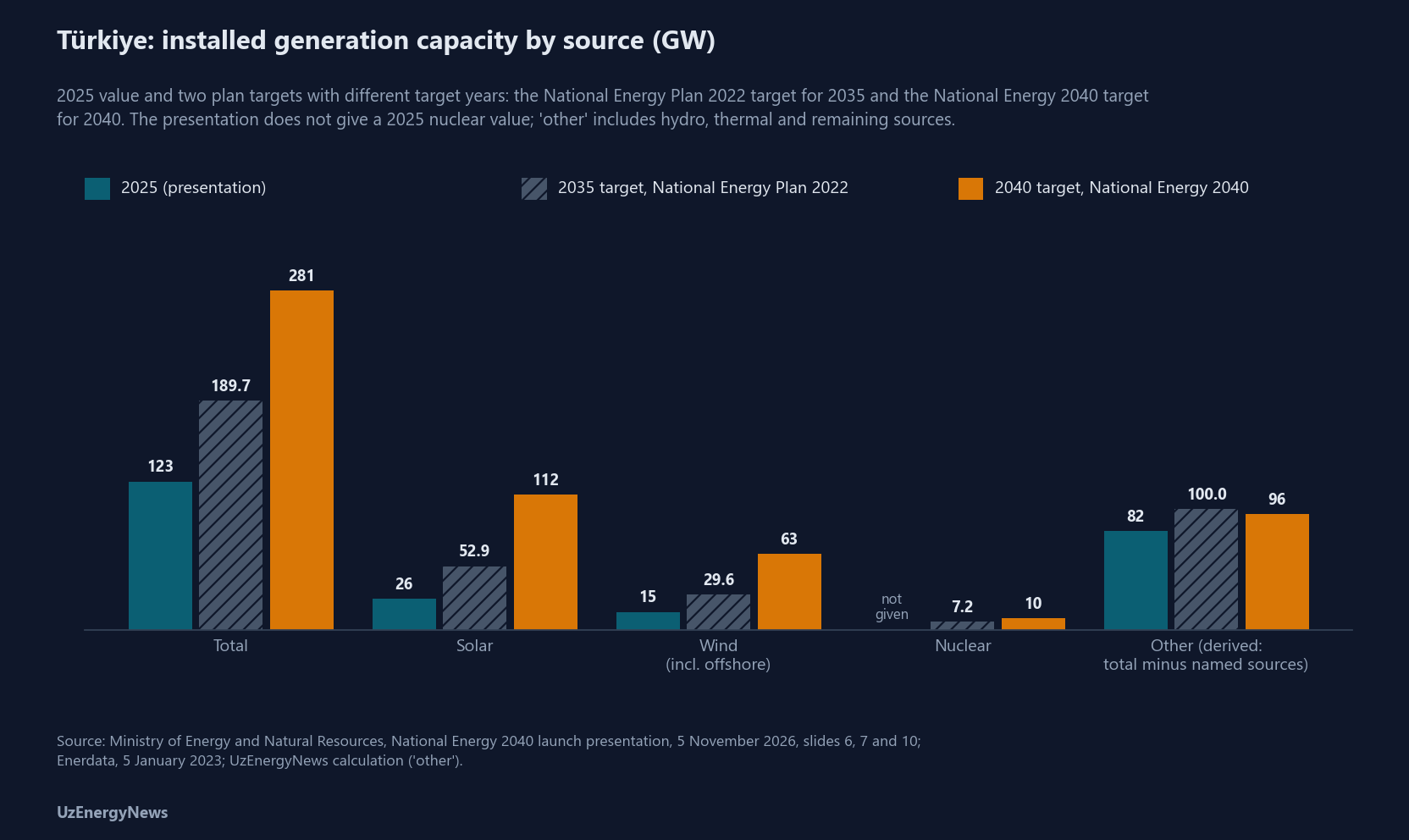
Solar capacity rises from 26 GW in 2025 to 112 GW in 2040 and wind capacity from 15 GW to 63 GW, of which 6 GW offshore. Slide 7 gives the starting values of 26 GW and 15 GW without a year; slide 6 gives installed capacity of 123 GW for 2025, and this article treats 26 GW and 15 GW as 2025 values. Combined wind and solar capacity reaches 175 GW; the presentation describes this as fourfold growth, and the ratio to the 41 GW of 2025 is 4.27 (UzEnergyNews calculation). Wind and solar account for 62 per cent of 2040 installed capacity (UzEnergyNews calculation). The presentation lists Renewable Energy Resource Area (YEKA) tenders of at least 2 GW every year, international projects, capacity increases and repowering, hybrid capacity at existing plants and automatic allocation of up to 1 MW of capacity at the same connection point. Slide 7 shows investment of 100 billion dollars for wind and solar, and slide 6 shows 190 billion dollars for installed capacity; the presentation does not state whether the 100 billion dollars is part of the 190 billion dollars. Applying the 77 per cent share to 281 GW gives about 216 GW of renewable capacity in 2040, against about 77 GW in 2025 (UzEnergyNews calculation). Ministry data put installed capacity at 127,355 MW at the end of September 2026.
Nuclear capacity reaches 10 GW in 2040; the presentation lists Akkuyu, Sinop, Thrace and small modular reactors (SMRs). The Ministry news release gives the 10 GW as Akkuyu's 4,800 MW and at least 5,000 MW of SMRs, with nuclear supplying 11 per cent of electricity and avoiding 15 billion cubic metres of gas imports. The presentation does not give a hydrogen capacity target; electrolysers appear as 20 TWh of electricity demand.
Transmission, distribution and flexibility
For transmission the presentation states growth of 50 per cent in transformer capacity and 30 per cent in line length, high-voltage direct current (HVDC) capacity of 28 GW over 10,000 km, and investment of 36 billion dollars. The Ministry news release gives transformer capacity rising from about 200 GW to 316 GW, line length from about 77,000 km to 112,000 km and international interconnection capacity from 5.4 GW to 15 GW; the transformer and line values correspond to increases of 58 per cent and 45 per cent (UzEnergyNews calculation). For distribution the presentation sets 100 per cent for smart metering, SCADA (supervisory control and data acquisition) coverage and urban ring networks, with investment of 80 billion dollars. According to the Ministry news release, the Minister described 2036 as an important milestone for distribution, the year in which many distribution licences expire. Slide 9, which has no heading, lists 140 GWh of battery storage, 15 GW of interconnection, 6 GW of pumped-storage hydro, 5 GW of demand-side participation, 20 million electric vehicles and 1.5 million charging sockets, with investment of 28 billion dollars. The Ministry news release refers to storage and electric transport as flexibility items, and ShiftDelete reports the 28 billion dollars as storage investment. According to Bigpara, reporting Anadolu Agency, the Minister said that losses and theft had been reduced from 18 per cent to 8 per cent; the presentation does not give a loss value.
UzEnergyNews reported on 30 September 2026 that the Minister had given 80 billion dollars of transmission and distribution investment to 2035 at a meeting in New York on 22 September 2026. On 26 October 2026, according to Anadolu Agency, the Minister gave a figure of about 100 billion dollars for transmission and distribution over the National Energy 2040 horizon. The presentation shows 36 billion dollars for transmission and 80 billion dollars for distribution, a combined 116 billion dollars (UzEnergyNews calculation).
Oil and natural gas
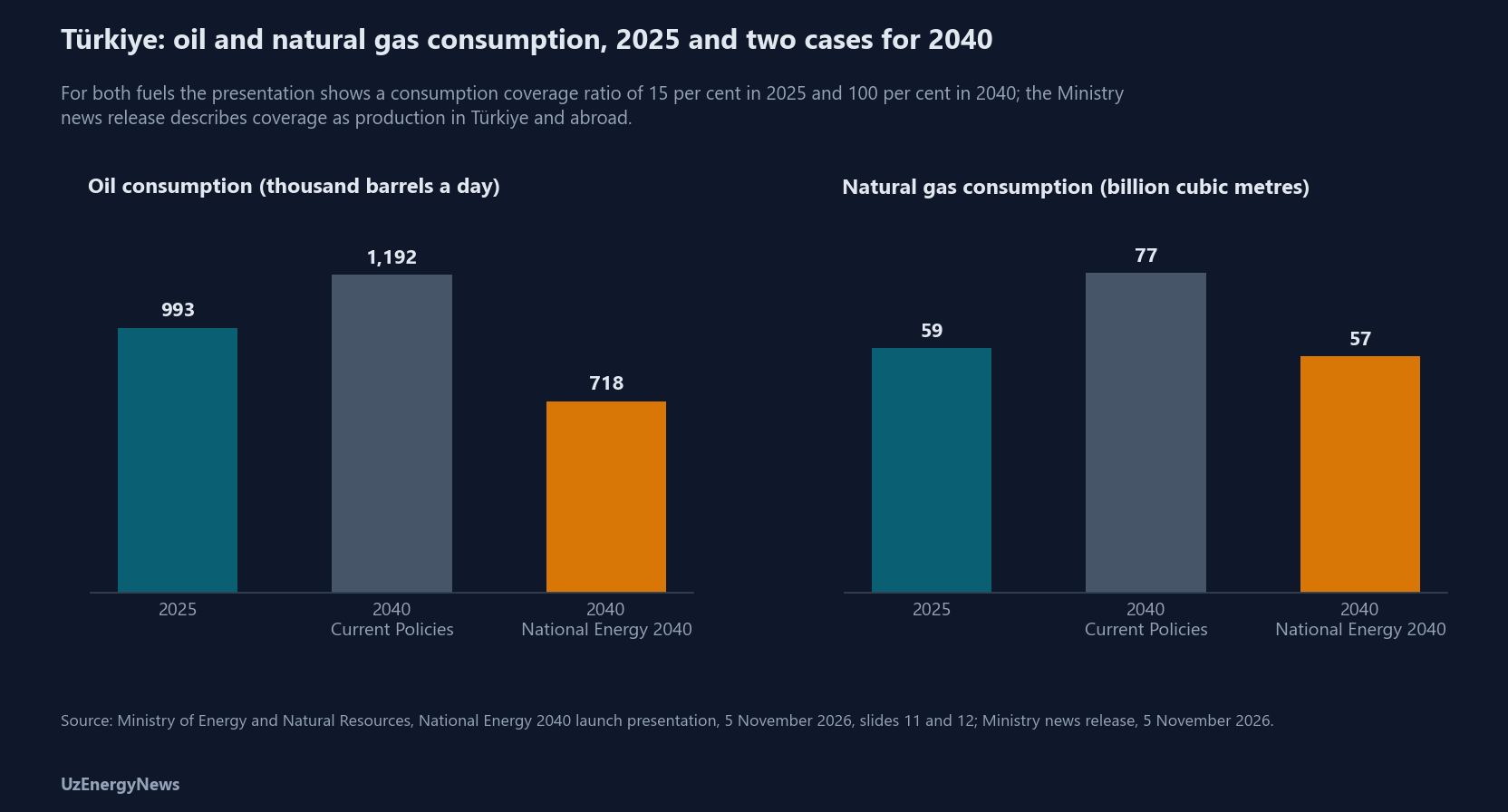
Oil consumption is 993,000 barrels a day in 2025; for 2040 the presentation gives 1,192,000 barrels a day under Current Policies and 718,000 barrels a day under National Energy 2040. Natural gas consumption is 59 billion cubic metres in 2025, 77 billion cubic metres under Current Policies and 57 billion cubic metres under the plan in 2040. For both fuels the presentation shows a consumption coverage ratio rising from 15 per cent in 2025 to 100 per cent in 2040. The Ministry news release describes coverage as production in Türkiye and abroad. The summary slide gives oil and gas production of 1.7 million barrels a day without a year; the Ministry news release describes 1.7 million barrels a day as the daily oil and natural gas requirement to be met by this production. Converting 57 billion cubic metres of gas at 5,800 cubic feet per barrel of oil equivalent gives about 0.95 million barrels of oil equivalent a day; with 718,000 barrels of oil the 2040 consumption total is about 1.67 million (UzEnergyNews calculation). The presentation also lists 5 per cent biofuel blending, 50 million barrels of oil storage at Ceyhan, regasification capacity above 200 million cubic metres a day, gas storage of 17.6 billion cubic metres and 1.5 billion cubic metres of renewable gas. According to CNBC-e and Bloomberg HT, Türkiye's energy import bill was 96.5 billion dollars in 2022, and the reports give an average of 65-70 billion dollars for 'the last four to five years', without naming the years.
Investment figures in the presentation
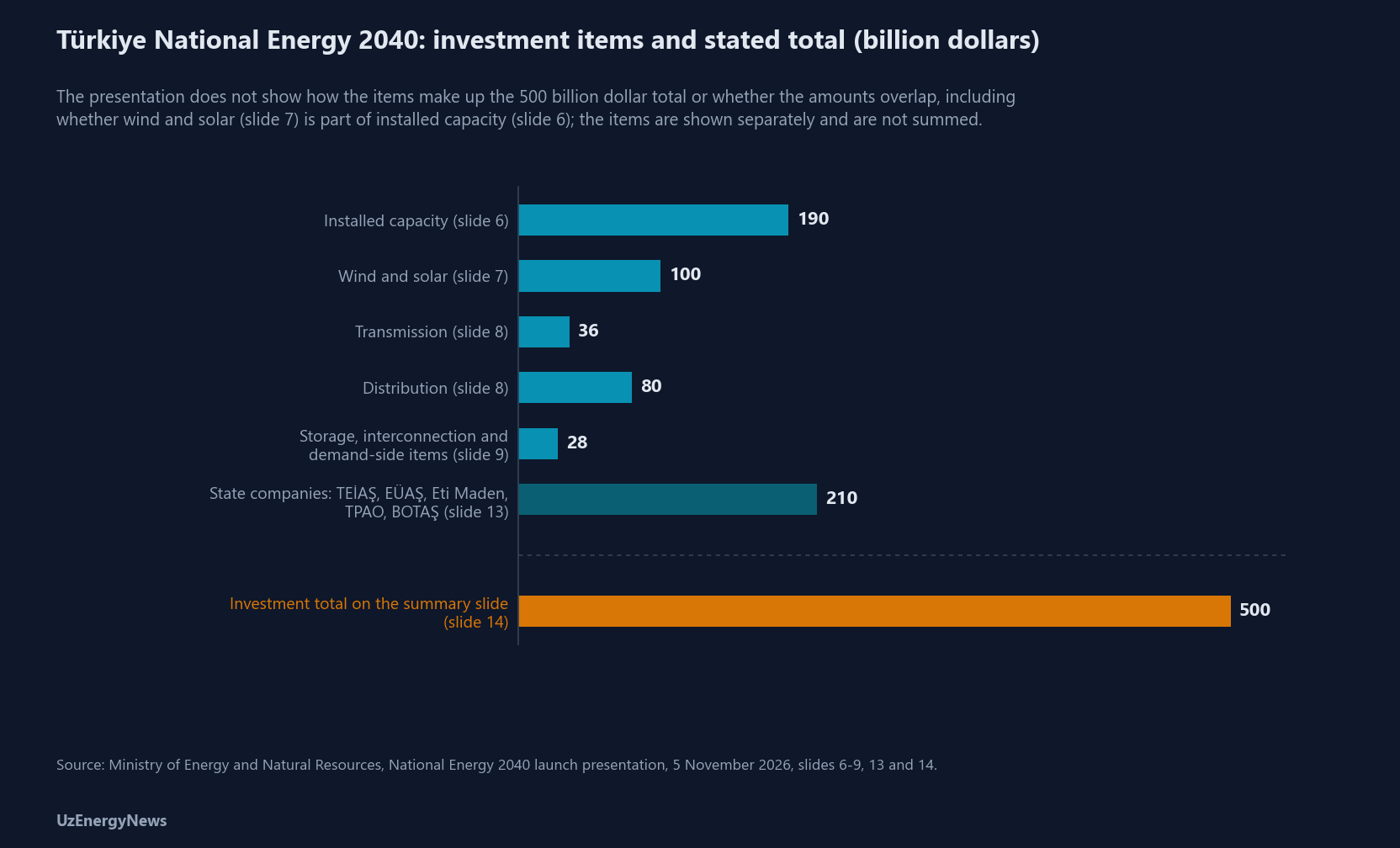
The presentation shows investment of 190 billion dollars for installed capacity (slide 6), 100 billion dollars for wind and solar (slide 7), 36 billion dollars for transmission and 80 billion dollars for distribution (slide 8), 28 billion dollars for the storage, interconnection and demand-side items of slide 9, and 210 billion dollars for the state companies Türkiye Elektrik İletim (TEİAŞ), Elektrik Üretim (EÜAŞ), Eti Maden, Türkiye Petrolleri (TPAO) and Boru Hatları ile Petrol Taşıma (BOTAŞ) (slide 13). The summary slide gives an investment total of 500 billion dollars. The presentation does not show how the items make up the 500 billion dollar total or whether the amounts overlap; an editorial note by ShiftDelete records the same point. The Ministry news release, Anadolu Agency and Bloomberg HT describe the 500 billion dollars as the investment required from the public and private sectors. The summary slide also gives a national production share of 92 per cent, an emissions reduction of 40 per cent and 108,000 direct jobs; the presentation does not state the denominator of the national production share or the reference year of the emissions reduction.
Comparison with the National Energy Plan reported in January 2023
The previous National Energy Plan (Ulusal Enerji Planı), dated 2022 and published on the Ministry website, was first reported on 5 January 2023 by Enerdata and on 6 January 2023 by Balkan Green Energy News. It set 2035 targets of 189.7 GW of installed capacity, against 99.9 GW in 2021; 510.5 TWh of electricity consumption, an average annual increase of 3.5 per cent; 205.3 Mtoe of primary energy; 52.9 GW of solar; 29.6 GW of wind, of which 5 GW offshore; 7.2 GW of nuclear; and a renewable share of installed capacity of 64.7 per cent. For 2040 National Energy 2040 gives 281 GW, 680 TWh, 199 Mtoe, 112 GW of solar, 63 GW of wind including 6 GW offshore, 10 GW of nuclear and 77 per cent. The two plans have different target years, 2035 and 2040, and the values are listed against their own years. On 21 October 2024 the Minister announced a target of 120 GW of wind and solar capacity by 2035, according to S&P Global. The presentation and the Ministry news release contain no values for 2030 or 2035.
Differences between press reports and the presentation
Several values in press reports of 5 November 2026 differ from the presentation. Bigpara, reporting Anadolu Agency, gave 2040 wind capacity as 50,000 MW, storage as 140 gigawatts, the renewable share of installed capacity as 71 per cent, wind and solar investment as 170 billion dollars and high-voltage line length as 140,000 km; the presentation gives 63 GW, 140 GWh, 77 per cent and 100 billion dollars, and the Ministry news release gives 112,000 km. ShiftDelete gave the number of electric vehicles as 2 million; the presentation gives 20 million electric vehicles, and the Ministry news release refers to a fleet of 20 million electric and hybrid vehicles and a total vehicle stock of 41 million. Bloomberg HT gave the target year as 2024 in one passage of its report. On 4 November 2026, before the launch, CNBC-e and Anadolu Agency, as carried by Foreks, reported that renewables would meet about 70 per cent of total energy needs in 2040; the 77 per cent in the presentation refers to installed electricity capacity. CNBC-e reported on 5 November 2026 an energy import dependency of 68 per cent falling below 50 per cent by 2030 and to 48 per cent in 2040, and Bigpara reported the Minister as saying that dependency would reach zero in 2049; the presentation contains no dependency ratio and shows consumption coverage ratios for oil and gas.
COP31 and the electrification target
COP31 is held at the Antalya EXPO site from 9 to 20 November 2026, with a Leaders Summit on 11 and 12 November. According to UzEnergyNews reporting of 29 October 2026, the COP31 Action Agenda includes a 2035 target of a 35 per cent share of electricity in final energy consumption; the International Energy Agency (IEA) Electrification Special Report of 22 September 2026 puts the global share in 2025 at 23 per cent. Türkiye's net zero target year is 2053 under its Long-Term Climate Strategy of November 2024, and its second nationally determined contribution (NDC), submitted to the UN Framework Convention on Climate Change (UNFCCC) in November 2025, sets a 2035 emissions ceiling of 643 million tonnes of CO2 equivalent (MtCO2e) including land use, land-use change and forestry. An Ember analysis of 27 October 2026 put the electricity share of Türkiye's final energy consumption at 21.8 per cent in 2024 and calculated that a 35 per cent share in 2035, with fossil fuel consumption on its trend, would require about 790 TWh of electricity demand in 2035. The presentation gives 680 TWh of electricity demand and 36 per cent electrification for 2040; the Ember value and the presentation values refer to different target years (2035 and 2040), and the presentation does not state the denominator of its electrification rate.
Watchpoints
The presentation gives no values for 2030 or 2035, no hydrogen capacity target, no reference year for the 40 per cent emissions reduction, no denominator for the 92 per cent national production share or the 36 per cent electrification rate, and no reconciliation of the investment items to the 500 billion dollar total. On 7 November 2026 the Ministry news release linked to no document other than the presentation file; UzEnergyNews did not locate a full plan document with methodology on the Ministry website. Sources differ on the 2035 solar target of the 2022 plan: Enerdata gives 52.9 GW and Balkan Green Energy News gives 59.9 GW. Reports differ on the growth assumption: CNBC-e gives 4.4 per cent and Bloomberg HT 4 per cent. The UzEnergyNews calculations in this article are derived from presentation values and are not Ministry figures.