World Bank Board Approved a 100 Million Dollar Loan on 27 October 2026; Total Financing of Uzbekistan's Distribution Modernisation Programme Is 371 Million Dollars; Government Projections Put 2030 Electricity Demand at 117 TWh and UzEnergyNews Scenarios at About 103-117 TWh, Against 86.7 Billion kWh Generated in 2025
Registered Electric Vehicles Reached 122,700 on 1 July 2026, up 66.7 Per Cent in a Year; Daily Consumption Exceeded the Winter Record of 283 Million kWh on 14 July 2026 and Reached 301.9 Million kWh on 20 July 2026; IEA Puts Global Grid Investment at 450 Billion Dollars in 2025 and About 930 Billion Dollars in 2035 in Its High Electrification Scenario; a UzEnergyNews Estimate Puts the Investment Need of Uzbekistan's 14 Regional Distribution Networks at About 350 Million Dollars a Year
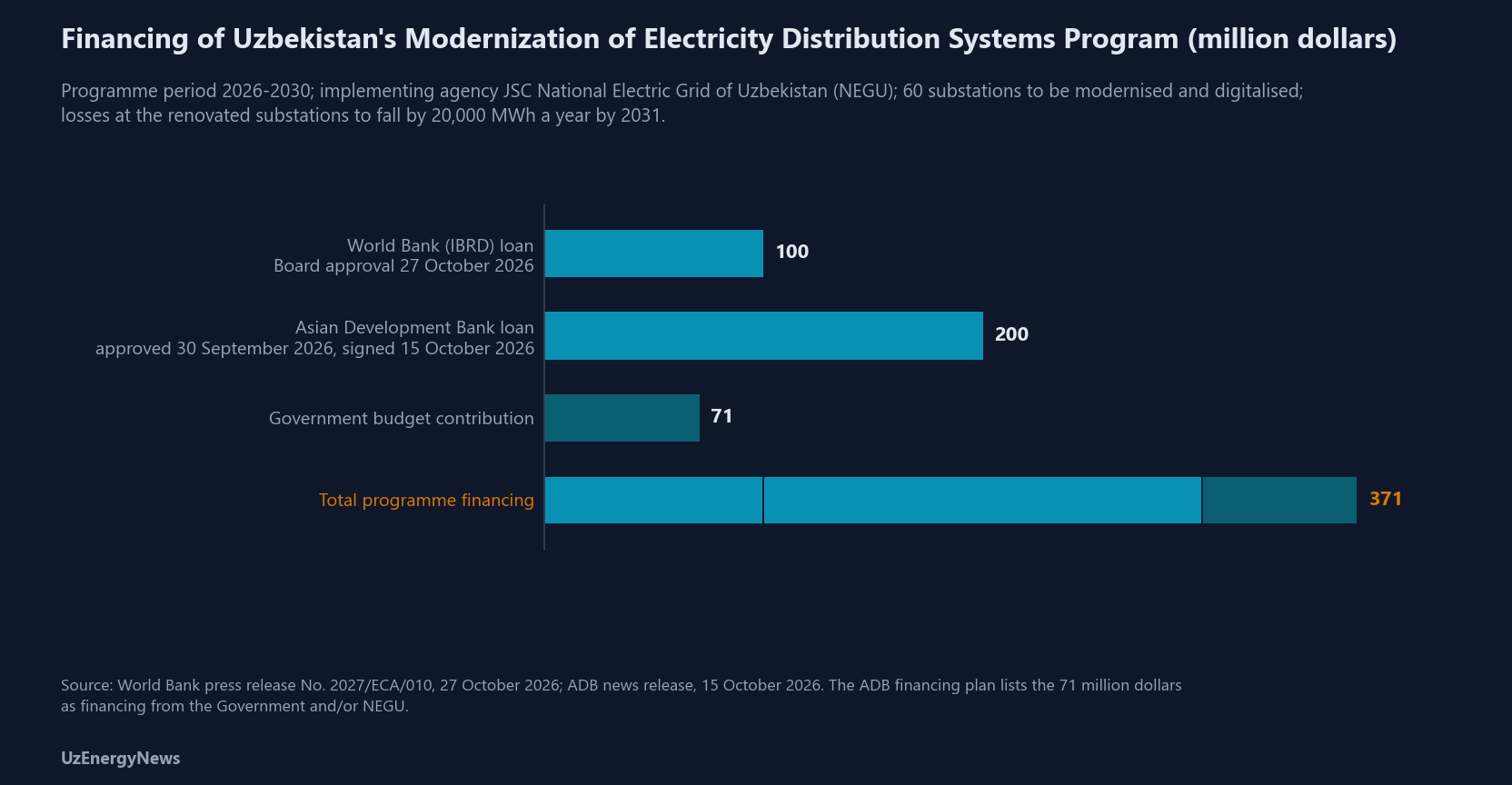
The World Bank Board of Executive Directors approved a 100 million US dollar loan for Uzbekistan's Modernization of Electricity Distribution Systems Program on 27 October 2026, according to a World Bank press release of the same date. With a 200 million dollar loan from the Asian Development Bank (ADB) and a 71 million dollar contribution from the government budget, total programme financing is 371 million dollars. The programme covers the modernisation and digitalisation of 60 substations operated by JSC National Electric Grid of Uzbekistan (NEGU) and targets a reduction in losses at the renovated substations of 20,000 MWh a year by 2031. Uzbekistan generated 86.7 billion kWh of electricity in 2025. Projections announced at a presidential meeting on 28 January 2025 put demand at 117 billion kWh in 2030 and 135 billion kWh in 2035; the Eurasian Development Bank forecasts 130.0 billion kWh for 2030; UzEnergyNews scenarios give about 103-117 TWh for 2030, with a middle scenario of about 110 TWh. Registered electric vehicles numbered 122,700 on 1 July 2026, and summer daily consumption exceeded the winter record in July 2026. A UzEnergyNews estimate puts the investment need of the regional distribution networks in Uzbekistan's 14 regions at about 350 million dollars a year.
The World Bank Board of Executive Directors approved a 100 million US dollar loan for Uzbekistan's Modernization of Electricity Distribution Systems Program (World Bank project number P514733) on 27 October 2026, according to World Bank press release No. 2027/ECA/010 issued in Washington on the same date. The UzEnergyNews account of the programme published on 29 October 2026 recorded the approval as unconfirmed, as the World Bank projects database then showed the project status as 'Pipeline' and no press release had been located. The press release states that the ADB approved its 200 million dollar loan on 30 September 2026 and that, together with the government's own budget contribution of 71 million dollars, total programme financing amounts to 371 million dollars. The ADB loan agreement was signed in Bangkok on 15 October 2026. The programme is co-financed under the ADB–World Bank Full Mutual Reliance Framework and implemented by Joint-Stock Company National Electric Grid of Uzbekistan (NEGU). Loan terms, the expenditure framework and the seven disbursement-linked indicators were set out in the UzEnergyNews account of 29 October 2026.
Targets in the World Bank press release
The press release describes the programme as the modernisation and digitalisation of 60 key substations nationwide. By 2031 it is expected to cut electricity losses in the renovated substations by 20,000 MWh a year, help enable at least 3.3 GW of renewable energy capacity and avoid nearly 23,000 tonnes of CO2 equivalent emissions a year. The World Bank estimates that the programme will enable about 11,700 more and better jobs during the five years following commissioning. The programme also covers NEGU's financial systems, cybersecurity, environmental and social standards and gender equality in employment. The press release states that Uzbekistan aims to reach 25 GW of renewable energy capacity by 2030. Najy Benhassine, World Bank Division Director for Central Asia, is quoted: 'Reliable electricity is essential for households and economic activity. It is a foundation for jobs, public services, and economic growth.'
Electricity demand: official projections and published forecasts
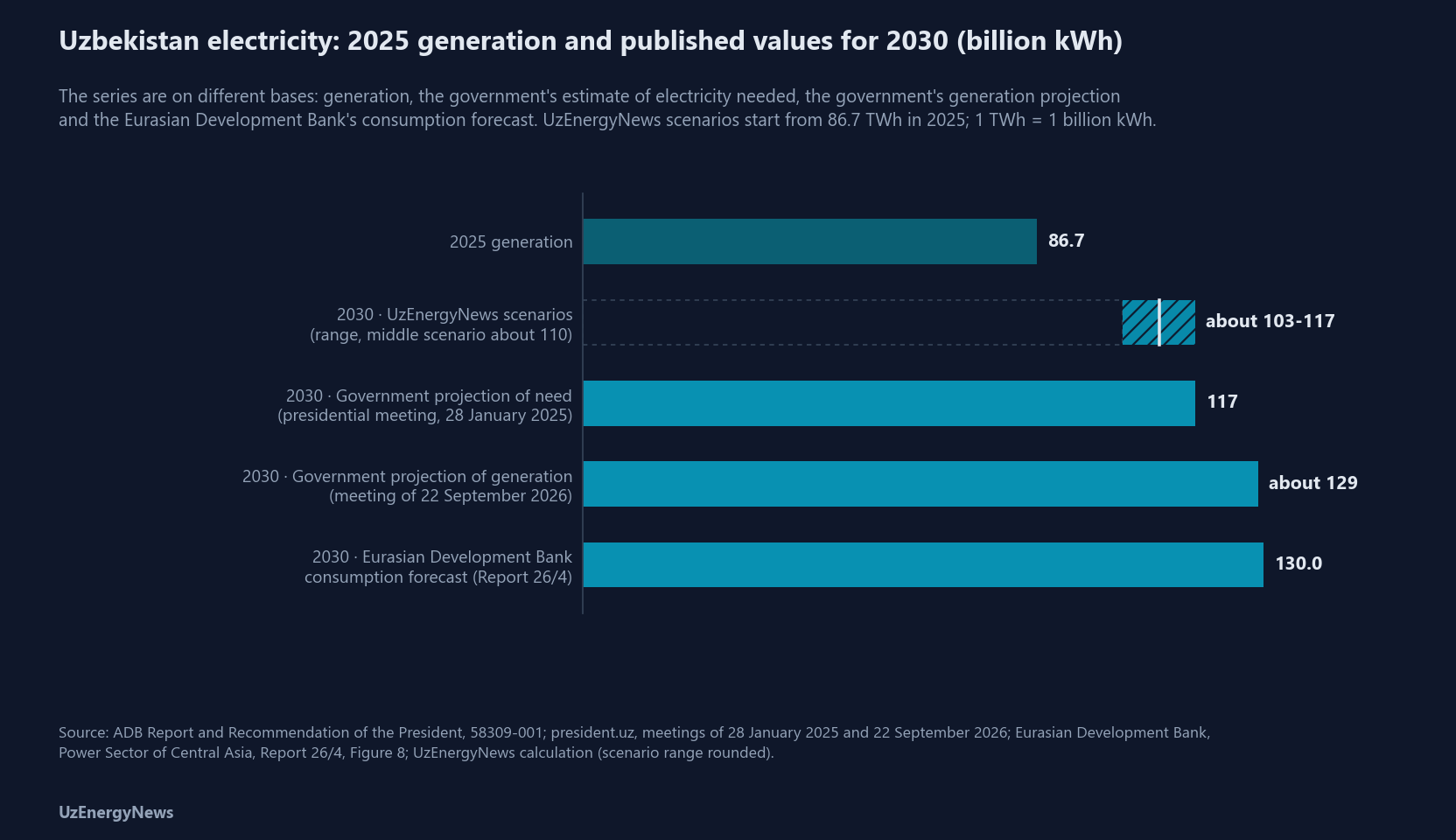
Uzbekistan generated 86.7 billion kWh of electricity in 2025; ADB's Report and Recommendation of the President for the programme uses the same value for demand and gives annual growth of about 5 per cent. At a meeting chaired by the President on 28 January 2025, the electricity needed was estimated at 117 billion kWh in 2030 and 135 billion kWh in 2035, 1.7 times the level at the time. At a presidential meeting on 18 April 2025, consumption in 2035 was given as 121 billion kWh. At a meeting on the fuel and energy sector on 22 September 2026, installed generation capacity was projected at 46.1 GW in 2030 and 57.2 GW in 2035, with annual generation of about 129 billion kWh in 2030 and 154.7 billion kWh in 2035. The Eurasian Development Bank's report Power Sector of Central Asia: Modernization and Energy Transition (Report 26/4) gives Uzbekistan's consumption as 82.35 billion kWh in 2024 and 130.0 billion kWh in 2030, an average annual increase of 7.9 per cent (UzEnergyNews calculation). In its demand forecasting study of early 2025, the German Economic Team gives three model variants for 2035 of 130.9, 137.2 and 151.5 TWh.
UzEnergyNews has calculated three demand scenarios from the 2025 value of 86.7 TWh. They give about 103-117 TWh for 2030, with a middle scenario of about 110 TWh. The upper end of the range is set at the level of the government's 2030 projection of 117 billion kWh, which is 35 per cent above 2025. The Eurasian Development Bank's 2030 forecast of 130.0 billion kWh is about 13 TWh above the upper end of the range.
Electric vehicles, cooling and heating
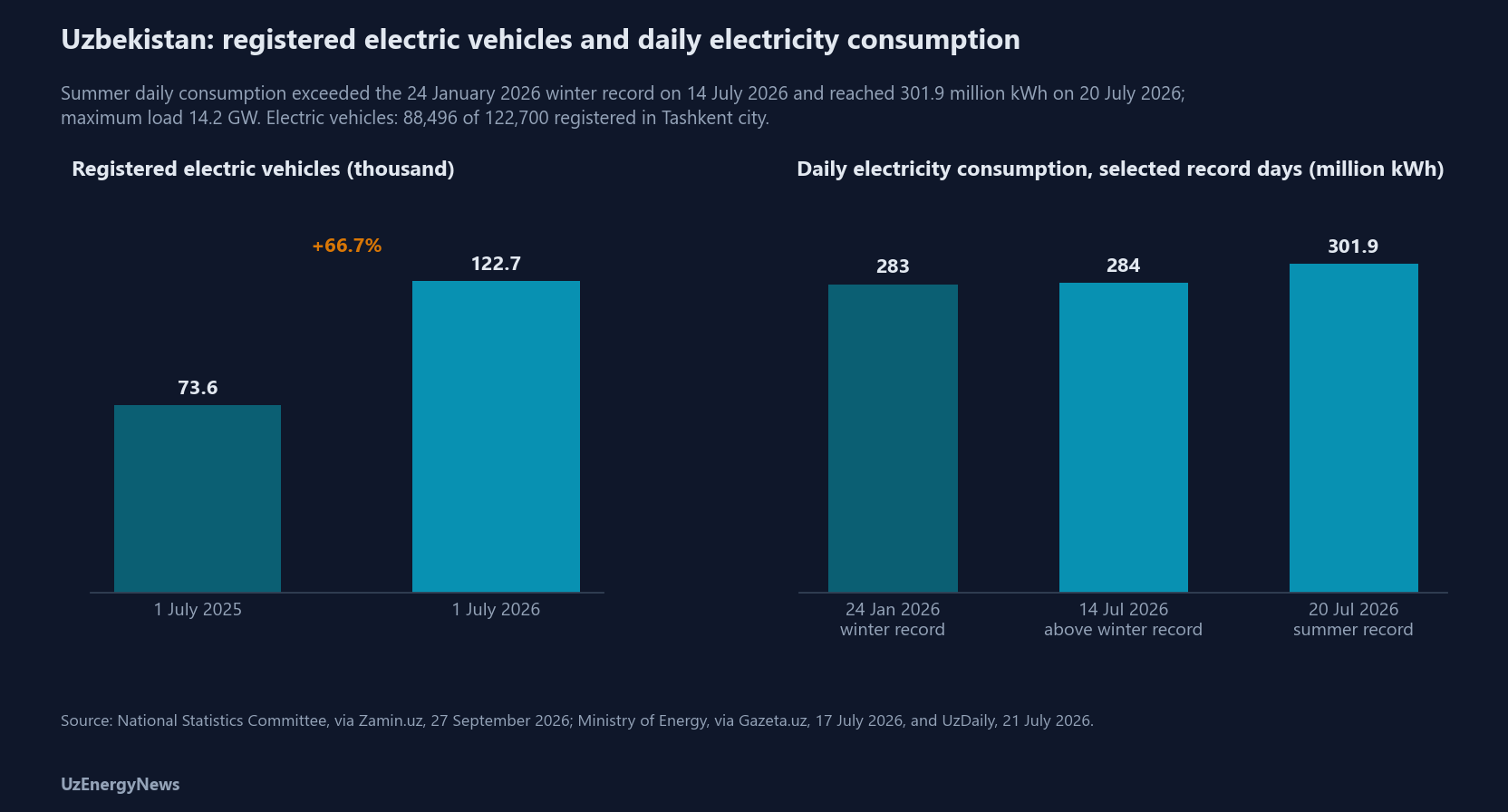
According to the National Statistics Committee, 122,700 electric vehicles were registered in Uzbekistan as of 1 July 2026, against 73,600 a year earlier, an increase of 66.7 per cent; 88,496 of them, about 72 per cent, were registered in Tashkent city. In January-June 2026, 37,874 electric vehicles worth 447.7 million dollars were imported, 2.6 times the volume of the same period of 2025. On 14 July 2026, daily electricity consumption reached a record 284 million kWh, according to the Ministry of Energy, above the previous summer record of 278.6 million kWh set on 13 July 2026 and the winter record of 283 million kWh set on 24 January 2026. In its statement the Ministry recommended setting air conditioners to 24-26 degrees Celsius and cleaning their filters regularly. On 20 July 2026, according to the Ministry of Energy, daily consumption reached 301.9 million kWh, 29.3 million kWh above the previous summer's record, and power plants generated 305.4 million kWh; the maximum load was 14.2 GW.
Presidential Resolution PP-100 of 11 March 2025, On Fundamental Reforms in the Heating Energy Supply Sector and Measures to Improve Energy Efficiency of Buildings, provides measures aimed at reducing gas consumption by 20 per cent, according to Kun.uz; Kun.uz reported in its account of the resolution that from 1 June 2025 all new and renovated buildings must be equipped with solar panels, water heaters and heat pumps. On 14 October 2026 the Ministry of Economy and Finance announced a proposal to raise the basic monthly electricity allowance for residents of areas without gas connections or with unreliable gas supply from 200 kWh to 350 kWh during the heating season, from 1 November 2026. According to materials presented by the authorities, the share of these consumers using more than 200 kWh a month rises from about 25 per cent to 39 per cent in the heating season (September 2025 to August 2026 data). The President approved the proposal on 6 October 2026, and a draft government resolution was published for public discussion on 13 October 2026.
Grid investment: global and Uzbekistan
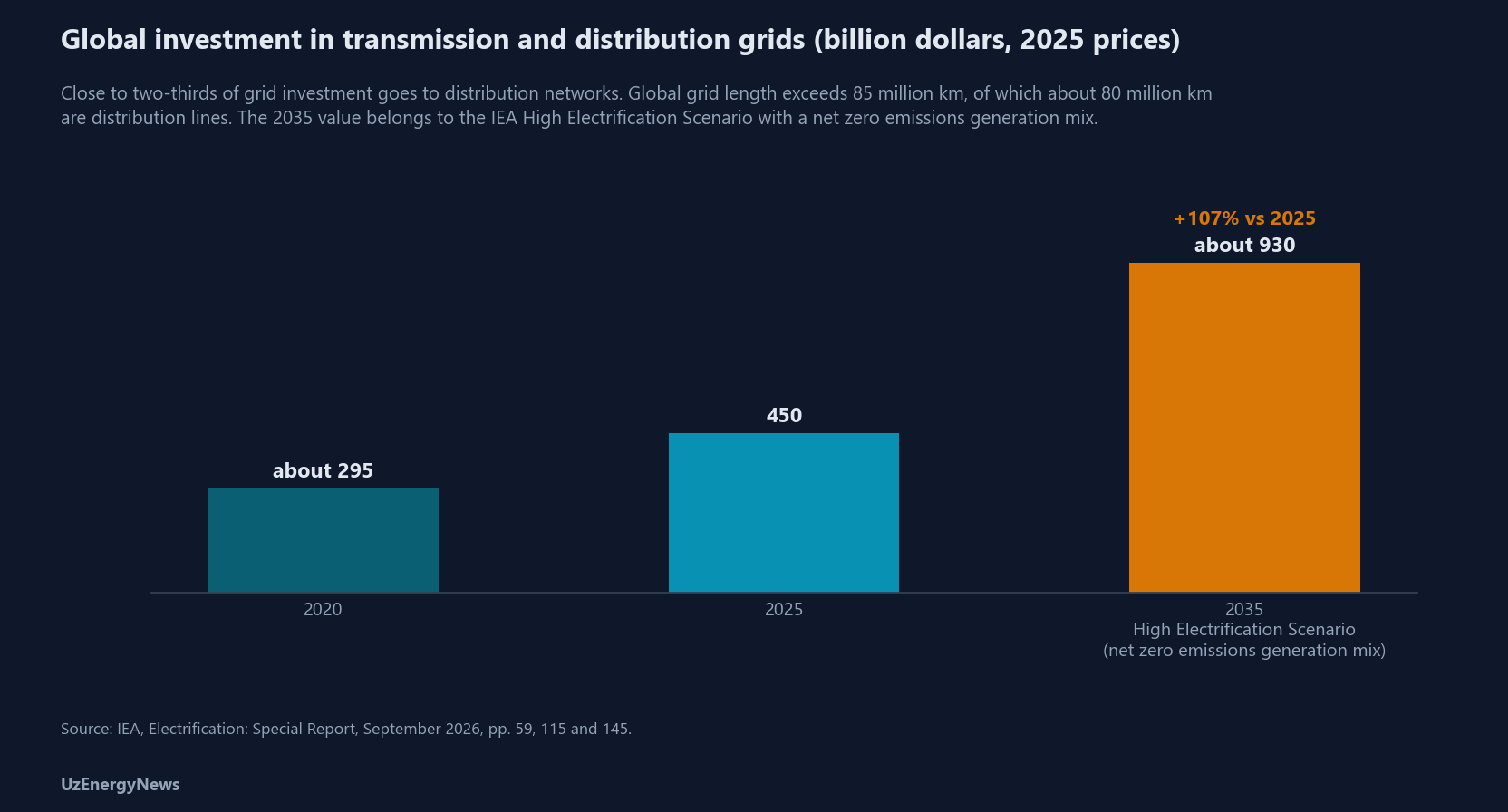
The IEA's Electrification Special Report (September 2026) puts global investment in transmission and distribution grids at 450 billion dollars in 2025, in 2025 prices, against about 295 billion dollars in 2020. In the High Electrification Scenario with a net zero emissions generation mix, the figure is about 930 billion dollars in 2035, 107 per cent above 2025. According to the same report, close to two-thirds of grid investment goes to distribution networks, and global grid length exceeds 85 million km, of which about 80 million km are distribution lines.
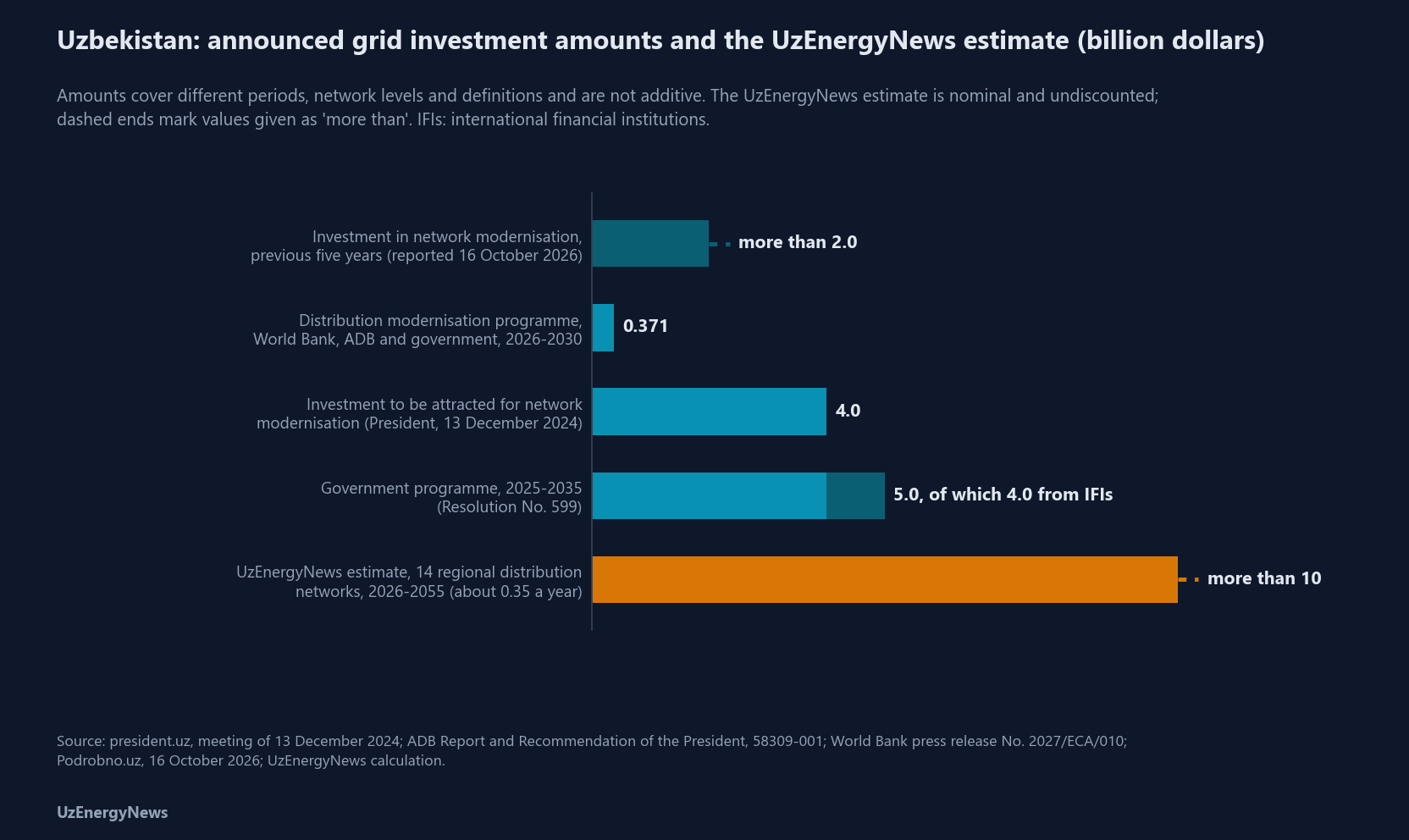
A UzEnergyNews estimate puts the investment need of the regional distribution networks in Uzbekistan's 14 regions at about 350 million dollars a year in nominal terms, or more than 10 billion dollars over 30 years (2026-2055), undiscounted. At a meeting on 13 December 2024 the President announced that public-private partnership would be introduced in the distribution sector and that 4 billion dollars of investment would be attracted for network modernisation. The ADB Report and Recommendation of the President describes a government programme of 5.0 billion dollars for 2025-2035 under Cabinet of Ministers Resolution No. 599 of 22 September 2025, of which 4.0 billion dollars is listed as funding from international financial institutions. On 16 October 2026 Podrobno.uz reported, in its account of the President's open dialogue with fuel and energy sector investors, that more than 2 billion dollars had been invested in network modernisation over the previous five years.
Watchpoints
The World Bank press release gives 30 September 2026 as the ADB approval date; the ADB news release of 15 October 2026 concerns the signing of the loan agreement. The press release describes the 71 million dollars as the government's own budget contribution, while ADB's financing plan lists it as financing from the Government and/or NEGU. Official figures for 2030 differ by date and measure: 117 billion kWh of demand (28 January 2025) and about 129 billion kWh of generation (22 September 2026). Official figures for 2035 also differ: 135 billion kWh of demand (28 January 2025), 121 billion kWh of consumption (18 April 2025) and 154.7 billion kWh of generation (22 September 2026). The Eurasian Development Bank does not publish the detailed method or date of its country forecast. The 350 kWh allowance is set out in a draft resolution (as of 17 October 2026). The UzEnergyNews scenarios and investment estimate are not official figures.